North and South (and Central) America are derived from Italian explorer Amerigo Vespucci latinized name. Asia comes from the Ancient Greeks, in reference to Asia Minor. Australia comes from the latin term meaning South. Oceania has its roots in French. And while Africa has many hypothesized etymologies, most are rooted in Latin and Roman origin.
So basically, what I am asking is if any indigenous Americans, Africans, Asians, Australians / Oceanic people have any other pre-colonial / non-European term used to denote their continent? Did they even have concepts of continents or somesort of division of landmass? Did their idea of what is a continent match what we consider a continent today (example: did pre-colonial Aborgines consider Australia to be three seperate continents and had unique names for all of them?)
Antarctica left out for obvious reasons
I can give some insight for the Latin American context (adapted from an earlier answer of mine). First off, when talking about pre-colonial "America" we have to keep in mind that there was exchange between different population groups over large distances; but also that there would not have existed a knowledge of the whole South American or North American continent, or of the Americas in any one place.
So a more useful way of framing the question in this case could be to ask how native people called their own states, or (often on a more cosmological level) the known world.
I'll have a look first at terms used by the pre-colonial/colonial Nahua (aka Aztecs) of central Mexico, and then more briefly at the South American Incas. These were the two largest states at the time of conquest in Latin America, so we have quite some knowledge of their perceptions and terms used.
Anáhuac/ Cemanahuac (Aztec)
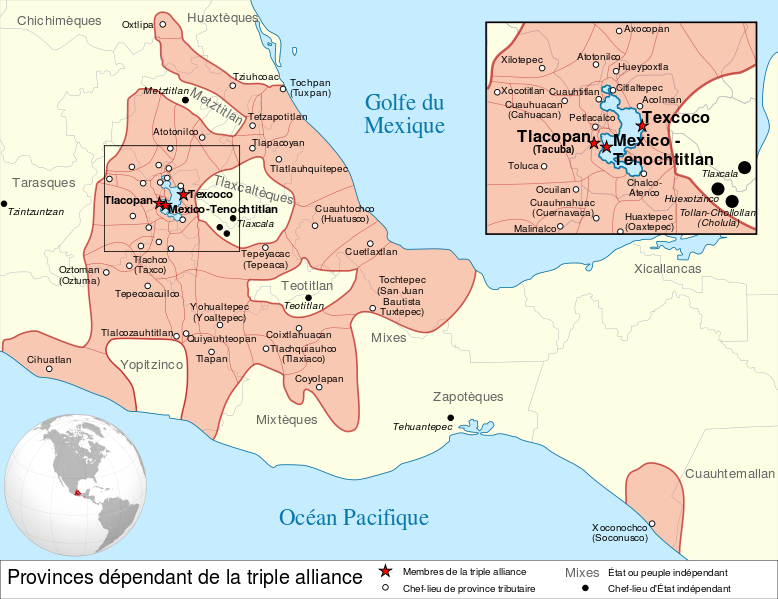
The Nahuatl term Anáhuac means "beside/close to water" and is most commonly used for the Valley of Mexico in central Mexico. More specifically it would have designated the south-central part of the valley, and was sometimes even used for Mexico-Tenochtitlan and its surroundings.
The Nahua and the Triple Alliance (the dominant political entity in the Valley of Mexico just before European contact in 1519) did not have an exact European border concept, which might add to why different interpretations exist for the space of Anáhuac (this map gives an idea of the Triple Alliance's extension before conquest). John Bierhorst in his Nahuatl-English dictionary gives us the following meanings:
- At the seashore ..., close to water ...
- At the shores of paradise...
- New Spain [following Motolinía's memoriales], the known world before Cortés...
So while 1. can fit with the Valley of Mexico (and/or Tenochtitlan, being close to Lake Tezcoco), with 2. we have a more spiritual meaning, and with 3. even a meaning extentending over the whole of colonial Mexico. This last one was very probably strongly shaped by colonial views, as the author draws on the Franciscan priest Motolinía here. Overall, the most common use for Anáhuac is for the Valley of Mexico though.
To make matters slightly more complicated, there was also the term cemanahuac (which I haven't come across as much). It comes from the words "cē" meaning one/whole, and "Ānāhuac" as described above. It can be translated as "land completely surrounded by water". The most probable definition of this would be the land mass known to the Nahua, surrounded as it was by the Pacific and Atlantic oceans. According to Bierhorst
- The world, the earth... [drawing on Motolinía again here], the whole world, in the world, throughout the world, throughout Anahua (the known world before Cortés); the Aztec empire (?...)...
- The eternal shore, paradise
- Island, the city of Mexico (?, usage expressly forbidden by Motolinía...)
Again we don't have one fixed meaning here. I'd still note that Cemanahuac would have designated a larger unit that Anáhuac - referring most probably to the lands (or world) known to the Nahua. Not also how we have again a spiritural meaning under 2. here - although the meaning of "paradise" should to be taken with a grain of salt. While Franciscans like Motoliía drew on Christian terms, the Nahua notions of an afterlife were very different from the Christian paradise.
Tawantinsuyu (Inca)
This term was used by the Incas for their empire, probably the largest in the pre-Hispanic Americas. In its official language Quechua it comes from “tawa” meaning four and “suyo” meaning state. It is often taken to mean "the Four Regions", referred to the Inca empire's division into Chinchaysuyu, Cuntisuyu, Qollasuyu, Antisuyu, terms which partly continue in use today (this map gives an idea of the four regions ).
While these regions were loosely tied to the cardinal directions, their center was at the imperial capital city Cuzco; apparently once again the limits of the regions were not clearly fixed. By the 1530s the Incas had formed a large state with its center on the Andes. At the point of its largest extension, the Inca state consisted of modern-day Peru, large parts of modern-day Ecuador,parts of modern-day Bolivia, north and central Chile and northwest Argentina.
To this can be added the pacha concept. It was used to divide the different spheres of the cosmos, on three levels. The levels or realms were not only spatial, but simultaneously spatial and temporal, differing strongly from European spatial conceptions. In a somewhat similiar way, Mesoamerican cosmology also knew a conjoining of spatial with temporal notions.
I'm less familiar with the Incas than with the Nahua, so hopefully someone can add to this very brief overview. Hopefully it's shown that there were different conceptions of the pre-hispanic known world in different parts of Latin America - the two just mentioned being only the best-known examples. And that there was often a conceptual division between the known world and a cosmological view of the world.
I should add that at least for Mexico, I've come across both "anáhuac" and "cemanáhuac" in texts written by native authors in colonial times. While they often were connected to Christian teachings, they also show that such concepts continued to carry significance after European contact - something we might forget due to the prominence of European continent names.
Lastly, I also wanted to mention that the term "America" as you mention came up following Amerigo Vespucci's expeditions in Nothern America, especially after its use in the Waldseemüller map of 1507. However, especially in the Spanish empire the earlier term "the Indies" (las Indias) continued in usage during colonial times into the 18th c. - the misnomer of course being connected to Columbus' first claiming to have found the western route to India/Asia. In order to distinguish these Indias from the Asian ones, the terms Indias Occidentales (America) and Indias Orientales (Asia) were introduced.
In the ancient Indian cosmography, there exist seven large landmasses, separated from each other by concentric encircling oceans. The Hindu Puranic texts have slightly differing descriptions of these continents, while the Jain & early Buddhist sources have their own variations. Of the Hindu puranic texts, the Vayu Purana has the most detailed descriptions.
The seven continents of the Puranas are stated as Jambudvipa (Indian Blackberry Island), Plaksadvipa (Fig Tree Island), Salmalidvipa (Red Silk Cotton Tree Island), Kusadvipa (Island of Grass), Krouncadvipa (Island of the krouca birds, probably eagles), Sakadvipa (Island of the Scythians), and Pushkaradvipa. Continent Jambudvipa forms the innermost landmass, and was named for a mythic Jambu (Indian Blackberry) tree in the central region. Jambudvipa consists of nine divisions called Varshas (analogous to subcontinents), while the other continents had 7 varshas each. Each Varsha is associated with mountains, valleys, and rivers.
India lies in the south of Jambudvipa, in bharat varsha.
Various sources describe the layout, geography, and customs of individual lands. Texts like the Mahabharata describe the location of different ancient kingdoms and peoples, such as the Greeks and Scythians, within this cosmography. Medieval scholars, including Al-Biruni tried to reconcile this world view with real world geography.
For modern hindus living outside India, this has real world consequences. Performance of religious activities must be accompanied by a Sanskrit formula called the sankalpa, which provides a geographic and temporal identification for where and when the action was performed. For example, the USA is identified as within Ramanaka Varsha of Kroucadvipa, while the UK is identified as within Shalmalidvipa.
As an Australian, I can try to give a little bit of insight into pre-colonial Indigenous Australians (though I myself am white, so this is all what I have learned academically). As far as I understand it, Indigenous Australians didn't have a concept of a continent, at least not as we understand it today. Also, the people living on this continent before the arrival of white colonists didn't consider themselves to be all the same people, that is, each 'tribe' or 'group' was it's own nation of sorts.
Because of the fact that Indigenous Australians had no written language, and the widespread destruction of Indigenous lives that occurred with the arrival of Europeans, it is difficult to to give exact numbers and statistics about pre-colonial Indigenous Australians. However, there were over 250 different languages spoken here before Europeans arrived, and generally each group spoke it's own language (sometimes with a number of sub-groups/slightly different dialects). Each group generally kept to it's own area, moving around within it as the seasons changed, the plants and animals grew, and the occasional extreme weather event altered the landscape. Here's a link to a map of an approximation of where these different groups lived.
However, the Indigenous Australians did not consider themselves as the 'owners' of the land the lived on. Rather, their relationship to the land was more that they belonged to it. They understood the importance of the land in their survival. They rotated which areas they planted food crops in, and let areas have a period of rest between crops so as not to overtax them. Nowadays the word 'custodian' is often used when talking about the relationship between Indigenous Australians and the land each group inhabited - they looked after the land, and the land looked after them. However, because no-one 'owned' the land when the colonists arrived, it was very easy for the Europeans to sweep in and inhabit the land, an issue which is still sometimes argued in Australian courts today. In fact, while 'Australia' does come from the Latin for south, another Latin phrase was also used when describing the continent: 'Terra Nullius', no man's land. Literally, the Europeans considered that there were no humans here, so they could take this 'empty' land.
I'm not sure why you've mentioned three continents as a possibility for the concept in pre-colonial Australia. Were you maybe referring to mainland Australia, Tasmania, and the Torres Strait? All Indigenous Tasmanian languages have died out, although there have been attempts to reconstruct them, and one attempt gives 'Lutriwita' as the Indigenous name for the island of Tasmania. I know very little of Torres Strait Islander culture, so I can't help you there. As for mainland Australia, as far as I know, no language group had a word for the entire landmass as we understand it, but rather just the land in general.
Some of the information here has come from 'Aboriginal Australians: A history since 1788' by Richard Broome. The rest is what I remember from my Indigenous History subject at uni that I took several years ago, so I don't remember the exact sources for all of it. I'll try and dig up my old textbooks in the next few days and find some more exact references.
P.S. Generally the accepted term nowadays is 'Indigenous Australians'. 'Aboriginal/Aborigine' are still used but considered a little bit dated and sometimes slightly offensive. Indigenous Australians will often call themselves/each other 'blacks' or 'blackfellas', but anyone who is NOT Indigenous should not use these terms. Only racist old people still use 'Abo'. /your random tidbit of Australian language/culture info for the day