I'm not aware of any other examples of this kind of warfare, but always wondered why there are no other examples in this time period. Are there examples to be found on the Balkan like the crimean war 1853.56? If not, then why not? Were these theatres of war simply never total wars?
It's worth beginning with a more general discussion of trenches. Field fortifications have a long history. When two armies faced each other, if one side was significantly weaker, they faced probably defeat if they fought a battle without trying to compensate for their weakness. The three main choices they faced were likely defeat, retreating, or improving their chance of victory (or at least their chance of avoiding defeat) by fighting defensively from a strong position. They could take advantage of natural terrain features such as rivers, hills, etc., or they could build field fortifications (which could also be used to strengthen a position using natural terrain features). Ditches, earth ramparts, palisades, and abatis were common methods of field fortification. Wagons/carts could also be used (emergency use of transport wagon (e.g., circling the wagons as seen in many western movies) and also purpose-built wagons such as Hussite war wagons). These perform two main defensive functions: they stop the enemy from getting to hand-to-hand fighting distance on equal terms, and protect the defenders from ranged fire (archery, catapults, guns, cannon, etc.). Individual elements of a field fortification might only perform one of these tasks; it is important to have both types of protection so different elements to contribute both is common (e.g., trenches to protect from fire, and barbed wire to stop/slow enemy infantry).
A stronger army will also use fortification like these, especially during sieges. In a siege, the attacker typically faces fortifications that (a) keep them from engaging in hand-to-hand fighting effectively, and (b) protect the defenders from fire. Thus, attackers are faced with the problem of fire from well-protected defenders. The defenders often have the advantage of extra range due to elevation - arrows shot from a high wall will travel further than arrows shot from ground level. The attacker could stay out of range and attempt to starve the defenders, but this takes time that might not be available. More active attack can be desirable. One solution is for the attackers to build their own fortifications to protect themselves from the defender's fire. In this case, defences that keep enemy infantry from closing effectively are less important, but can still be useful to protect against surprise sorties.
Returning to the first case, when the weaker army builds field fortifications, the stronger army is faced with the choice of whether to attack. If the defensive position is strong enough, and the weaker side cannot stay in that position for as long as the stronger side can wait, the stronger side can simply wait, and attack once the weaker side abandons their fortified position (this was suggested as a strategy for the French at Agincourt, but this advice was disregarded in favour of immediate attack). If the opposing army is not the target, there may be no need to attack at all. If the goal is to advance into enemy territory, and it is possible to bypass the fortified position, the stronger side can do so. If the fortified position blocks an important pass or bridge, or it would be too dangerous to leave a force of that size in the rear, waiting or attack can be necessary. If the field fortifications are strong enough so that simply attacking is likely to fail, the attacker can treat it as a siege (but, e.g., if the defender holds a pass, their supply lines can't be easily cut, and starving them out isn't an option). Thus, the attacker can also build field fortification in order to have protection when firing on the defenders.
Cannons strongly encourage trenches. While palisades and wagons can provide effective protection against arrows and even early handguns, such fortifications are vulnerable to cannons. When faced by cannons, dig trenches. With the development of modern rifles, which can penetrate over 12"/30cm of wood (and 24"/60cm of clay or earth) at ranges of hundreds of metres, trenches become even more important. Unlike palisades and wagons, trenches do little to stop enemy infantry from closing, and other defences such as fences, barbed wire, abatis, and stakes are often essential supplements to trenches. Before cannons and rifles, elevation was defensively useful, so earth ramparts (often topped by palisades) were common. After cannons and rifles, elevated field fortifications were often too vulnerable, and trenches were preferable.
Before guns, defensive ditches were dug, but these were typically not occupied by the defenders. Ditches could be dug as obstacles to enemy cavalry, and as a source for earth for a rampart (which could be built next to the ditch, with the ditch increasing the difficulty of climbing the rampart).
Thus, the main ingredients for trench warfare are (a) facing cannons and/or rifles, and (b) either not needing to keep enemy infantry away, or being able to build obstacles to keep enemy infantry away. Permanent fortifications such as the trace italienne/Vauban fortress/star fort used artillery and handguns to keep attackers away; attacking such fortifications made trench warfare a common part of sieges.
While the main weapons were muzzle-loading smoothbore muskets and muzzle-loading cannon (also smoothbore), these weapons had limited effective range. Trenches could also be usefully dug as part of a defensive position, but there was little need for the attacker to follow suit and dig their own trenches. If the attacker wanted to exchange fire with the defender in order to weaken their position, trenches (or at least protected artillery positions) were important, but if they planned to simply use superior numbers in a direct assault, they could form their troops up for the attack at a reasonably short distance without needing their own fortifications and attack.
This changes with adoption of rifles and longer-ranged artillery. These greatly increased the distance over which the attackers would be subjected to fire from the defenders, and the improved weapons also usually provided higher rates of fire. The attacker's task had become harder, and digging trenches to allow an attack to be launched from closer became important. This, plus the size of armies making it impossible to simple bypass and ignore fortified positions on the Western Front in WW1, made trench warfare so important in WW1. In addition, the invention of barbed wire in the 1860s allowed rapid construction of obstacles that would stop infantry, making it easier for a defender to construct effective trench systems.
However, even before WW1, these ingredients for trench warfare were present. Attackers often preferred to bypass fortified defenders. Even if, with the assistance of trenches, the attacker could take a fortified position, this took time, and spending time taking positions can allow the defender to bring in more armies, build more fortified positions, and so on. Where attacking armies could simply bypass defenders protected by field fortification, trench warfare was unimportant. Where attackers couldn't bypass such fortified defenders, trench warfare was important.
The well-known examples of pre-WW1 trench warfare are the American Civil War, The Crimean War, and the Russo-Japanese War. While the Crimean War largely involved European nations, the action was remote from Western Europe. The Russo-Japanese war was even more remote. However, there were cases of trench warfare in Europe before WW1. For example, a French trench in the Franco-Prussian War:
and Bulgarian troops entrenching in the First Balkan War (1912-1913):
It wasn't trench warfare as such that was surprising in WW1. The armies dug trenches because digging trenches was a known and effective thing to do. What was unexpected was the trench vs trench stalemate on the Western Front.
One early example outside Europe was the Maori wars (New Zealand, 1845-1872), where Maori forces defended positions against superior numbers of British troops (including local New Zealand forces, and forces from the colonies in Australia), who not only had superior numbers but also better weapons. Trenches provided protection against artillery, and fences helped stop infantry. Some depictions of Maori fortifications in 1864:
Some further examples outside Europe:
Entrenched Uruguayan soldiers in 1866 (Paraguayan War):
Boer trenches in the Second Boer War:
This is a rather minimal trench. A similar position, occupied:
Positions like this provided reasonable protection against rifle fire, but poor protection against artillery.
Russo-Japanese War:
Since WW2, trenches have featured prominently in a number of wars. Very often, trenches are used locally by one side, but on some occasions, they have been widely used by both sides. This is usually the case when the front lines become static and neither side can bypass the other or quickly break through. Some examples:
Korean War: https://i.pinimg.com/originals/3c/f6/51/3cf651bc1fdb062b4506f7b801772d1e.jpg
Iran-Iraq War: https://commons.wikimedia.org/wiki/File:Iranian_Troops_in_Forward_Trenches_during_Iran_Iraq_War.jpg
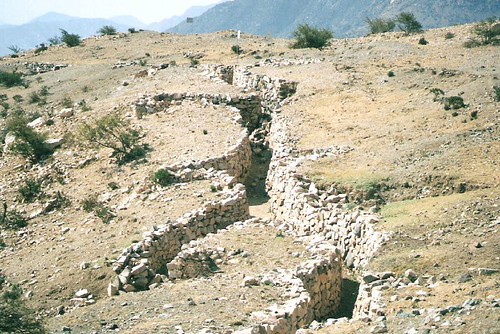
Ethiopian-Eritrean War: https://farm2.staticflickr.com/1415/1212629220_d4374d9515.jpg
Further reading:
Nicholas Murray, The Rocky Road to the Great War: The Evolution of Trench Warfare to 1914, Potomac, 2013.
Anthony Saunders, Trench Warfare 1850-1950, Pen and Sword, 2010.