The story is that they are diamonds that, as the name implies, are mined in states undergoing civil conflict (or civil war), and the sale of those diamonds generates income for a military or militia group in order to continue their struggle. Very often, it is not milita members themselves who are doing the mining, but civilians in areas under rebel/milita control that are coerced into mining/panning for diamonds.
Much of the discussion around conflict diamonds focuses on conflicts on the continent of Africa. Famous cases include Jonas Savimbi's UNITA rebel movement in Angola, which relied on diamond proceeds to support their struggle in the 1990s until 2005. Another notorious example was the cooperation between the RUF rebels in Sierra Leone and Charles Taylor, warlord president of Liberia. Diamonds were mined in RUF-held territory in Sierra Leone, smuggled across the border in Liberia, and sold on the international market as diamonds from Liberia (despite Liberia having no known diamond deposits).
The reason for this seeming link between conflict diamonds and Africa is a matter of geology, of politics/security, and also has to do with the end of the cold war.
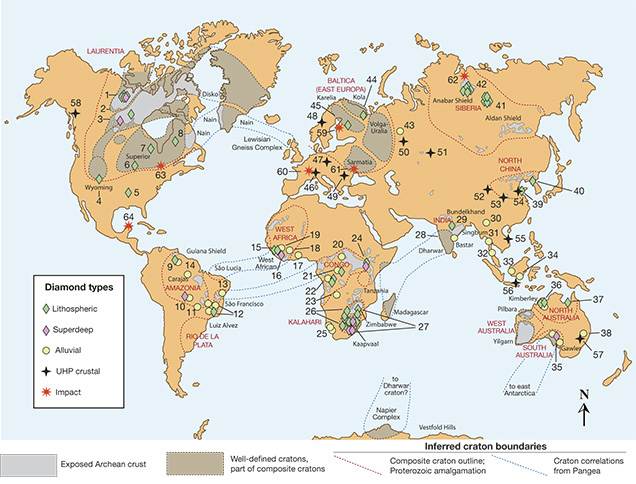
In terms of geology, diamonds are [distributed unevenly around the world](http://www.diamcormining.com/_resources/images/diamond_info.world_production(op1)---Global-Archean-Cratons.jpg), with countries like Canada, Russia, India, Australia and Brazil having extensive deposits, as well as extensive deposits on the continent of Africa. Importantly, Africa is comparatively rich in alluvial diamonds, that is, diamonds that are located close to the surface in stream beds, and can thus be mined using only manpower, not requiring large capital investment in drilling or blasting equipment for deep sub-surface diamonds.
So, other regions where prolonged civil conflict has occurred, like Colombia, Sri Lanka, Lebanon, Afghanistan, tend not to have deposits of alluvial diamonds. Looking at that second map, it seems that Myanmar could be a country with both separatist rebels and alluvial diamonds; but I have not read anything specifically about Myanmar conflict diamonds.
In terms of the political-security history of the continent of Africa: the countries of the continent have faced a multitude of coups during the second half of the 20th century. The threat of removal from office by ambitious military officers probably led several African heads-of-state to limit the power of their militaries. For example, Mobutu Sese Seko took power in Zaire (now Democratic Republic of the Congo) in 1965, and mostly through government mismanagement and corruption, the Zairian army was so weakened that by 1978 they were not able to push back Angolan-supported rebels in the south of Zaire without support from Moroccan and French troops. By the early 1990s Zairian troops were regularly mutinying and protesting in the streets of Kinshasa demanding pay in arrears. By the time of the First Congo War in 1997 that toppled Mobutu, he was relying on Eastern European mercenaries to try and bolster his weakened national army.
As said, Mobutu was toppled, and incoming president Laurent Kabila soon turned against his Ugandan and Rwandan allies, starting a Second Congo War in 1998 which lasted until 2004. While Ugandan and Rwandan troops did participate in the war, those countries also relied extensively on anti-Kabila congolese militias. Both Kabila and anti-Kabila forces extracted diamonds to support their war effort.
And of course, right about here is where I should mention that this phenomena goes beyond diamonds. Other resources can and have been used to support conflict. Conflict in the DRC notoriously also includes the mining and sale of Cobalt-tantalum (coltan), an important component in electronics. Charles Taylor made illicit deals for the sale of timber to support his rebel army and later his government in Liberia. Today, experts are raising concerns about the sale of conflict rubies and conflict sapphires in Myanmar. In the long Colombian civil war, marxist FARC rebels as well as anti-communist militias were involved in the manufacture of cocaine to fund their struggle.
The salience of the end of the Cold War to conflict minerals.
The examples that I have given; Charles Taylor and Sierra Leone, DRC in the late 1990s, Jonas Savimbi, all of these examples happen after the end of the Cold War.
During the cold war, there was a great deal of geopolitical competition between the United States, Soviet Union and China on the continent of Africa. Each of these three great powers would provide (i.e. donate) military materiel and training and sometimes funding for anti-government forces that were ideologically aligned with their interests.
However, with the end of the cold war, a lot of that outside support dried up. So, if we return to the example of UNITA and Jonas Savimbi, from 1975-1991 the United States and South Africa supported him as an anti-communist warrior in his fight against the Soviet and Cuban supported MPLA regime in power. But, when the Soviet Union collapsed, the United States lost strategic interest in Angola. Similarly, with apartheid South Africa's transition to majority rule, aid from South Africa was no longer coming to UNITA. So, in the 1990s, UNITA began to rely on producing illicit diamonds to make up for the discontinuing of foreign aid, and to keep their armed struggle going.
More broadly, I think it is fair to say that this end in Eastern and Western support for rebel groups in Africa led leaders of these rebel or separatist movements to look more intensively into resource extraction to support their struggle.
Edit- fix broken link
---Global-Archean-Cratons.jpg)