I've heard that the Romans and later cultures made this up to demonize the "barbarians". I've also been told that there are first hand accounts by Romans who witnessed this ritual. And if so, how would they go about getting all of the sacrifices into the structure without escape.
As preliminary notes,: wickerman description are always about Gaulish practices, and not British.While association with British rites isn't far-fetched giving the druidic presence in the isle and proximity of material and cultural features, understanding Gaulish practices as "pan-Celtic", can really be misleading.
The notion of human sacrifice and consecration of humain remains is important enough in Gaulish religion, whom display could be considered as a bit macabre.
Religion played an important part in Gaul as a social and political institution under the influence of Druidism. Sanctuaries were places of sacrifices, would it be inanimate (tools or swords, broken to pass to the other world as if "killed"); wine poured in holes on the ground, or animate (beefs, horses, pigs, etc.).
Animal sacrifice was common, and vowed similar animals to Romans, except pigs instead of goats, and Gauls sacrified dogs as well.And while taces of violent killing can be found on animal skeletons (clubbing, piercing) they are absent on human remains within sanctuaries.
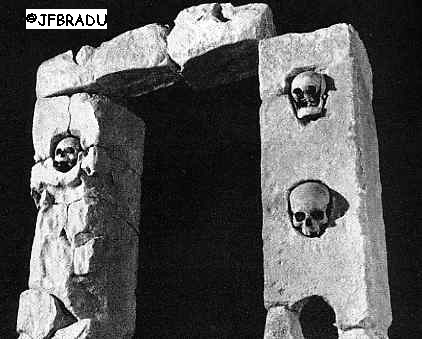
There's traces of decapitation, but these were probably post-morte, which is to be tied to head-hunting as practiced by Gauls and Celts in general (something well attested both trough ancient sources and archeology) skulls sometimes being put, within sanctuaries' entrances (or nailed them).There's a religious component, but it was probably a social custom too, in order to tighten the community by showing-off its victories. This relation is underlined by the customs that warriors had to enbalm and keep head for themselves or the depiction of heroic figures collecting heads as proof of social status.
Bodies could be found within sanctuaries put in display and let to rot with armors and weapons, sometime with skulls and let to rot until being taken, burnt and buried.It's tought they could rather be bodies of the people using the sanctuary, giving this burial is fit the common practices of incineration without being individual incineration of inhumation, but collective (it's not even a given that bones weren't taken outside the sanctuary)
Both were sacrificial but not necessarily human sacrifices as we might understand it, or individually dedicated killings. A priori, there were no human sacrifices in Gaulish sanctuaries, while there is an intriguing case: at Gournay where (with the described remains above) remains were found which were treated differently : skeletons were cut in three pieces, some might have been women, so the idea that specific rites could be practiced on non-warriors inside temples shouldn't be dismissed, up and including human sacrifice.
The site of Mormont is really interesting : serving as an open-air offering deposit in -10 ( just before the conquest) by Eluetioi. Among the lot of usual offering (broken swords and tools, animal sacrifice, libations), there is a lot of corpses in various states, including cutted skeletons as discovered in Gournay but much more massively.Evidence would lean to think that these peoples were already dead (and with "missing" parts) when buried but at least one of the bodies was litterally butchered and emptied of entrails before being cooked. In fact, many corpses seems to have been...grilled. Human sacrifice, cannibalism, new forms of rituals? All that is assumed for now is that Mormont might have been the sign of a deep social and spiritual crisis in the region, possibly to be tied up with the Cimbric War (which might have been a reason for some social changes in Gaul, including the decline of druidism).
Some Greek or Roman authors account for these sacrifices, many are silent while depicting human sacrifices, and these tend to be the ones giving the most shocking depictions while ignoring the basics of Gaulish rituals.Cicero is probably one of the most obvious case of bias, arguing of the barbarity of Gaulish sacrifices to dismiss witnesses of Fonteius' corruption; while he hosted Diviciac in his own home and without any mention of these sacrifices in "On Divination" (with is at least intriguing giving that, for Romans, Gaulish humans sacrifices were about divination)But he's not alone in this : it's part of the overall cliché on the impious Barbarian, atheist and suspertitious in the same time, whom gods are as bloodthirtsy as they are.
On the other hand, accounts from people that did went in Gaul are a bit different. For instance, Caesar, who was fascinated by the concept of a philosophic-scaderdotal group regulating both public and familial devotion with a main political role (now, Druids were already in the decline socially since the IInd BCE, but probably still remained an important social presence)He does mentions human sacrifice, but mixes a bit everything there : sacrifices during festivities or made privately (for clients sacrificing themselves in exchange of support for their family), judicial duels (approximately as religious as gladiatoral fights, even if as religion and justice wasn't really that separated it makes sense Caesar list it), etc. Still it's interesting because he make two points : sacrifice is something regulated and controlled; and the belief among Gauls that a life had to be payed for another life.
Diodorus of Sicily identified form of sacrifices he tought similar to Homeric accounts : namely, acknowleging the importance and popularity of animal sacrifice for divination (which already set him apart, when it comes to credibility, to armchair sensastionalist authors) he describes an exceptional sacrifice of consecration trough libation, sacralizing a being on a divine scale, and whom killing allow to sort out a perillous or difficult collective situation, especially war. This is attested for both Greeks and Romans (such as the couples buried alive under the Forum Boarium in -216), and there's no reason to think Gauls wouldn't have practiced it, especially as other authors mention it.He, furthermore, describe a sacrifice of thanksgiving. After a battle, and a vow one made, prisoners among the fairest and strongest were selected, similarily consecrated and elevated, and sacrificied. (Again, the practice isn't that far from what Romans knew, for exemple the triumphal execution of Vercingetorix). Again it is a rare exemple, and said to be made on animal as well.
And then, the wickerman.
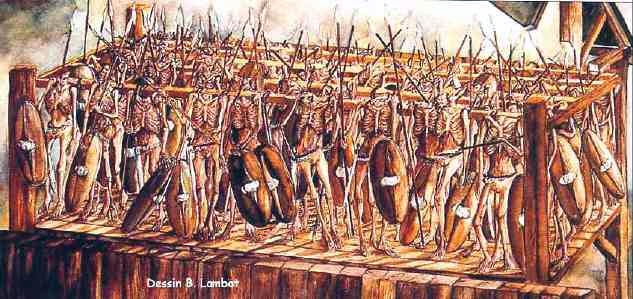
It is described even by the best authors, roughly in the same terms : a man-like figure (simulacrum or kolossos) made of wood and wicker if filled with cattle, wild animals and men, and then burnt with them inside.This nightmarish vision really characterized the insanity and monstruosity of Gaulish ritual and beliefs, and never was really discussed...But there's some problems there.First, there's simply no archeological account; or comparison found elsewhere. Then, sacrifice of wild animal is largely unnatested in Gaul. It is never detailed, even when other human sacrifices were. Finally, it really goes against the druidic role as was accounted for, which regulated and moderated rites.
It's quite possible that the aformentioned incineration of human and animal bones whithin sanctuaries was misunderstood, especially as Greeks or Romans weren't part or witness of the act itself, simply gave birth to this narrative. It is possible that it existed, but the body of evidence so far rather goes in the other direction.
Basically, human sacrifice was practiced by Gauls, but as for Romans, it remained exceptional and didn't involved mass killing.
The wickerman, particularily, is part of a mythos of "Celtic" barbaric exotism still living on. There is little evidence it took place, and several clues that in the context of Gaulish religion, it didn't.Confusion with head-hunting and body rotting then burning might have fueled some confusion which was well served by a large Roman bias on Gauls as necessarily Barbarians in their beliefs, or to a rejection of druidism as essentially opposite to Roman conceptions of sacerdoce.
Sources
- Les religions gauloises, Vème - Ier siècle, nouvelles approches sur les rituels celtiques de la Gaule Indépendente; jean-Louis Brunaux
- Corps en tout sens; Patrick Moinat
Quand les Gaulois perdaient la tête (Not a source, but interesting video on head-hunting))