Peasant winter wear during Edo Period in northern/ Snowy part of Japan, not the Ainu people?
It would be definitely better to wait for the answer from the specialists like /u/ParallelPain or
/u/wotan_weevil, OP's question might be a bit tricky due to the availability of the translated primary sources, so I'll also make a brief note on the topic.
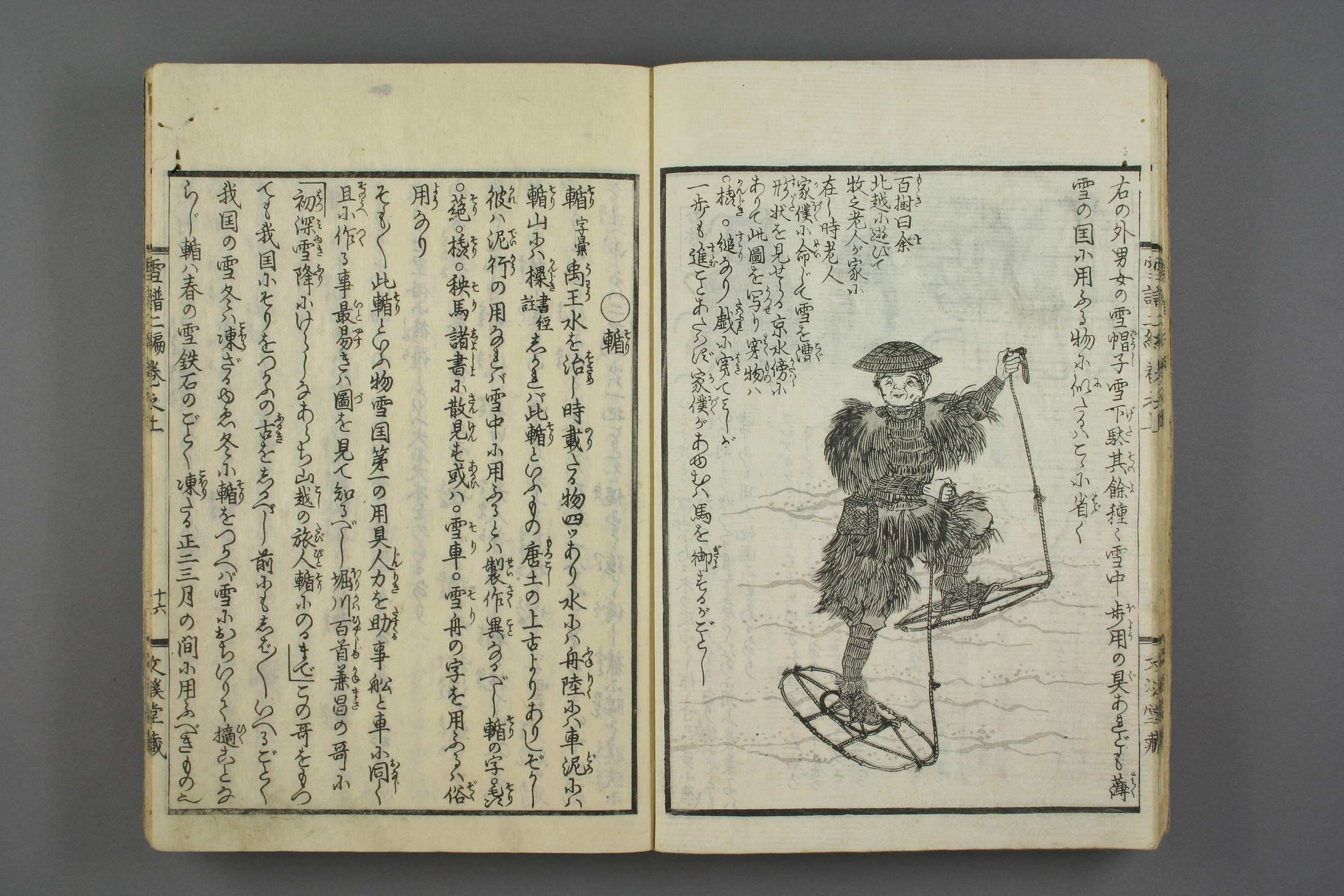
AFAIK the best source for OP's question might be some illustrations from pre-'folkloric' authors, recording manners and customs in northern Japan during the late Edo period (Late 18th to early 19th century):
As you can see in these pictures, outfits made of straws indeed played a very important role in peasant's winter outfit. While Hokusetsu Seppu (Snow Country Tale), narrating the customs in Echigo region (now Nigata prefecture, one of the most snowy region in Japan) was published in 1837 (in complete form in 1841) and became the bestseller travel literature, Ohmin Zui was written in the end of the 18th century by one of Samurai who had been born in Edo and served the Edo office of Clan Tsugaru (now Aomori Prefecture, northernmost part of Honshu Island, Japan) and 'came home' first time in Tsugaru and observed various local manners and material cultures in his first visit homeland.
1: Footwear
The old man in Hokuetsu Seppu puts very big pipe footwear (?) (with some ropes) on his feet under straw shoes. This kind of footwear is called kanjiki, and opted for walking on snows, like the ice cleats in Europe. Another variant of kanjiki was made of wood board instead of pipes, were mainly used in the paddy field. The encyclopedia notes that more ice cleat like spiked kanjiki was also invented in middle of the Edo period (Iwai 2017: 120), but I have not seen any of such actual kind.
In addition to relatively well-known straw sandals and water-proof setta (made of bamboo skins and leather), peasants and hunters in snowy region of Japan also used to put straw shoes and legwarmers made of straws on, as shown in the above-cited images both from Hokuetsu Seppu and Ohmin Zui. This kind of straw or plant-skin legwarmers was called habaki or haki, and clothed one was called khahan (Iwai: 2017: 143). Habaki had got popular since Muromachi Period (late 14th/ 15th century). People made it rule to wear habaki especially for the outdoor work during winter. On the other hand, straw or plant-skin shoes had various names and I don't know which name was the most popular one. The author of Ohmin Zui annotated haki of male peasant as 'Gama-haki' that meant that that haki was made from straws of Gama marsh plant, common cattail.
If you don't mind scrolling .pdf document written in Greek to you, (Sasaki 2011: 124) has some additional picture of such snow-proof straw shows employed in Aizu (western part of Fukushima prefecture, southernmost of Tohoku region) in the 19th and 20th century.
Although it is not clear from the images cited above, I'm also almost sure that these peasants (including women) further put very durable tabi, Japanese counterpart of socks on their feet. They were so durable that some people use them as shoes (i.e. without putting any additional straw sandals or anything like that on). These tabi socks were originally said to be made of leather, but cotton tabi became popular at least in Edo in the middle Edo period (though I'm not sure whether peasants in northern Japan could afford/ or was allowed to buy cotton tabi socks (see below).
2: Straw Bracers
Sorry, I don't know the exact name of straw bracers depicted in Hokuetsu Seppu (and the author did not annotate anything on it).
3: Torso and Coat Ware
While straw rain coat with hat, called mino (and kasa) was the most commonplace rain-proof coat also for peasants during Edo period, as illustrated in Hokuetsu Seppu, some peasants in northern Japan had to cope with the cold climate during winter with help of another outfit. The man in the last illustration from Ohmin Zui put a special winter fur jacket on the very long sleeve kimono. This fur coat was called kakkoro, abbreviated form of Kawa-Koromo (leather jacket/ cloth), and made of animal fur or pelts like of dog.
Various clans in northern Japan, however, struggled to maintain somehow the balance between the convenience of the daily life of peasants and the strict ideal of status order, i.e. foundation of Tokugawa Shogunate. They repeatedly forbade the peasants to wear cotton clothing. Only hemp and other plant skin like Boehmeria nipononivea were permitted. While cotton became popular for the clothing material also for commoners in early Edo period, the cotton flower cannot grow in the cold climate in northern (Tohoku) Japan, and they had to import expensive cotton from the clans in south (and that the lords of clans in northern Japan didn't like it too much) (Cf. Nagahara 2004). Thus, the samurais mainly monopolized this warm as well as durable clothing material in northern Japan, and they enforced other population of their fief to wear inferior non-cotton cloth as a kind of a symbol of their obedience to the status order.
Instead of cotton, Some clans like clan Tsugaru encouraged the peasants to develop embroider on hemp cloth to enhance the warmness during winter, as shown in the female working outfit in Ohmin Zui's illustration. This kind of embroider work, called Kogin or Kogin-Zashi now became a traditional folk art in Aomori prefecture.
References:
(Primary Sources: Note: I haven't read all of them, just to check some of the original illustrations in them on the Internet)
+++
[Edited]: Fixes typo.