There actually was a huge difference. If you were a pope during early Christendom, you were much more likely to be involved odd conspiracies pertaining to ancient artifacts and relics. St. Peter famously had gotten into a few kerfluffles over the leg of a chicken that Jesus had eaten, fighting off twenty, maybe even thirty men on his own! The leg dated from 23CE from a dinner party that Peter hosted, where Jesus had created the first buffalo wing. It was described by guests as being covered in a "Red, Cayenne hot sauce"^1 and was said to have been very spicy! So this chicken leg wasn't just any leg, but the first Buffalo Chicken Leg. It was a hit at the party, and Peter opted to keep one of the legs as a souvenir. Later that same year when he came down with the flu he rubbed the leg bone and suddenly was no longer feeling achy and feverish^2 . It was thought to have healing properties and Peter guarded this relic jealously.
In 53CE there was an outbreak of Dysentery in Antioch. St. Peter was actually in Antioch during the outbreak and valued the leg more than anything at that time. After getting out of his popemobile to stroll on Antioch's streets, a mob of citizens attempted to steal the leg from him^3 . In one of the greatest brawls in human history, he managed to fend off all twenty or thirty of them. He was left psychologically scarred however, and didn't want to leave the safety of the Popemobile on his own again. Thus, Switzerland and the Swiss guard was born, founded by Peter in an attempt to stop the Buffalo Chicken Leg from being stolen^4 .
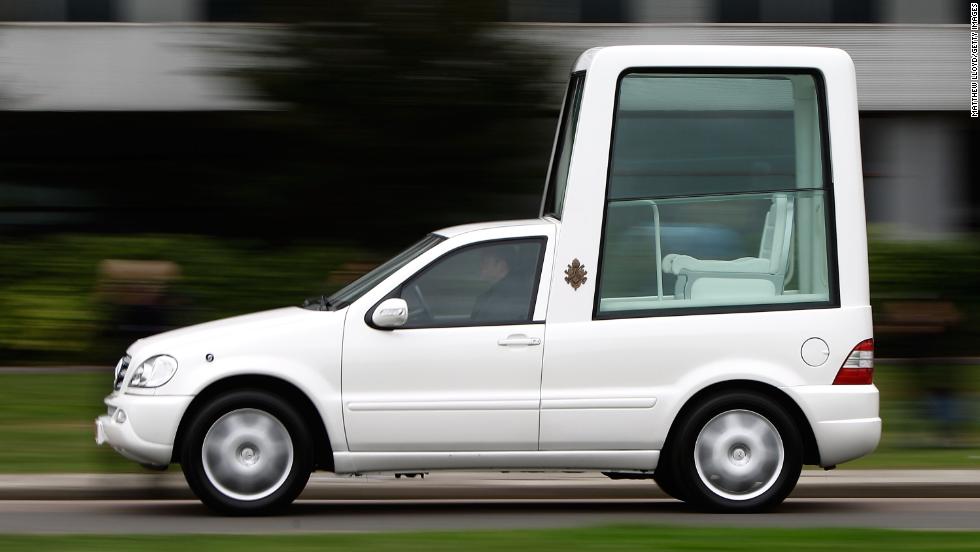
Of course, this leads to another one of the differences between popes now and then: popemobiles! Today we know the popemobile as vehicles such as this one. Now, the Internal Combustion Engine had not been invented yet, so the popemobile had to rely on other means of energy. While your mind may think these early Popemobiles were just litters (as the pharaohs and many others through the ages have used) where an individual is moved around by people, this would be incorrect. The Flintstones actually has the most accurate version of an early popemobile in the titular family's car. Of course, the early Pope's was much less designed after a stereotypical "stone age" aesthetic and instead evoked feelings and images of Christianity. We're not entirely sure what the aesthetic looked like, as there are no full surviving examples and artists neglected to make record of it. However, the Flintstones did get the basic design correct! There was only one critical flaw in their version - the lack of Heelys. A common criticism of the Flintstones school of thought was that the feet of those who had to drive the vehicle would be torn up as they were barefoot. Thus the "Flintstones" thesis of popemobile didn't catch on until 2003 when an early Christian Heely was discovered in Rome^5 .
This discovery changed the field. It was found near a support beam from a Popemobile, one that would connect both drum wheels together. This beam was marked "Popemobile, property of Pope Linus" and as such Archaeologists just knew that the Heely belonged to the driver of a Popemobile. There had been rumors through other ancient sources that Pope Linus had been involved in a bad Popemobile accident as well, and this too was proven.
Onto Switzerland! So it is commonly held that Switzerland was only founded in the late 13th Century, and the Papal Swiss Guard founded in the 16th Century! These "facts" are simply hogwash! St. Peter was very disturbed by the Medical Relic Riots that had been taking place, with the attack in Antioch only preceding them. People were desperate for the cures to ailments and it seemed that religious figures such as St. Peter were hogging them all. They broke out all across the ancient world, people trying to find any sort of sacred chicken legs, goblets, buttons, coins, or anything else you could imagine^6 . Through vigorous rubbing and gnawing these relics were thought to ail any disease. Some of them may have, as St. Peter attested to in his autobiography.
As previously discussed, St. Peter was able to fight off up to thirty men entirely on his own, so it's not as if he wasn't good in a scrap. He didn't want to fight all the time, and he needed a dedicated guard. And thus the idea of Switzerland was born. He put together his closest advisors and they started brainstorming where a new nation could be created. And in time, he hoped that that this nation he created would provide a neutral buffer state in any World War^7 . After about two years of deliberation he and his advisors agreed on Switzerland. It was to be founded in a mountainous region of Central Europe, bordering what he hoped would become France and even eventually Germany. His advisors thought it to be a prime central location, where the Swiss Guard could respond to any threat to the Papacy with immediacy.
Creating a nation on paper is one thing, it's entirely another to actually create it. St. Peter fund-raised throughout the ancient world for what he called "Papal Security". People everywhere, and of every faith, were moved by his calls to action and donated. These funds were sent to the treasurer of the "Board to Create Switzerland" and the Board was thus able to spend money on nation building^8 . They had to create roads, schools, administrative buildings, and housing! They even had to make the mountains, which prior to 60CE did not exist! Creating Switzerland was easily the grandest and most complex engineering project in human history. All thanks to Saint Peter.
After the physical location was completed Saint Peter recruited many to move to Switzerland and live there. This was no easy task, as many were content with their own homes. However, the allure of adventure and a dinner with Saint Peter persuaded enough to move. Many were employed as the Swiss Guard to help the Pope fight off any more rioters. The Guard provided dental insurance which many employers did not in the same period^9 . Saint Peter did not live to see Switzerland finished. He had passed away by 65 CE, and Switzerland wasn't done until 73 CE^10 . However, he had laid much of the groundwork and founded the country.
Safe to say that the modern papacy is far from a nation builder, especially in the sense of Saint Peter!
Of course, the fist fighting phenomenon did not end with Saint Peter. Around 1000 CE we have evidence that the Popes were running a "fight club" out of the Vatican^11 . The "title fights" were always against the Pope, who was able to claim victory in every recorded instance. Even when faced with the biggest, and largest, men and women from around the globe, the Popes were victorious^12 . That has led Historians to ask the question of why the Popes won every fight club. This question was thought to lay unanswered: Until 2009.
2009 changed the field of Papal Fight Club Research forever. For the first time we had video evidence of a Papal Title Fight, and it was even the first instance of the pope losing! I'm talking of course about the very excellent piece of research called Assassin's Creed II! In it, one Ezio Auditore da Firenze is recorded fighting Pope Alexander VI. The mystery of why the Pope's always seemed to win seems to lie in a relic he was seen wielding called the "Apple of Eden" which gave the Pope immense powers^13 . When the fight is over, Ezio has overcome the relic and takes it from the pope, who then scurries into a secret chamber. The recording ends soon after, but it's safe to say that we now know the popes WERE running fight clubs, and that they eventually lost. Researchers are fairly sure that the loss of this "Apple of Eden" led to the death of Papal Fight Clubs, as none of have been mentioned since^14 .
So it's safe to say that A LOT has changed in the role of popes since Saint Peter: From popemobiles, to nation building, and fight clubs!
EDIT: By the way, April Fool's!