Since history and archaeology are such big subjects, I was wondering if someone could elucidate this for me.
For example, it struck me that we once thought Troy, site of Homer's Trojan War in about 1,200 B.C., was mythological. Then we discovered the city existed, and there likely was a real war of some kind.
1,200 B.C., in broad historical terms, doesn't seem all that long ago to me. Egypt was in its New Kingdom. We were well past the onset of the Bronze Age. In just several centuries we would see definitive-fact history like the Peloponesseian (sp?) War and the rise of the Roman Republic. And we didn't know that Troy existed?
That struck me: just how much do we know about the ancient world, anyhow? If we missed Troy for a long time? What kind of evidence do we currently use to construct our current story of ancient history?
And how much might we be missing?
So that all goes back to my question: at what point do we definitively say that one civilization existed? What is the archaeological evidence we require? What's the standard where we say "okay, the Sumerians were a thing, but anything before that was nomads." Or is that even what we say?
I hope this makes sense. Kind of a complex question, I know, I'm just curious.
I have a B.A. in Classical and Near Eastern Archaeology, so this is a question I can finally answer.
As you suspect, the process of forming a sedentary society takes many, many generations. The agricultural "revolution" is much less of a "revolution" than a long process of selective advantageous decisions that gradually amounted to large cities, hierarchical states, and fixed agricultural economies.
This long history is well documented in Mesopotamia. The earliest known semi-sedentary population within the Levent were likely the Natufians, concentrating around the Dead Sea, and the earliest larger settled communities included sites such as Çatalhöyük in Eastern Anatolia. These cultures date back some 3000-7000 years before the rise of what is known as the "Sumerian" culture, and while neither were in Southern Mesopotamia proper, neither of which also developed into larger states as we associate with the Sumerians. Why they never developed massive cities like Ur, Uruk, or Eridu is still a matter of debate, although many arguments simply boil down to that they rose at the wrong places and at the wrong times (alternatively, early cities kind of sucked, so a large school or thought simply argues that they dispersed and became more reliant upon animal husbandry and pastoral nomadism).
Now, the reason we pay attention to the Natufians and the culture of Çatalhöyük isn't because they were the only people living in the area, but rather that they were the only sedentary populations, meaning that they accumulate a lot of trash in one permanent spot, which we archaeologists like to refer to as a "complex and rich site." While both of these examples buried their dead, other cultures were likely contemporaneously practicing excarnation or depositing their dead at sea. One preserves, one doesn't, and archaeology is very prone to these types of biases.
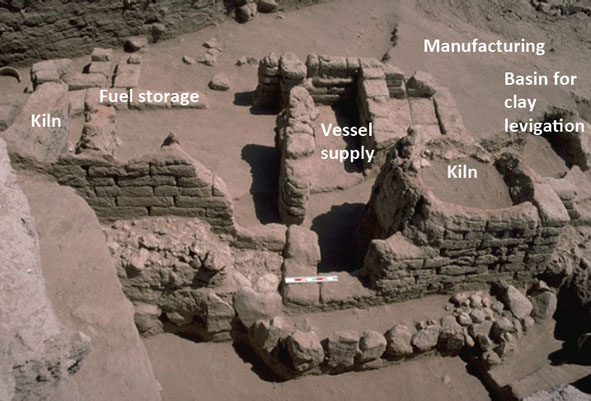
Within Southern Mespotamia, the earliest pre-Sumerian culture is referred to as the Ubaid, named after the site Tell al-'Ubaid although largely associated with the site of Eridu, which the Sumerian King List referred to as the oldest city in the world. These sites have a very long history of occupation, which make them great for studying the gradual emergence of the Sumerian Civilization. Dating from at least 5500, they produced distinctive ceramics, and through time, their level of statehood and sedentism gradually increases, first with building canals during the "Ubaid 2" period, then building much larger houses and spreading their ceramic style elsewhere in the region in the "Ubaid 3" period. By this point, houses were becoming increasingly larger, and specialized ceramic-production facilities began to emerge. By 4000 BC, the "economic center" of Sumerian culture shifted over to from Eridu to Uruk, which produced a ton of ceramics that you can find all over 4th Millennium Mesopotamia.
This is a complicated answer, I understand, but to tie it together, I'll reference your OP:
So that all goes back to my question: at what point do we definitively say that one civilization existed? What is the archaeological evidence we require? What's the standard where we say "okay, the Sumerians were a thing, but anything before that was nomads." Or is that even what we say?
So, just think for a minute here. Most sites have a layer where the great city was a small village if you dig deep enough. You look at its early ceramics, burial practices, architecture, and overall economy and make a judgment as to where its people came from and who they could be related to. If the similarities aren't sufficient enough to merit a direct movement of people into the area which founded the original city, then you can make an argument that a local population decided to attempt a sedentary lifestyle as a result of environmental decisions or as a result of imitating a nearby established sedentary society. At the end of the day, it all comes back to a timeless debate in archaeology - we're mostly looking at pots and rocks here to try and determine how past people lived and where they came from. You try your best, but at the end of the day, pots aren't people, and they can only tell you so much.
Further reading:
Richard, Suzanne. Near Eastern Archaeology: A Reader
Hodder, Ian. The Archaeological Process: An Introduction <-- Hodder is the former excavator of Çatalhöyük and one of my favorite authors on archaeological theory.
Have and old answer from /u/mckinnon42 while you wait:
This is a huge question because you’ve asked many, but I think you want to know a great question – what we don’t know. Are there still any lost civilizations, or other lost Troys? Let’s start with the easy one...
So sure, if we’re talking about bronze age cities, we have lost almost all of them. Many have been destroyed, many looted, a few excavated; but surely there are many more which simply haven’t been found. Forget cities for a moment, we’ve barely translated any of the excavated cuneiform tablets! And how many more buried archives do we not know about? There will be a massive breakthrough when machine learning can translate ancient texts, but we’ll have to wait for that. About buried cities, recent use of imaging tech such as LIDAR is finding that much more is completely buried than we’d realized. Its recent use in the already archeology-heavy nation of Egypt is reported on here which only looked at this one country found 17 pyramids, 3000 settlements, and 1000 tombs; all previously unknown. Using ground penetrating radar in Kazakhstan in 2013-2014 found some 50 unknown geoglyphs.
The bronze age, chalcolithic, and neolithic periods are fraught with innumerable archeological details, in every place a transition occurs on earth. When we’re talking about Troy, we at least have its name in texts. As someone who loves the histories of indigenous peoples, we know comparatively so little about these metals usages in the Americas and Africa. But comparatively little doesn’t mean we know nothing. I’ve written about the time-line of the chalcolithic to bronze age in the Near East and the Americas here and just as u/Philitian has mentioned, we do know the basics of what happened.
While I’m not a specialist, I do know that in these areas there is so much we don’t know. We should expect new digs, new tests, and new instruments to refine the dates and time-line: to redefine what are “essential” sites within cultures, or to find slightly older evidence of X practice, etc. This is what archeology will do. It’s always possible that we could find earlier metal use, especially since the earliest metals were the first “recyclable” tool (when broken they could be remade). So it’s even more rare that we’d find the earliest one, which somehow luckily made it into the ground before it was recycled.
“What happens with the archeological record is that we never ever...find the first of anything, ever. We always have the earliest evidence of, but never the first thing. So we can usually assume, like that copper axe with [neolithic period Oetzi], that [copper working] existed before we actually find it. So what happens with the archeological record is it grows backward in time. We always find that things get older...what always happens is, we go, ‘oh it existed 5000 BCE, now it’s 6000’...it pushes backward. This is exactly what happened with metallurgy.”
Putting aside single cities, you’ve mentioned lost civilizations. You want to know, as much as I do, are there new “civilizations” hiding, say, in the middle of the neolithic? Was there some Sumer at 8,000 BCE, 15,000 BCE, that we’ve simply missed? Near Eastern archeology has a huge corpus of work and has been going strong since the professionalization of archeology in the early 20th century. Since we know the details of the developmental phases, all evidence points to a “no”. There’s not another Sumer hiding somewhere, sad to say. Will we find another archeological culture with 30+ walled cities somewhere, probably not; simply because the Near East has been so closely studied.
Although with LIDAR, we’ll soon find how much we’ve missed. So what’s hiding down there, if not new “civilizations”? Let’s look at that cursed word. It’s really impossible to define, although it conjures a clear image in people’s minds: The bronze age Near East, that is Sumer and Egypt...and let’s throw in China too. These polities are geopolitically-regional “proto-ethnic groups”, formed from multiple hierarchical class-based city urban states, who had writing, used farming (preferably with an animal-led plow), and had metal tools. This is a pretty specific checklist, but what we’re simply talking about here are very complex farmers. These “Very Complex Farmers” exist all around the world, and we know each one is associated with some archeological culture. They may be criminally understudied, but they are not lost.
Myself and u/Philitian have been speaking authoritatively about what may exist. But, everyone has to remember that scientists are always wrong about the details. There have been totally new “civilizations” found; and recently! 25 years ago in 1994, Ruth Shady, a Peruvian archeologist, started excavating sites in a valley in the Norte Chico region of Peru. The research established that these mounds and towns (cities?) were a new civilization, called Norte Chico or Caral-Supe. And that these urban mound sites dated to 1000-1500 years prior to the Chavin culture, who were thought to be the earliest urban society in Peru.
In 1996, Klaus Schmidt’s excavations at Gobekli Tepe have shown another new archeological culture which we had no idea previously existed. While the Caral culture pushed the date of regional complexity back 1000 years, Gobekli Tepe pushes it back many thousands. The earliest buildings at the site are estimated to be around 10,000 BCE. While we knew that these peoples (similarly complex peoples to the northeast of the Natufians) were some of the progenitors of the neolithic period. But we had no idea that they could construct megaliths, create monumental stone buildings, or produce bas relief carving. We thought they were hunter gatherers living in small villages, because that’s how they lived; but we missed this single site which introduced so much of their social complexity. Recent research at the Natufian village of Shubayqa 1 in Jordan, which dates to ca. 12,000-10,000 BCE; has found bread and stone floored houses. So we now understand that regional complexity (farming, house building, megalithic construction) here has been pushed back a few thousand years.
But if we look more closely, will we find another Gobekli Tepe? Perhaps, as LIDAR becomes more thoroughly used and technologically more effective; surely we will find new great sites. The tradition of masonry at Gobekli Tepe came from somewhere; and perhaps when we study the Aterian culture of the Near East (a few thousand years before) we will find more examples of masonry and social complexity. Don’t believe the hype spread by people like Graham Hancock, that Gobekli Tepe shows us that there are lost civilizations everywhere behind every overturned rock. There is a fine line between expecting future archeologists to find novelty, and assuming it’s already there. In the end: you, me, Graham Hancock, and everyone else are sitting on the edge of our chairs; patiently waiting the results of new excavations, new LIDAR studies, new radiocarbon dates. These will bring us new sites and cultures in the future.