After watching Peter Jackson's documentary earlier today, I went on a bit of a binge on YouTube into WWI footage. The American films seem to give significant weight to Americans joining the war with respect to the eventual Allied victory. Would the War have actually been winnable if the United States had chosen to remain neutral?
Thanks to all the historians who are active here! I find all of your answers enormously fascinating.
It's contentious and there are many ways to cut this cake. There were many times the war looked winnable for the German Empire, especially after the collapse of Russia and the military riots France had to quell in 1917, but the disparity of material production under the blockade and more than anything, the ability of defenders to re-allocate men and material with railways while offensive infantry were limited by marching speed (so at most around 20 miles per day) meant that any kind of a breakthrough eventually petered out because of human exhaustion, at which point material and manpower attrition and sapping the will to fight was the only means of anyone ending the war, and the British blockade effectively dictated the course of material production/trade after Jutland by ensuring American trade with the Allies continued and stopped for the Axis powers. America had an immense role to play in shoring up British and French industry, American trade with Allied countries tripled during the wartime years while it absolutely stopped with Germany as the blockade would turn back merchant ships seeking to trade with Germany, however, the impact of American soldiers was fairly limited in direct combat (and unusually costly for the short duration and time they arrived to the war), however, the number of Americans waiting to arrive was daunting and in some sense forced the Germans' hand.
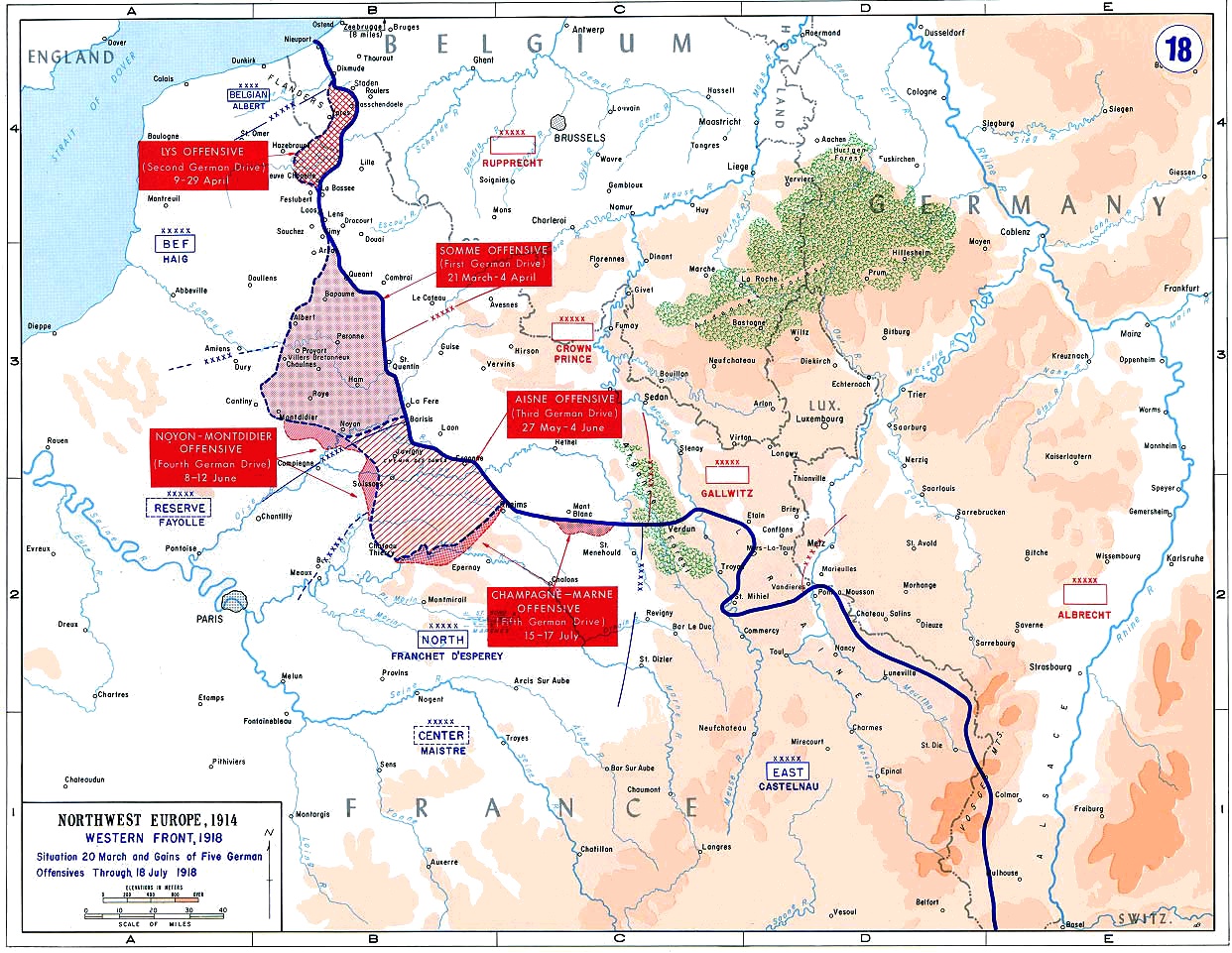
The United States lost a lot of soldiers for its very brief time in the war. The American Expeditionary Force wasn't assembled until July 1918, there hadn't been enough recruits sent over and properly assembled to warrant it, those Americans who had been fighting in France had been operating under joint command under the Allies. There were a million American recruits in France in May 1918, but more than half weren't anywhere near the front lines or anywhere near ready to be deployed, most of the American soldiers we sent missed all but the tail end of the last major offensive by the Germans in spring of 1918 (the Kaiserschlacht), after which the Germans had essentially exhausted their manpower and material in that last offensive, and the US still had 150k deadly casualties and 300k wounded and sick, bearing in mind the last handful of months only had token offensives on either side as the conclusion was negotiated.
A part of that is because American soldiers were notorious for being more... earnest? than their European allies, especially by 1918, because at that point American forces simply didn't have the morale fatigue Europeans armies had endured for 3 years of war. American officers were still implementing some of the same tactics that Europeans had been using in 1914 and 1915 yet by the later years of the war Europeans had effectively abandoned. The famous quote by an American officer, Daniel Daly, "Come on you sons of bitches, do you want to live forever?" is probably the smallest encapsulation for how much less war weary Americans and more gung-ho Americans were compared to their European counterparts, as the same eagerness for combat had existed in Europeans at the outset of the war. Even so, when the US declared war in December of 1917, volunteers were practically non-existent, in part because news of how awful the war had been in Europe had been in the press for 3 years at that point, and in part because America was notoriously isolationist before WW1 and the idea of a European war was anathema to early American doctrines (the Monroe Doctrine). The American public was still on the fence about participating and we had to implement the draft to get anything resembling a worthwhile army to contribute. There are some historians who make Wilson less of an idealist and proponent of international order and instead argue he's much more calculating, that America's hedged neutrality that still offered material support to Britain and France while not trading with Germany made American involvement in WW1 Wilson's war, not the American people's war.
Despite all the vast preparation and immense mobilization of Germany, the blockade effectively strangled German production in a way that French and Anglo industry wasn't, and the only German recourse after the naval battle in Jutland failed to break the blockade was the U-boats, and, for practical reasons there was no way for the U-boats to distinguish American (non-combatants) from "combatant" shipping. After Jutland, the U-boats were the only option remaining to break Allied industrial advantages from the blockade (as I previously mentioned, American trade with Allies tripled during the war years and effectively dropped to zero with Germany for all trade goods that Britain declared "wartime materials", which was practically everything). There's a quote from Admiral Beatty, "The real crux lies in whether we blockade the enemy to his knees, or whether he does the same to us". Because the US remained a major shipping ally of the Allies, it was pretty unavoidable that the US Congress would respond in some fashion to escalating German U-boat activity indiscriminately attacking Allied shipping (although the Zimmermann telegram did far more to harm American neutrality in the view of the American public).
In contrast, Great Britain and France had the manpower of their vast colonial empires to draw upon to finance their war machines and pay Americans for their goods - as much as British and Commonwealth soldiers complained of poor rations (endless plum jam and beggarly strips of bacon), they ate comparatively well. There are accounts of German soldiers breaking British lines in 1916 and 1917 in night raids during the Turnip Winters just to raid much more plentiful Allied stores before returning to their own bunkers (so called Turnip Winters because Germany was so short-handed for labor that the only food for civilians was turnips imported from Sweden). I remember reading a diary account of a German officer during the first push of the Kaiserschlacht, Operation Michael, when the Germans had actually and truly broken the French trenches, they were in open country, bombardment of Paris (only 70 km away) had begun again, German soldiers saw French depots and little villages that seemed untouched by the war, and a colonel or major drove up to some village that had a railway to assess the situation and commandeer the trains when he realized the village was just being looted, german soldiers were carting off pigs and gooses and running around in women's dresses rather than fortifying or advancing. The major began berating a captain who had survived the assault and was drinking a bottle of wine (officers had some of the highest attrition in the war) and who was nominally in control of the situation to continue the advance, and the captain said something to the effect of "I can do nothing, if I should lift a finger to stop this I'll be shot dead". That's how desperate German soldiers were for food and supplies. The Kaiserschlacht effectively failed because A. mechanized mobile infantry didn't exist yet and the French were able to redeploy soldiers to cauterize breakthroughs, even dramatically effective ones B. there was nothing left for Germany to throw at the war, the blockade had worked and the army was running on fumes that it had burnt out for the Kaiserschalcht, especially in veteran frontline soldiers who did infiltration work and were essential to armies in preparing recruits for the reality of trench warfare.
To give some sense of how bad things were, the German navy mutinied in 1918, Allied advances in fall 1918 were characterized by German surrenders en masse (whole divisions) in the hope of just getting food, and war production had very nearly stopped because of mass labor strikes over food. Everything was poured into the Kaiserschlacht, and it worked to decimate allied trenches, but it was just too easy to rebuild defenses and redeploy soldiers, and too hard to make serious advances before mechanized infantry in an era of mechanized rail, and the Kaiserschlacht was over before America had even sent enough forces to justify having its own command.
The other side of the story however is that France was dealing with army riots in 1917 and England had a democratic government that still owned an incredibly unpopular war that at least initially it had, on paper, had the option to sit out of, whereas Germany was in the process of ending the eastern front and the kaiser didn't have an electorate to answer to. Germany might have been able to negotiate an advantageous truce in mid 1917, however, because they had begun unrestricted submarine warfare early in 1917 and with the Zimmerman telegram, there was just enough public support in the US to encourage the Allied governments to hold off on a truce, even though that had a great deal of popular support and growing demand, especially among the lower classes, in the hope the US would come in, which did happen by December 1917.
TL:DR after failing to break the blockade at Jutland, Germany needed some kind of relief in shipping or to even the production scale, the only way that was really possible was with U-boats, and that basically sealed American involvement in the war. While the threat of additional american manpower was daunting, by the time it was on the scene the war had mostly been played out, and while American forces would have guaranteed a victory, their role was small - it was mostly the guarantee of material strength from American industry, basically implicitly from the beginning of the war but openly by the end, that was America's principal contribution and which forced the end of the war.
A lot of the answers here are about the US military contribution to World War I. Fair enough (and good answers!). But in some ways that overlooks other contributions that the US made to the Entente/Allied war effort, even before the United States officially became a combatant in April 1917.
The United States provided massive amounts of supplies and credit to the Entente powers over the course of the war, both before the US entry as a combatant and after. Before US entry, these loans were privately raised by the British and French governments on Wall Street, especially through JP Morgan. Some $500 million was borrowed in 1915, and $1.5 billion in 1916, before the American government stepped in as a lender and provided some $4 billion in 1917-1918.
Most of that financing was in turn spent on US purchases. While World War II would see the United States became a major supplier of finished industrial goods such as tanks and airplanes, in World War I, most of the goods provided to Entente powers were agricultural materials such as grain and beef, or munitions. The US Army itself had to use French and British tanks, rifles and even helmets on entry into the war.
Anyway, this was all at a time when Germany and the Central Powers, with the exception of a few cargo U-Boat shipments, were largely cut off from American finance and trade and under blockade. Even before the US military made itself a presence on the battlefield, US food and ammunition, paid for by US credit, were making themselves a presence on the frontlines.
Source:
Adam Tooze, The Deluge.