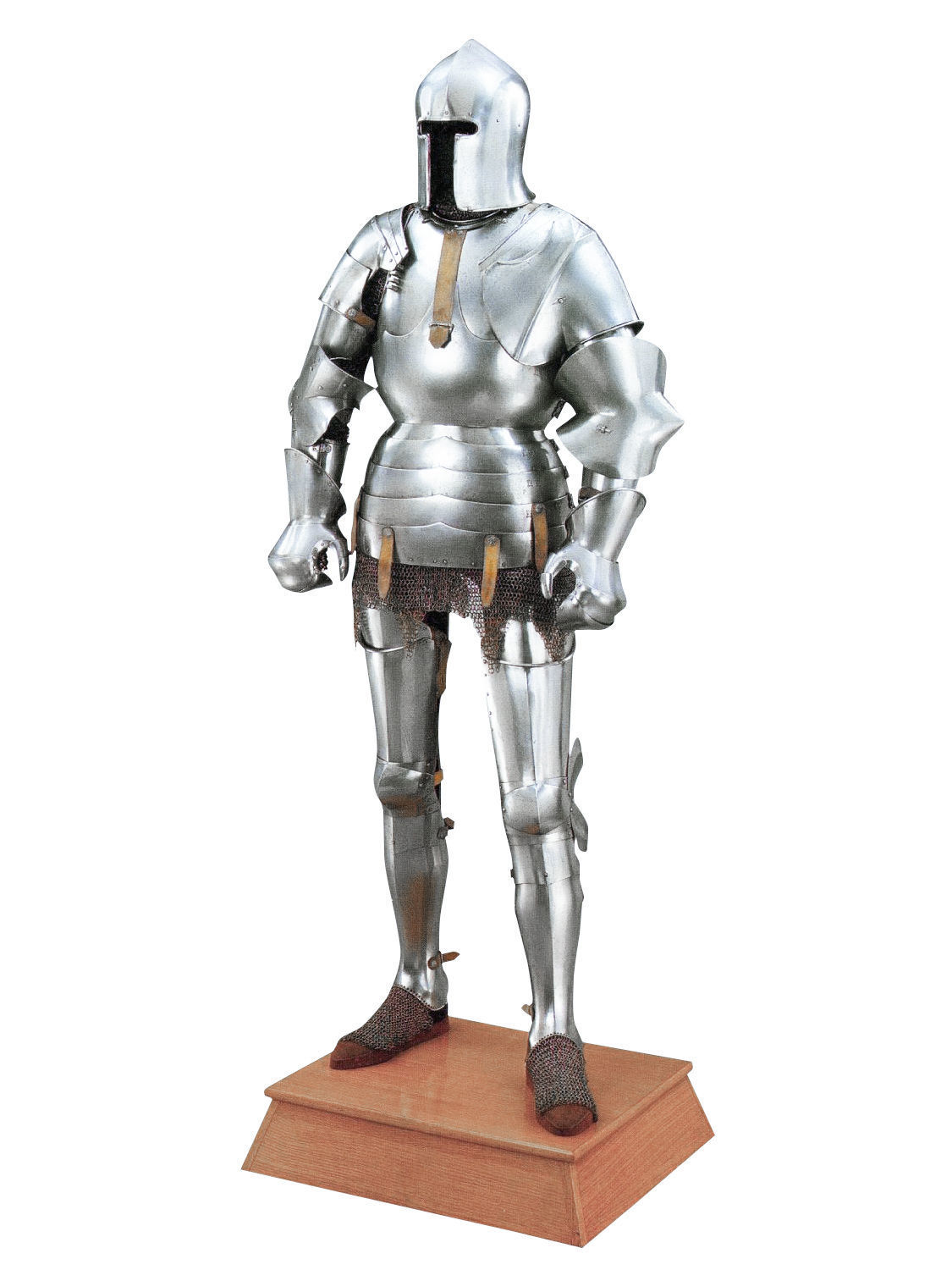
When you walk down the street today in any city in the United States it's easy to spot luxury and high quality goods on others (you can recognize a Louis Vuitton purse or a Lamborghini and associate those items with wealth and high quality). I know Middle Ages is vague and I'm sure the answer varies by region. For conversations sake, let's say we're in England roughly 1200-1500 AD. My question is: were there branding marks on Sir Knight's armor that I would recognize and say oh that's a good guild that I know of! Or would it just appear to be of higher quality in comparison to others?
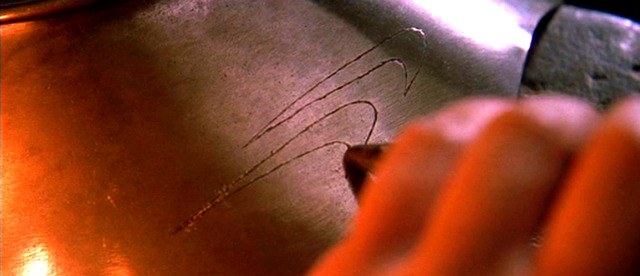
If you're like me and you think of 'brands' on medieval armour, you probably think of this scene from one of the best-ever medieval movies when the armourer Kate puts a...rather familiar mark on the jousting armour that she's just made for our somewhat dopey hero. Now, can armour historians document the Swoosh as an armourer's mark in later Medieval France? No - not any more than we have records for crowds at jousts chanting Queen songs or nobles dancing to David Bowie. But as is often the case with this uniquely silly and self-aware bit of medieval movie-making, Kate's mark is inspired by historical fact, remixed through modern sports and pop culture to produce a silly result that still gets at something true about medieval armourers - yes, they did have marks, and yes, they could be something like a 'brand'.
First off, let's talk about the limits of the analogy. There weren't modern corporations in the Middle Ages, obviously. Society as a whole was not dominated by international joint-stock companies with massive marketing departments that could shape the very culture around them. There was no medieval McDonald's and, as I said above, no medieval Nike. But there -were- powerful families and institutions that concentrated an enormous amount of wealth and influence and shaped the economy of all of Europe. Some of the most famous of these are the banking families - most famously the Medici of Florence and the Fuggers of the Holy Roman Empire. But there were also -armouring- families, most notably the Missaglia of Milan, who combined manufacturing, marketing and trading armour into a multinational vertically integrated enterprise. I write more about them here and here. Moreover, there were the armourers guilds themselves, which allowed armourers to collaborate to ensure that their work was profitable (by regulating the trade and lobbying authorities), to monitor quality and to organize large-scale purchases. I write about the extent to which we could compare both the armourer-merchants of Italy and the guilds of Europe North of the Alps to corporations here. While neither of those entities was exactly like a joint-stock company, they absolutely had enough power and produced a large enough volume of goods to create quite a presence for their 'brand' in the market. In the case of the Missaglia, they traded on their name and their contacts - they and their home city, Milan, was renowned for producing good armour, and producing it in quantities that no one else could match (while maintain decent quality). The Missaglia were able to do this through a system of subcontractors, in which smaller workshops would be contracted out to make invidiual components of armour (the guantlets, the cuirass, the helmet, etc) and the full armour would then be assembled by a specialist, the Traversator. In the case of the guilds, different cities developed their own distinctive reputations for quality, some greather than others. Nuremberg was well known as an armour producing center - it produced perhaps more armour than anywhere else north of the alps (except perhaps Cologne, and some cities in the low countries also had very large industries), ranging from simple armour for infantry to workaday full harnesses for fully armoured men at arms to luxury armours for the elite. It dominated the middle of the market in the German lands, probably, and was powerful on the low end as well (along with Cologne). By contrast the city of Augsburg (and the even smaller city of Landshut) became famous as a maker of bespoke, boutique armour for those who wanted the very best. Even infantry armours from Augsburg are of an exacting metallurgical quality - Augsburg armourers didn't do things by halves!
Moreover, individual armouring workshops could build up their own reputation for quality. We have records of armourers marketing themselves widely - the Flemish armourer Martin Rondelle (probably of Italian descent) made armours for the Duke of Burgundy, and also wrote to the English Knight John Paston boasting of his skills and his ability to make an armour to suit his customer's taste. Perhaps the greatest family of armourers of all are the Helmschmids of Augsburg - 3 generations of this family served 5 generations of Habsburgs. Their works are masterpieces of the armourer's art and form the cream of the collection of the Habsburg royal armouries in Madrid and Vienna.
So, to recap, their were city guilds, and large semi-corporate families of armourer-merchants, and individual armourers who had market power and 'cachet'. This is an important part of being a brand - having a reputation and and an identity. The 'brand' of an armour could roughly be said to be two-fold - the reputation of its individual maker, but also the reputation of its city of origin. But what about the 'branding' itself? That's where armourers marks come in.
Beginning as early as the 14th century with the development of plate armour and the rise of prestige of armourers, armourers began to mark their wares. These markes can be divided into two types, which correspond to the two levels of 'brand identity' I mention above:
Guild or Regulatory Marks - these are marks of inspection, showing that the guild or regulating municipal authority has inspected (possibly tested the armour by 'proofing it' by shooting it with guns or crossbows) the armour and found that it meets the standards set out for the armourer's craft in that city.
Individual armourer's marks, corresponding to single workshops generally under a single master. Often members of the same family would have similar marks, and sometimes sons would inherit the marks of their fathers.
In the case of armours which had both city and individual armourer's marks, you would see these paired, as you can see in this combination of the helm-and-cross Helmschmid mark and the fir-cone mark of Augsburg.
Not all cities had inspection marks (notably, Milan didn't) and not all armourers marked their armour with an individual stamp. In these cases you might just see the city mark as in this mail shirt from Nuremberg or they may only have the mark of an individual armour as in this sallet attributed to Adrian Treytz the elder. But using the combination of the city and the armourer's mark you could tell a lot about the quality of an armour - who made it, and what standards it had met. In the case of Milanese armours, the subcontracting system meant that each piece of a quality armour would be marked by its individual maker and by the traversator that assembled the final armour, so their marks are also paired or in threes as on the wrapper of this Italian helmet (the big mark is a later mark denoting the collection) and repeated on individual pieces of armour. This means that Italian armours can have dozens of marks - for example, this famous harness now in Glasgow has 51 marks representing at least 5 different master armourers. In a world where quality control was difficult and where the quality and authenticity of goods was hard to verify, those marks were your best bet to know that you were getting an armour worth paying for - one that you could trust your life to.