I know Epictetus was a former slave, but he had the unusual situation of being given access to Stoic lectures by his master, and was educated to a very unusual degree
I'm curious to know if we have much evidence beyond him for lower class people of average means and education embracing any of the major philosophical systems that were so popular with the elites at this time.
You're asking a very good question, and I've included a few sources at the end that would treat this topic better than I can. I can't answer for the systems you mentioned (I discuss them a little bit toward the end), but I can give you an answer for another philosophical/religious system around the same time period: Neoplatonism. You might call it a philosophical religion, in that in was based on Plato's writings (with some Aristotle, Stoicism, and other philosophies mixed in) but also borrowed heavily from near eastern and Egyptian religions, so that it had a lot of the features of religion: it had ethical rules, divinities, and notions about the afterlife, among other things.
A lot of my answer depends on Michael Bland Simmons' book Universal Salvation in Late Antiquity, which, as the title suggests, focuses on religious and philosophical systems in the late antique period, something like 200-400 AD, which puts it after the early development of Epicureanism, Stoicism, and the main way of life covered in the book, Neoplatonism. The primary argument of the book is that Christianity, which was ascendant at this time, offered more than other philosophical systems to the regular people living in the later Roman Empire, when a lot of things had started going down the drain: emperors were short-lived and often assassinated, the economy was doing poorly, and the various wars they fought were expensive. (Note: I'm doing this from memory, and I'm not well-versed in the history of the Roman Empire, so apologies if some of my details are incorrect.)
So Simmons argues in his book that Neoplatonism was in some ways successful as a religious philosophy and way of life, but that it was almost exclusively available to the elites of society, for a few reasons. First, it was incredibly abstract and philosophical: there is a remote, ineffable One, which is essentially the highest of the gods, and from this One emanates the Intellect, and from that emanates the Soul, and these are all possibly in a hierarchy but also not exactly. It required dedication, formation, study, debate... things that average people didn't have time for. Moreover, because the One is ineffable, it is completely irrelevant to the concerns of most people. It doesn't help you with your problems (lower gods could do that, but they weren't always dependable or easy to contact), it doesn't "care" about you, and it demands a lot. Regarding this last point, Neoplatonist philosophers strongly emphasized asceticism: don't give in to bodily temptations, including sex and especially food; sacrifice regularly to the gods, but only to the right ones; seek after knowledge; in short, follow a difficult way of life. And for what reward? Uhhh mystical union with the One? Which entails... I'm not sure? Plotinus claimed to have experienced it, as did his student Porphyry, but in general, Neoplatonism didn't really offer anything to the regular person who wasn't adept at abstract thinking and whose concerns were more about staying alive than achieving union with a god who doesn't care about him.
Another aspect of Neoplatonism, which I believe was shared with Epicureanism, et al, also didn't help its appeal to the common man: its focus on the "holy man." (See Garth Fowden's book (article?) "The Pagan Holy Man in Late Antiquity," it's very, very helpful for your question.) Even though religions in general care about exemplary figures, Neoplatonism seemed almost to be pointless if you couldn't become a holy man during your life. True, it has an eschatology that's fairly complicated, and you can keep doing better through your reincarnations so that you ascend to the One, but in this life, what matters is mystical union, which, like I said, is really, really hard to do. So the holy man becomes a deity unto himself, which leads to the perception Fowden discusses, that of the elitist Neoplatonist philosopher. And you can easily see how this comes about: you have a religion, which is the truth, and it requires a lot of you, including for you to stretch your intellect beyond the material world; but it doesn't give you anything material or spiritual (like hope for a better life, life after death, etc) to hold on to; and the people who seem to be adept at the religion are pretentious assholes who claim to be better than you -- why would you care about a religion like that?
Enter Christianity, whose structure was similar (surprisingly similar, in fact: see St. Augustine's City of God, book X) to Neoplatonism, and which made many of the same claims that Neoplatonism did, but with some key differences, most notably (according to Simmons) that it actually moved people to belief. He quotes Eusebius, the church historian, at length in the book, and I can find quotes when I'm at home later, but they amount to: Christianity has spurred people to belief, given them things to hope for, and most importantly caused them to change their lives for the better, whereas Neoplatonism had nice intellectual features but ultimately did nothing for people.
Of course both Eusebius and Augustine were Christian authors writing at a time when the future of Christianity was by no means certain, so their accounts are not to be taken as even-handed evaluations of these two systems. But they do offer insight into how these religions were interacting with the each other and struggling against one another.
I know your question was more about Epicureanism and Stoicism, so let me try to address them a little bit. I don't know the full history of those philosophies in the later Roman Empire, but they were absolutely around and being debated. Porphyry, the Neoplatonist I mentioned above, wrote a treatise called "On Abstinence from Eating Animals," where he presents philosophical arguments for vegetarianism. Two things about this treatise. (1) It is directed to the elites. He explicitly says that he is not writing for the average person, or, e.g., the athlete, who might need to eat meat for bodily strength; he is addressing his treatise to a philosopher-friend who has recently lapsed from vegetarianism. So he does not have everyone in mind when writing this treatise. (2) He argues for vegetarianism against the doctrines of the Epicureans, Stoics, and Cynics, who are concerned with many things but not the eating of animals. To my knowledge, these systems varied in the importance they placed on ethical injunctions and abstract argument: I would imagine the Stoics cared a lot more about them than the Cynics did, but I don't know enough. However, Porphyry's argument against the Cynics I think is particularly good: he says that they like to claim to be indifferent to ethics, and to not care about social prohibitions on things like public defecation because, hey, it's natural to poop so why not poop in the street? To this Porphyry responds that if they were truly indifferent, they wouldn't care whether they poop where they're supposed to or in the street; and since they insist on pooping in the street, they can't be indifferent.
Sources:
Simmons, Universal Salvation in Late Antiquity
Fowden, The Pagan Holy Man in Late Antiquity (emphasizes socio-cultural aspects, esp. the elitism of holy men at the time)
Augustine, City of God
Porphyry, On Abstinence from Eating Animals
Great question indeed! I can give no exhaustive answer on the subject, but from my own personal specialty, I can maybe give a few insights into a part of this. Roman funerary inscriptions are a way to get an insight into the middle class of the Empire (the lower classes usually lacked the funds to put up such an inscriptions) - so these would be your 'people of average means', on the upper end -, and in fact there are some intriguing inscriptions that point at an understanding of some points of Epicurean philosophy.
In this context, of course, the most fitting of Epicur's thoughts is that concerning the meaninglessness of death, as expressed in the letter to Menoeceus:
Death, therefore, the most awful of evils, is nothing to us, seeing that, when we are, death is not come, and, when death is come, we are not. It is nothing, then, either to the living or to the dead, for with the living it is not and the dead exist no longer.
Before we were born, we didn't exist and couldn't care about it, in death, we won't exist and can't care about it, thereore there is nothing to worry about. It's a timeless argument for consolation in the face of death, and it seems to have helped ordinary people cope with the loss of a close relative in ancient times as well. There is a not very large, but considerable body of inscriptions from all over the empire, both in Latin as well as in Greek, that present an abbreviated version of this argument.
I'm going to give a few examples:
From Merja, in the province of Africa proconsularis:
D(is) M(anibus) s(acrum) / C(aius) Seius Dona/tus pius / vixit annis / LXVII h(ic) s(itus) e(st) / non fui et fu(i) / non su(m) quid / ad me [CIL VIII 27736]
To the sacred Manes (i.e. the spirits of the departed). Caius Seius Donatus, (a) pious (man), lived 67 years. Here he lies. I was not, and I was. I am not, what's it to me?
From Lectoure, Aquitania:
D(is) i(nferis) M(anibus) non fui fui me/mini non sum / non curo Do/nnia Italia an/norum XX hic / quiesco Sm[in]/t(h)ius et Donnia / Calliste l(ibertae) piissimae [CIL XIII 530]
To the infernal Manes. I was not, I was, I remembered, I am not, I don't care, Donnia Italia, 20 years, here I rest. Sminthius and Donnia Callista to (their) pious freedwoman
From Lambaesis, Numidia:
D(is) M(anibus) s(acrum) / Aureliae Vercel/lae coniugi dulcis/simae quae vixit plus / minus annis XVII non / fui fui non sum non desidero / Anthemus maritus eius
To the sacred Manes of Aurelia Vercella, sweetest wife, who lived more or less 17 years. I was not, I was, I am not, I do not desire. Anthemus, her husband.
There is a similar trend in Greek epitaphs, as for example in this epitaph from Rome (IGUR III 1283), for Nikomedes:
...οὐκ ἤμην καὶ ἐγενόμην, οὐκ εἰμὶ καὶ οὐ λυποῦμαι...
..I was not, and I was, I am not and I do not suffer... The absence of suffering here makes it quite expressly Epicurean.
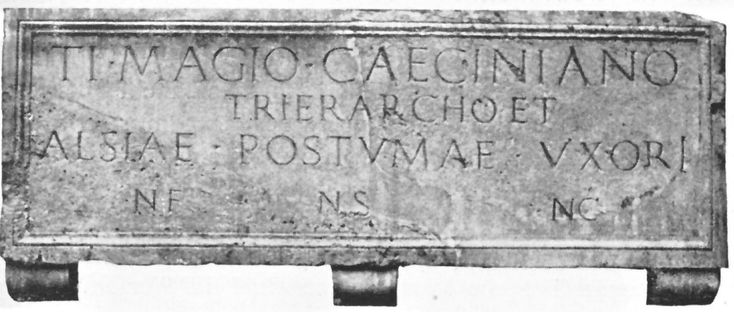
There are a few more Greek examples, which is not suprising since we would expect to find some Greeks under people in contact with Epicureanism. But it has been suggested that this was just a formalized expression, especially since it appears abrreviated on some inscriptions, for example on this one from Iulium Carnicum in Northern Italy, a funerary inscription for the trierarchos (captain) Tiberius Caecinianus and his wife Alsia Postuma, which ends with a nicely placed n(on) f(ui) n(on) s(um) n(on) c(uro) (I was not, I am not, I don't care). Such abbreviations are often an example of formulae that are used so often that they are easily recognizable, but this does not seem to be the case here. There is just one other inscription expressing that sentiment that heavily abbreviated (CIL V 2893), from Northern Italy (Padua to be precise) as well, which ends with n(on) f(ui) f(ui) n(on) s(um) n(on) c(uro) (I was not, I was, I am not, I don't care), so in a slightly different way, but more importantly, all the other one's aren't quite that standardized, they change up the words used or the precise order. It seems more likely that there is at least a desire to express something original (and anyway, inscriptions with this 'epicurean' ending aren't very numerous anyway). Ferguson concludes that it definitely shows a permeation of Epicurean thinking, if not active Epicurean philosophers (though they might).
The scarcity of this phrase in face of other, more popular witticisms that often were used on the epitaphs of people who wanted to appear a bit more sophisticated (such as 'what you are now, I once was, what I am now, you will one day become', for example), to me is indicative of something original here. The people who used words to that effect consciously echoed the solace of Epicur, even if they were not philosophers themselves, they certainly had come in contact with Epicurean thought in one way or another. Especially the different endings ('what's it to me?', 'I don't care', 'I don't suffer anymore', 'I have no wants anymore') seem to be indicative of originality more than formulaic emulation. They might not be lower class, but we can scarcely get at their thoughts through any kind of sources, sadly.
To close off, we do indeed hav some inscriptions which mention that the deceased were Epicurean philosophers (these might of course not fit your defintion of 'average people'), they declare themselves to be a philosophus Epicureus: From Rome, there is a Publius Octavius Secundus, mentioned in a funerary inscription, probably from the 2nd century (CIL VI 37813), and from El Kef if Africa Proconsularis, we know a Caius Artorius Celer from another funerary inscription (CIL VIII 344).
Further Reading: