It’s up in the colder north, not near the ocean, and not near the Mediterranean where much of the wealth and trade was at during antiquity and early Middle Ages. How did the spot where Paris resides become the Paris we know?
The emergence of Paris as a main city in Late Antiquity and Early Middle-Ages is rather, at the contrary, due to its geographical situation both human and politic.
First, Ile-de-France isn't that cold : mild to warm winters with mild summers, it's climatically much less cold than Brittania or Germania.
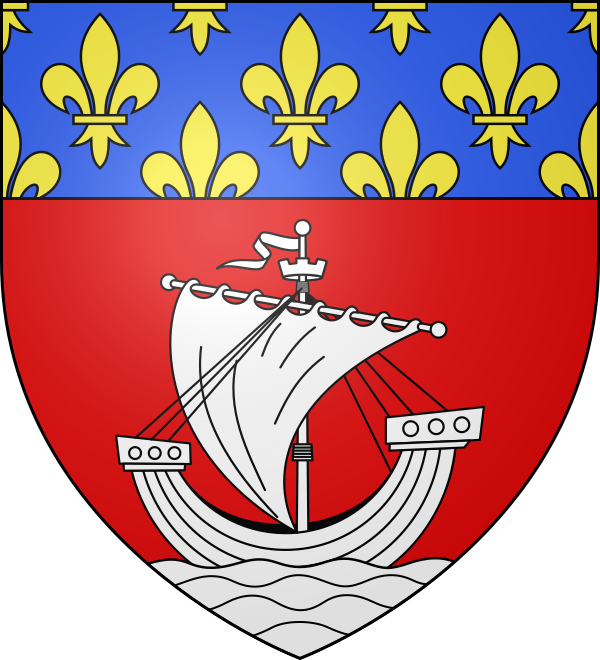
Then, while not set on the coast, the Seine is a perfectly navigable waterway, which is remembered in Paris' arms.
The preceeding Gaulish oppidum of Lucotetia (maybe set some kilometres westwards of the modern city, at Nanterre) as it emerged in the IIIrd century is better understood trough the trade ways between Britain and North Sea from one hand, and Mediterranean Sea on the other, trough the Rhone and Seine rivers (which formed one of the tin trade ways since centuries) which took a great importance between Romans and Aiduoi after the Roman conquest of southern Gaul (Parisioi being under Aiduoi's political influence) for exemple in the really fructuous wine trade for Gaulish and British consumption.
The role of the Seine in Lucotetia/Lutetia's prosperity is highlighted by the importance of nautae,a fraternity of traders and ship owners present in other river ports (such as Lyons)..
After the Roman conquest, this wouldn't change much in spite of Lutetia's "relocation" to its current center : the city remained fairly prosperous and a similar urban romanization to what happened elsewhere in Gaul (municipal ervegetism, imperial acknowledgement, Latin and Roman Law, etc.). But it wasn't that important and was actually not that discernible from other provincial secondary cities and beyond main cities of northern Gaul such as Rheims. Even the division of the province and the establishment of Lugdunensis IV propelled Sens as regional capital.
Still, the city grew in importance with the Late Empire : it controlled a fortified crossing point on the Seine, it waterway trade allowed the city to be easily supplied and to garrison a fluvial patrol, and it was far enough from the limes or raided shores. Julian made the city his headquarters during the campaigns against Alamans. This centrality gave Paris (from the usual Urbs/Civitas Parisianorum, then Parisius) an importance not relative to its demographic or institutional weight, while being relatively spared the worst of the Late Empire (suburbs surviving, on both banks, the fall of the Empire) at the contrary of important cities such as Rheims or Trier, while other main cities in Gaul tended to decline (Saintes as soon as the IInd, Lyons in the IIIrd)
As Franks took over Gaul, Paris not only kept this role but it began to overshadow other provincial cities of northern Gaul : Clovis made Paris one of his main residences (at the imitation of Julian and Valentinian? The presence of the palatial-baths network certainly played a major role) and his successors, while sometimes making Paris the capital of one specific sub-kingdom, still considered the city important enough to jointly share its jurisdiction and benefices.
The Merovingian period of Paris seems to have been prosperous, the city gaining back some peripheral areas abandoned in the Late Empire, in no small part thanks to this royal protection and the same old Rhone-Seine axis from Provence to Anglo-Saxon Britain carrying prestigious Mediterranean goods. It's not that Paris dramatically blossomed in early Middle-Ages, than other cities either declined or didn't beneficed from royal patronage and religious ervegetism.
Even the decline of Mediterranean trade in the VIth to VIIth centuries didn't that impaired Paris' fluvial port, even if the Carolingian period is traditionally considered to coincide with a decline (at least political) of the city as the trade roads shifted to North Sea/Rhine. By Carolingian times, Paris was considered the natural chief city of Francia (understood as the region between Loire and Meuse, roughly)
But as Vikings raided multiple times Paris's port and city while long-range trade largely vanished. These raids significantly damaged Paris, however, and reinforced its decline compared to neighbouring cities, especially Orléans during the reign of Robertians and early Capetians.
Nevertheless, at the end of the general crisis of the Xth century, Paris' location and semi-institutional importance only grew again for the same reasons than before. Capetians favoured their main residence in the same time it became a major trade place (at first for grain produced in the fertile region).
Far from disadvantaging the growth of Paris, its location in conjunction with political importance and support, allowed it to become a demographic giant in medieval era, comparable to Italian cities in size and population, while other Gallic cities remained part of an urban network without one really going out of the lot (at the exception of Orléans in the VIIIth and IXth centuries) to rival Paris.