I know elephants have been used in war for centuries, as well as using them (and other exotic animals) for pageantry such as in the Coliseum under Roman Rule.
Where did empires like Persia or Rome source these elephants? Were they captured in the wild and then shipped? Did they have specific breeders to provide elephants in captivity? Were they a common sight to a regular citizen or cavalryman?
Elephants were always caught from the wild, since they're not economical to breed; they take too long to gestate (about two years) and too long to reach full maturity, when they're most useful (decades). How they were caught and tamed in classical times is not very well known, but Pliny claims that in North Africa they were caught in pits or narrow ravines, trapped and starved into submission.
In [North] Africa they take them in pit-falls; but as soon as an elephant gets into one, the others immediately collect boughs of trees and pile up heaps of earth, so as to form a mound, and then endeavour with all their might to drag it out. It was formerly the practice to tame them by driving the herds with horsemen into a narrow defile, artificially made in such a way as to deceive them by its length; and when thus enclosed by means of steep banks and trenches, they were rendered tame by the effects of hunger; as a proof of which, they would quietly take a branch that was extended to them by one of the men.
http://www.perseus.tufts.edu/hopper/text?doc=urn:cts:latinLit:phi0978.phi001.perseus-eng1:8.8
Much better recorded is how they were caught in India and Southeast Asia in more recent times, where they were caught in pens and brutalized. Here is how it was described by a visitor to Siam in 1636;
These creatures being great, very strong, and strangely docible, are taken in several parts of the Country, and disciplined as followeth; A Troop of fifteen or twenty tame she Elephants, which were taken when they were young, are driven into the Wilderness, with two or three fellows to observe them; the wild ones upon fight of them, associate with them one or two at once, which are driven with the rest infensibly into a great square building with high stone walls, and encompassed on the outfide with trees which cover them; as soon as these Beasts are decoyed in, a great turn pike is shut behind them, and gates to hinder their return; when they are entred further into the square place, the tame Elephants being brought up to it by their teachers, upon notice from them, flip away through other gates for the purpose; so that the wild ones being left alone, are out of other little squares, whereof one is in the middle, vexed and tormented with all manner of inventions to make them angry and furious: the above mentioned squares are made of great thick posts, well nigh two fathoms high, but so far distant from each other, that a man may creep betwixt them; so that when the Elephant with his running turning and winding, seeks to revenge himself upon his tormenters, they save themselves behind these posts; at length, when the beast is weary, and sufficiently tormented, there is a great door opened, into which he runs to save himself, which is immediately shut upon him, and he restrained to a narrower prison, and is there bound to two or three tame Elephants, placed for the purpose; this done, they are led into a covered house, where cross planks being contrived under the wild ones belly, they are hoyssed up with pullies, and left as it were half hanging for some time so that with this invention, and help of the tame ones, they are wholly tamed in three or four moneths, and rendred and useful. The Court is for the most part present (Galleries being builded for the Spectatours) at the taking and tormenting of the Elephants, which is most pleasant to be hold. These Beasts are fometimes taken in the open fields, being environed with tame ones, and caught in snares and jins, but this way is dangerous although often practised; and both shew how fabulously Writers have informed the World in this particular.
https://quod.lib.umich.edu/e/eebo/A34454.0001.001/1:9?rgn=div1;view=fulltext
Whether similar methods were used in the classical world is anyone's guess, but brutalisation seems to be a fairly universal aspect of it (still goes on today; https://en.wikipedia.org/wiki/Elephant_crushing).
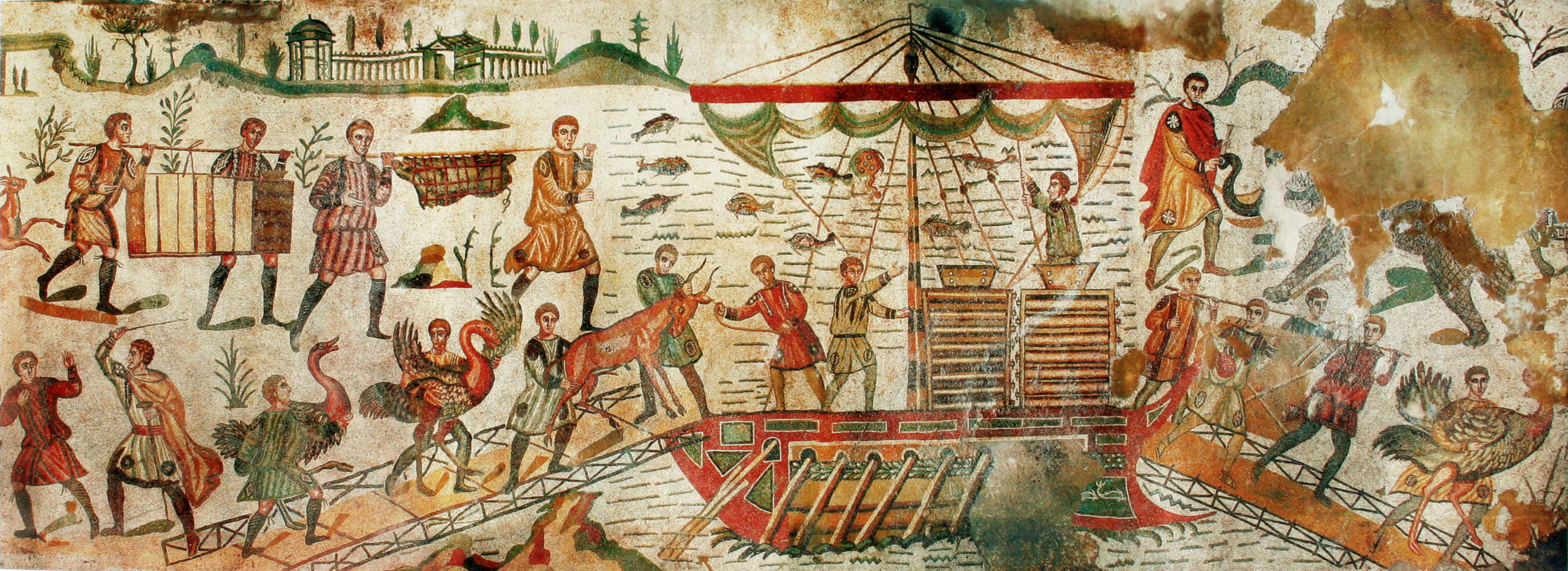
As for shipping, I don't know much about the details, but there are some amazing mosaics depicting this from the 4th century Villa del Casale.
I don't know how often they'd be seen by a regular citizen, but beyond North Africa I'd assume they were a rare sight outside of the amphitheatre (and even then, presumably quite rare). That's just a guess though.