So, the Terracotta Army has around 9000 soldiers, buried in around 210BCE to "protect the Emperor in the afterlife". Did Chinese culture of the time view the afterlife as a physical place, which could be conquered with a big enough army, or was this entirely symbolic, as a display of the Emperor's wealth and power for the benefit of the living?
Though it is terribly amusing to think that the Terracotta Army was constructed to, say, storm the gates of Heaven and lay siege to a Jack Chick-esque Faceless Titan God, the truth is - as it so often is – something more complex. In terms of what we often umbrella-term into “traditional Chinese folk religion,” one of the carry-overs from region to region, and across time, is the idea that what is presented and sacrificed to the dead on Earth is reflected in the afterlife. The beliefs of the era were a combination of animism and shamanism – much of which continues with quite a few modern variants of Chinese Folk Beliefs.Spirits of the Divine, the living, and humans did physically (er, well, spiritually) persist in perpetuity, and could offer advice, assistance, divinations of the future, and good fortune. Of course to receive that, one had to properly honor and give to them. The human dead essentially became minor gods with specific influence over the fortunes and fates of their living descendants, and as such could confer powerful boons if properly cared for and revered. Indeed, every year one of the Chinese national holidays is 清明节 , commonly known in English as Tomb Sweeping Festival. During this holiday, an extremely common practice is the ritual presentation of food for the dead – a laying out of what was known to be Dad’s or Grandma’s favorite dishes and treats in life, and the lighting of flames and candles… and the burning of gifts (though as of this year “officially discouraged” by the government… lol, good luck with that, Beijing – how’s that fireworks ban working out for you?). These gifts range from cash, to cars, to property, and anything else you might want Grandpa to “have” in the afterlife.
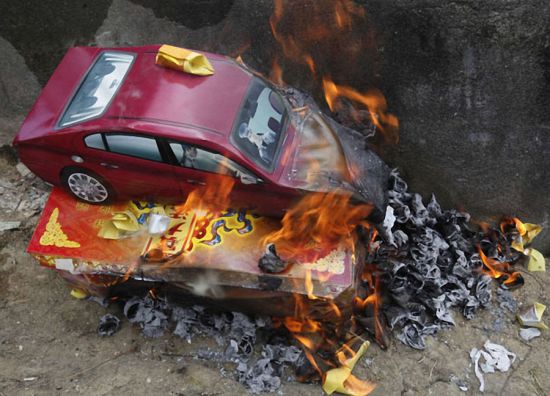
Now, before you ask, NO, Chinese families aren’t annually burning actual Audis and stacks of cash – instead, the objects are substituted with paper equivalents. So, for instance, here is an example of some fat wads of what amounts to Monopoly money being offered to an ancestor, and likewise here is an example of a car being offered up. This can seem silly from the outside, but it is in fact quite common across spiritual belief systems. Think, for instance, of the Roman Catholic Church, and specifically it’s sacrament of the Transubstantiation. Bread and wine (or grape juice) are substituted for human flesh and blood, and through the appropriate blessing and ritual, that is “transformed” into the real thing. Likewise, the paper money and cash and credit cards are, through the ritual of flame, carried up into Heaven and delivered to Granddad as the real thing.
So, let’s take this contemporary model and flash it backward 2,200 years. It holds up in a largely similar fashion, albeit with much fewer Buddhist bells and whistles that were added in later on. Upon uniting the Warring States in 221 BC, and declaring himself not just the King of Qin, but the First God-Emperor of Qin (AKA Qin Shi Huangdi), Ying Zheng did spend quite a lot of time considering his own mortality, and specifically ways to potentially get around it. He had good reason; no fewer than three times in the course of his rise to power and conquest, he had been very nearly murdered by assassins. Shihuang spent the vast majority of his reign trying (and largely succeeding) in knitting together culturally, linguistically, militarily, and legally the realms that had been divided for nearly 4 centuries, and even before that had been only a loose feudal coalition. Yet he knew that his time as the earthly sovereign would come to a close before the cement holding those constituent pieces together could solidify. What to do?
His Daoist priests and alchemists offered him a potential solution – to subvert mortality, or potentially transcend it entirely. Initially, Shihuang seems to have been seeking earthly immortality by learning its secrets from one of the legendary Immortals who purportedly lived in isolation on the tops of distant mountains. According to Sima Qian, the Grand Historian of the early Han Dynasty that would ultimately succeed the short-lived Qin, Shihuang dispatched a fleet of ships with 1,000 each of young men and women to the Great Eastern Sea (the Pacific Ocean) to seek out one of these Immortals, and either bring him back to the emperor, or to learn his secret of eternal life and report it back. They were instructed to not return unless they succeeded, on pain of death. Suffice it to say none of them ever returned. Legend has it that they might have sailed all the way to Japan and permanently settled there, but there’s no way to confirm any of that.
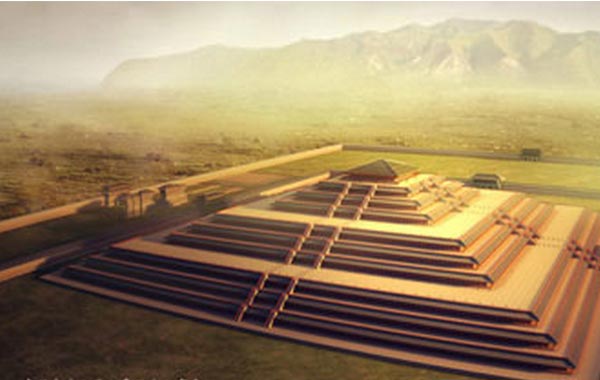
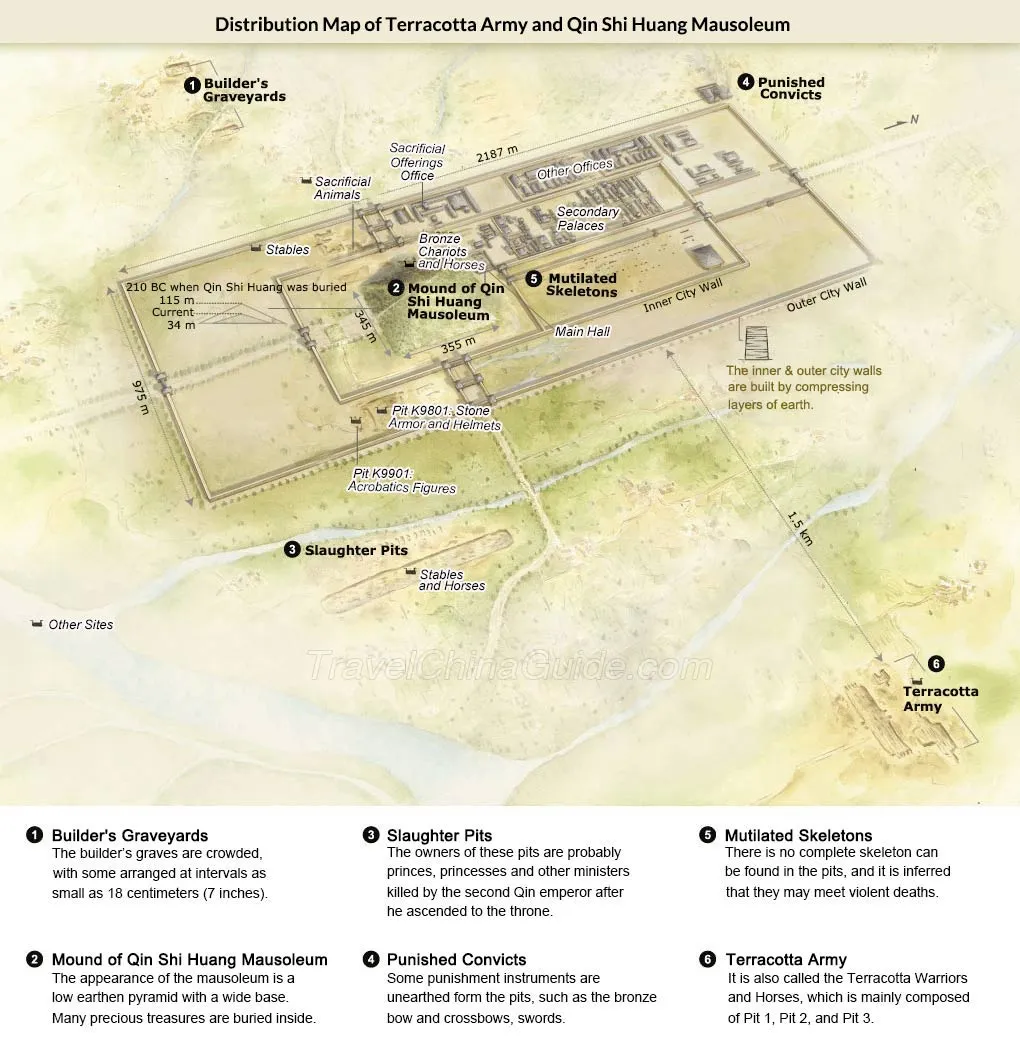
Regardless, the Qin Emperor was not putting all of his eggs into a single basket. Early in his reign – when he was 13 and newly enthroned as the King of Qin - he ordered the beginning of construction of one of the most massive projects of his eventual dynasty: the City of the Dead just outside of his capital from which he would eternally rule his empire from the Beyond. Employing convict and corvée labor for years on end, the centerpiece was a massive earthen pyramid, around which was constructed a full-scale palace complex and city that would be fully staffed in the afterlife. This is where the Terracotta Figures largely come in to play.
Much like the bread and wine of the Sacrament, or the spirit money for Tomb-Sweeping Festival, the 8+ thousand Terracotta figurines were 1:1 models. Though the majority of the figure are indeed soldiers in battle armor, along with chariots, and (actual) sacrificial horses, some also seem to be representations of officials and other functionaries. Given, however, that the Qin was first and foremost a militaristic bureaucracy, it’s not surprising that even the command staff and high officials would be outfitted and prepared for battle.
So this is where I get back around to the idea of transubstantiation. Prior to the unification of China into the Qin Empire, prior even to the previous order – the Zhou – which had nominally ruled China in a feudal capacity for 7 centuries, the first two listed quote-unquote “dynasties” of China – the Xia, and the Shang, respectively – are noted to have utilized extensive human sacrifice for the funerals of its nobility and royalty. The Shang royal cemeteries are noted to have uncovered at least 3,000 bodies with evidence of having been slaves used as human sacrifices for noble funerals, along with horses, money, jade jewelry, and protective amulets for the dead. As with many Bronze Age societies, all of these things – and people – were expected to be taken with the noble dead and used in the afterlife, as they had been in life. Thus, the sacrifices would serve their master in the hereafter, as they’d done in life (which is a heck of a way to spend eternity).
The Zhou, however, did away with that practice, as well as formalized slavery (albeit, there is an awful lot of caveats there). As such, by the time of Qin unification, substitution needed to be used, rather than actual sacrificial victims (albeit, there also a lot of caveats here, as well.) On the whole, the mere representation of an army would suffice and be made use of – not as some kind of strikeforce against the Heavenly Jade Emperor or the like – but as a representation of his Earthly power that would assist him in his continued rule from the afterlife.