Today, the most commonly used pitch standard is 440hz. I've read a bit about different tunings (432hz, 451hz, 256hz...), and some sources tend to claim that the Egyptians, ancient Greeks and even Mozart tuned their instruments to 432hz. Seeing that a lot of pitches have been used throughout history, I need to ask. Do we have scientific proof that 432hz was used as the standard tuning in the ancient world?
With some notable exceptions such as the New York Philharmonic, 440hz is common amongst modern orchestras in the US and UK, but on the continent and in Russia, 442 and 443 are almost universal.
Prior to the 19th century, there was no pitch standardization at all. Tuning forks and organs of the period cover a range of 60hz or more, with no geographic grouping. The earliest organized establishment of a pitch standard was the diapason normal, dictated by an 1859 law in France that set a standard concert pitch of 435hz, which was gradually adopted throughout the rest of Europe over the following few decades. The 440 standard was first proposed at a conference in Stuttgart in 1839, but it wasn't made official — insofar as such things can ever be made official — until the International Organization for Standardization catalogued it in 1955 (as ISO 16).
The leading Viennese piano-maker during the 17th century owned a 421.6hz tuning fork that likely set the original tuning standard for all of his instruments,^1 including those sold to Haydn, Mozart and Beethoven. Mozart himself left no recorded discussion, either favorable or unfavorable, about tuning standards. Verdi generally preferred the 1859 diapason normal, but did once express a slight preference for 432 in a late letter. This was for practical reasons, though, not ideological or "scientific" ones (lower pitch standards put less stress on singers' voices).^2
To answer the title question: There is no evidence that ancient instruments even adhered to local pitch standards, much less to some unified standard encompassing dozens of different cultures that had little to no contact with each other, spread across thousands of years and thousands of miles. Ancient people would have had no way to measure frequency accurately and consistently, nor would they have had a good way to propagate those measurements. Concert pitch is totally arbitrary, tuning and intonation are and always have been relative, and there is nothing special, important, or meaningful about any particular frequency. Bluntly, all of this A432 stuff is the bastard child of woo-woo conspiracy theory crap and quasi-religious numerology nonsense. And of course Joseph Goebbels is the secret architect of the evil 440 standard, because every good conspiracy theory has to have a Nazi in it somewhere.
u/-more_fool_me- covered the answer a bit, but I wanted to add something that I thought was cool and relevant. We essentially have no proof that 432 hz was the standard tuning pitch for A, partially because our concept of "A" never really existed until a lot later.
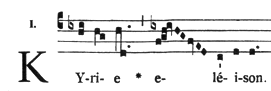
Take for example the music in this picture
This is a gregorian chant kyrie. While, it is tempting to read the music as if it is in F major (you have the "b" or flat symbol), in reality, the music is a bit more abstract than that. This is because, until around the Renaissance, even though it had written form, music was primarily an oral tradition. It was expected to be memorized, anything written was simply supposed to remind the singer of what the chant sounded like. Music theory at the time, was also primarily concerned with the relationships between intervals, not the pure Hz content of individual pieces. If there is evidence of what the pitch was, it's in the engineering of the instruments and the tensile strength of their strings/tuning of pipes. As u/-more_fool_me- said, A = 432 is bogus conspiracy theory. You'll find a lot of people with an agenda to push proclaiming A = 432. This is usually (in my own experience) in an attempt to make a cultural claim of all musical heritage.
Interestingly, there are still traditions where pitch names are standardized, but pitch Hz values are not. In Balinese and Javanese Gamelan, we see large variation between pitch Hz values, as Gamelans are often tuned to the whims of the craftsperson making them. Pitch class 1 of Gamelan A is theoretically equivalent to pitch class 1 of Gamelan B, but in actuality there will always be significant variation on the Hz values of all notes in every gamelan.
Since there are plenty of cultures where tuning and pitch Hz Values are non-standardized, and our older texts on western music all tend to suggest more of an interest in music as representing ratios, rather than the important of specific Hz values, I'm personally convinced that there was no standardized tuning, possibly even no standardized interval distance in ancient music.
tl;dr: Nope
Brinner, Benjamin Elon. Music in Central Java: Experiencing Music, Expressing Culture. Oxford University Press, 2008.
Crocker, Richard L. A History of Musical Style. Dover Publications, 1986.
McPhee, Colin. Music in Bali. A Study in Form and Instrumental Organization in Balinese Orchestral Music ... With Photographs by the Author. New Haven & London, 1966.
Seay, Albert. Music in the Medieval World. Waveland Press, 1991.
Taruskin, Richard. The Oxford History of Western Music. Vol. 1, Oxford University Press, 2005.