I've been doing research into 1260s Iran, especially Kerman, for a personal writing project. I've found dozens of fascinating sources in English covering many of the major political, social, and economic issues of the time, but I am still struggling to piece together what living in the period would look like in terms of daily life, including material culture. One of the big questions I have relates to what streets and houses would look like in cities such as Kerman, Shiraz, Tabriz, etc. Visual or descriptive reconstructions would be ideal, but I welcome references to any sources that might be helpful in improving my understanding. I would assume a lot of continuity with other periods, so Abbasid or Seljuk-era info would also be useful. Thanks!
This is an interesting question, and difficult to answer! One problem is that most European travelogues from that time, which would be the first place you'd go to look for mentions of what would seem unusual to European eyes, a) describe overland travel routes to the north of Iran proper, and b) tend to be a lot more concerned with tents and so on than the settled landscape, because they're really there to talk to the Mongols. I just went to skim through some of my Mongol-era travelogues and didn't see much of interest, besides allusions to brickwork and noting whether or not cities had walls. You'd definitely expect earthen bricks (often arranged in interesting patterns) and you'd definitely expect some decorative tilework, and I'd tentatively say that windcatchers would be around, especially in the desert cities - but that's the most confident I feel. Many cities had walls, but some did not. Ordinary residences are just extremely difficult to find contemporary descriptions of.
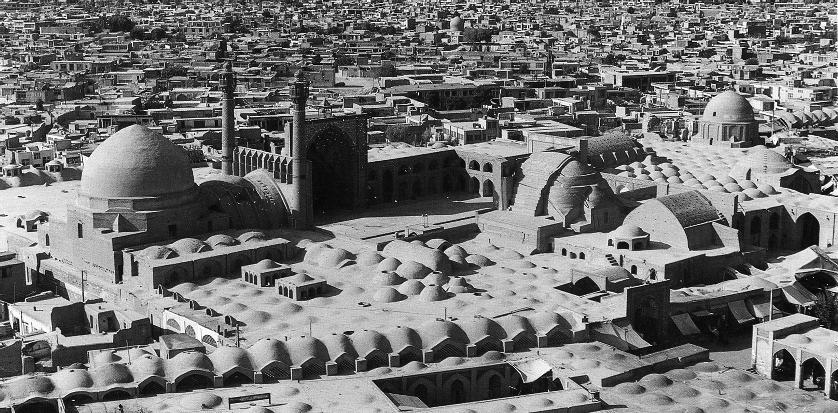
As a very general rule, the most unexpected thing about a traditional city in this region for you might be that a lot of the time, city buildings are interior-oriented, not exterior. Meaning that there's no such thing as a big grand facade you stand outside and gaze at - instead, you go through dark unassuming passages and winding streets that are sometimes roofed, and then suddenly you emerge into a beautiful courtyard, where the "facade" is really located. So instead of the European cathedral dominating the city with a cruciform plan and empty space around it, you have the mosque which is entirely implanted into the cityscape without clear borders. From overhead, instead of a clear plan, it looks kind of like chaos. Try and find the edges of the mosque - it's not so easy! It has shops all the way around its outside walls, and other buildings glom onto it, and so it can only really be experienced as impressive once you enter and see the iwans that open up from the interior. The amazing facades you can see from later periods are actually pictures taken from within the courtyard (sahn) - the public face of the building is its inside.
This principle certainly did extend to residential buildings, traditionally. Everything is oriented towards the courtyard. And - here I'd be cautious about an orientalist bias, because I'm relying on descriptions from a more recent time period, but my best guess is that it applies to the period you're interested in too - even within this general interior-focus, there's an even more interior space. In a well-off family's home, the biruni ("outside") is the courtyard and male space in which strangers can enter, and then the andaruni ("inside") is a deeper courtyard and female space, with water and a garden, where children live and women can go unveiled, and real life goes on. So you've got an interior to your interior.
In any case, because the documentary sources aren't so great, you probably want to look at some extant buildings if you can! The best resource I've found for looking at buildings in the Iranian world that are still around is ArchNet. I'm not going to lie, its interface is kind of garbage, but it's the most comprehensive collection of images of buildings by a long shot, so if you can find reference to a specific building you want to see, you can feel confident you'll see it there.