So a though I had recently is that has the modern more simplistic english alphabet always existed alongside cursive writing, or was the modern alphabet introduced relatively recently as more and more people became literate as a way to help let more people be able to read?
Second question: Are there any other languages or alphabets (either modern or ancient) that have a form of "cursive" writing as well?
I can't speak entirely to your second question, but I can definitely speak to the first.
We first have to abandon the phrase "modern English alphabet" because we have to go back to Rome to look at the origin of our alphabet (well we could go back to the Etruscans, Greeks, or Phonecians.) Also, it's more proper to refer to English block-letter and cursive writing as scripts rather than alphabets. A standard letter C, whether written in cursive or not, still produces the same sound. An alphabet is a collection of phonetic sounds, not just written styles.
Not too speak too broadly, but cursive has usually been the script of short-hand. While it might seem today that cursive is fancier, that was not always the case. We write in cursive because it's a lot easier to take notes, or write quickly that way. Especially when folks did not have the modern conveniences of keyboards, and might have to write a lot, it was difficult to write things down. Pretty much any script, hand, or way of writing will have a cursive form written down. Cursive just means that the letters are joined together.
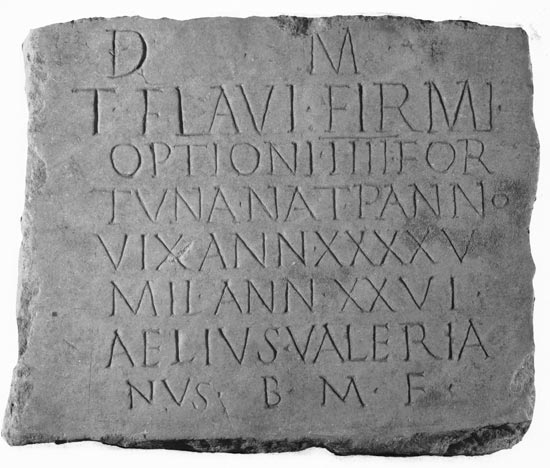
The modern English alphabet is based on the Latin alphabet. Indeed, Latin script, especially those found on public inscriptions, looked very similar to what we see most people use nowadays. If you think about it, the "Times New Roman" font reflects the old Latin script fairly well. Here's an image of a Latin inscription that is very legible and immediately recognizable. There was also a script of "rustic capitals" that was used for writing books on papyrus (example.)
The Romans also used cursive, although it is illegible to any untrained eye. There are two primary versions of Roman cursive that are talked about: old, which is sometimes called majiscule, and new, sometimes called minuscule. Cursive was more common for note-taking, children, business transactions, etc.
The Latin alphabet and English alphabet are fairly similar, but there are a few differences. They had no u, j, or w. This was a development in later Romance languages. Despite the appearance in Roman cursive, there were no lowercase letters in the Latin script until the 9th century AD (that's when we see the development of block lettering used by scribes in monasteries)
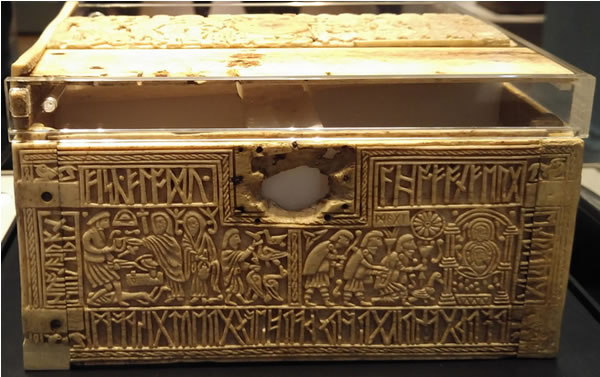
While of course the term English alphabet is entirely accurate to describe our system, older (i.e. before ) forms of English used an entirely different alphabet, based on old Germanic script. This was a runic-alphabet, similar to what we find in Nordic and Germanic languages. Indeed, the word "letter" refers to the letters in Latin scripts, while rune is the correct term for the Anglo-Saxon alphabet. That alphabet was still phonetic, in that each rune represented a sound. Over time, it was replaced by Latin script, especially as the English had more contact with other European Christians.
As Anglo-Saxon evolved, so did its alphabet. A few letters, such as the thorn, remained in the English language for a time. Later writers, however, would just copy Latin script letters for sounds that could be produced in Anglo-Saxon. Here is an example of a recreated Anglo-Saxon alphabet in a 1714 imprint, where most letters, save a few, are recognizable. We might recognize it in the forms of "Ye Olde Flower Shop." But the thorn (þ) actually represents the "th" sound. It was because of printing, in which type-set for runic characters were never made, that it got replaced in printing by a y. In 16th and 17th century English language texts, we might see the represented as "ye" or that represented as "yt."
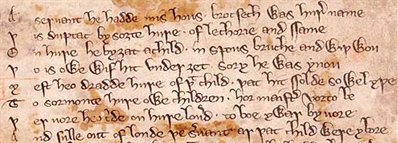
I'm not sure if runic scripts had cursive. But with the need of writing quickly, there was of course cursive in English. Now, when Latin script began to replace Anglo-Saxon script for English, it was based on continental book-hand (here's the Domesday book.) If you look carefully at that, and at other books (especially bibles) in Europe, you'll notice that the letters themselves are separate. While the script is different from our own, it is not cursive.
The examples above is typical for what we might see in a bible. Around 1400 in England, we see the emergence of new and distinct hands. There was some cursive before that, and its purpose was similar to the Roman: quick letters, business, etc (example)
As to your second question, you might be interested in these previous answers on some cursive writing systems:
How much did hieroglyphics change over time? by u/Bentresh gets into hieratic in the second half
Roman cursive? with u/Astrogator and u/XenophonTheAthenian