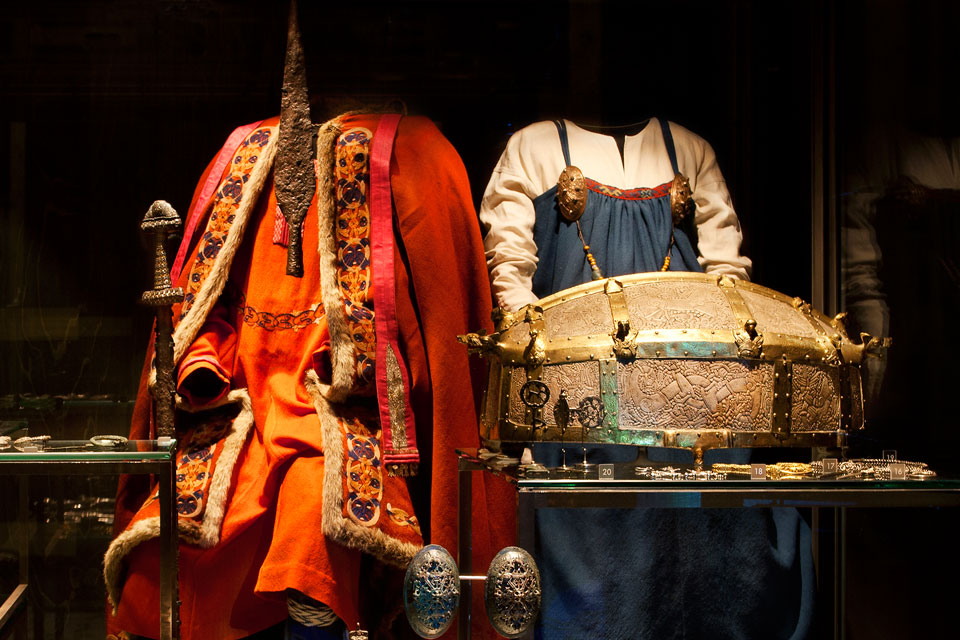
Ibn Fadlan describes the Rus in his travel chronicler. He called them the “Rusiyyah,” now commonly known as the Vikings.
“I have never seen bodies as nearly perfect as theirs,” he wrote. As tall as palm trees, fair and reddish, they wear neither tunics nor kaftans. Every man wears a cloak with which he covers half of his body, so that one arm is uncovered. They carry axes, swords, dagers and balways have them to hand. They use Frankish swords with broad, ridged blades.”
At one point he mentioned that all the men were tattooed from the tips of their fingers to their necks. The tattoos were dark green figures of trees and symbols. It is likely, however, that the tattoos were probably dark blue, a color that comes from using wood ash to dye the skin.
https://www.historyonthenet.com/viking-tattoos-historical-or-not
Many articles allude to a process of dyeingn the skin with wood ash but I have not found any text explaining the process. Some experimentation on my end has turned up unfruitful. Does anyone know to process?
Nothing says you're not on a serious Viking Age history site like featuring the "Vegvísir" (as it does at the top). A symbol that first appears in the 19th century Huld Manuscript, a full 900 years after the end of the Viking Age and not as it implies at the end, the 17th century Galdrabok from Iceland. The latter does have similar symbols though, and they all likely originate from symbols called 'pentacles' in a tradition of grimoires (magic books) called they Key of Solmon, that seems to have originated on the continent around the 15th century (e.g. here are some in BL Harley MS 5596) and were widespread around Europe before coming to Iceland. In other words: Neither a specifically Scandinavian thing, nor associated in the slightest with the Viking Age. Combining it with Old Futhark runes that occurred a full millenium earlier just underlines the point further: We're now in the realm of the romanticized Vikings of fiction and extremely speculative history off 3rd hand sources.
To its credit though, the page does seem to try to link to this paper by James E. Montgomery, which is a reputable source. To their discredit, it doesn't seem they read it. The part you've quoted, ends the quote of Ibn Fadlan and says "at one point he mentioned.." even though what he mentioned is literally the next sentence. The natural thing to do if you'd read it would be to just continue the quote, wouldn't it? If they did read it, it wasn't Montgomery's version which reads:
Every one of them carries an axe, a sword and a dagger and is never without all of that which we have mentioned. Their swords are of the Frankish variety, with broad, ridged blades. Each man, from the tip of his toes to his neck, is covered in dark-green lines, pictures and such like.
Note that 'lines and pictures' have become 'trees and symbols'. Clearly they're conflating different translations here. And there are a number with quite different interpretations. Some of the earlier due to Frähn, took the whole passage as referring to decoration on the swords.
So let's unpack this: In no translation is it clear that Ibn Fadlan is even talking about decorations on people's skin. How do you know it doesn't refer to clothing? The next sentence certainly does. ("Each woman has, on her breast, a small disc..") At best the statement is ambiguous. As even that source points out as well, Ibn Fadlan wore his religious biases on his shoulder, as well. (although even there the author seems to invent facts - washing in a communal bowl is an "ancient Germanic custom".. based off what?) the text may also have been altered over time, Ibn Fadlan himself may have misremembered, etc. He, and other Arab writers also conflated the Rus' with Varangians.
In short: If the written account is correct, it's not clear it refers to skin at all. It could refer to embroidered cloth for intsance, which is known to have existed in Viking Age Scandinavia (see e.g. the reconstructed Mammen clothing)
Even if it is the skin that is decorated, there is no evidence to suggest the skin was tattooed or dyed. Tattoos aren't known to have existed anywhere in Europe in that period. No tattooing tools have been found in Scandinavia in tha period. The closest you'll get is over a thousand years earlier in the Bronze Age, when there are some finds of possible tattoo-needles. It is also the Bronze Age they're reaching for with extremely speculative idea that the Norsemen got it from the Pazyryks who lived a millennium prior in a different part of the continent.
There is no unambiguous reference to tattooing in any other contemporary accounts of the Scandinavians (and this would be the main ambiguous one). Nor are there any in the sagas and other later written sources about the Viking Age. There's no reference to it in the Middle Ages either, why? When did it disappear? If Christians banned it, it's conspicuously absent from early medieval laws of Scandinavia like Gulatingsloven. It's also absent from descriptions of the conversion (e.g. Íslendingabók) which mention practices that were to be abandoned. It's not entirely obvious why it'd be banned either. (Leviticus 19:28 would be a possibility but far from a certainty, given that people didn't follow 19:27 about hair/beards)
In short we have no evidence of any such practices or much reason to think it would've existed. For a normal history topic, that'd be the end of it. But this is about Vikings. People like the Vikings - you get more Viking questions on this subreddit than about the rest of Scandinavia and the rest of history combined. But they're more interested in Vikings as in HBO's Vikings, as in the Vikings of popular fiction. Less so about actual Scandinavia in the period 800-1050. And so they go out to find ways to create the Vikings of their imagination, even though it might mean - as in this case - literally combining things 19th century Icelandic manuscripts with Bronze Age finds from the Altais. You could just as well claim they may have had Space Shuttles. Yet such websites abound. I'm continually amazed by how many 'Viking facts' there are out there and how widespread they are online despite having zero basis in fact. They take the most speculative theories, promote them to fact and add their own layer of speculation, and then so does the next person, it seems.
So to answer your specific question: no. Since there's no source depicting them as tattooing or dying their skin in the first place, there's no account of how they did it.