I should point out, I'm mostly interested in Mesoamerican and South American cultures such as Aztecs, Mayas, Incas and etc. but I welcome knowledge if someone knows about other cultures from other parts of the world that used them
Charles Horetzky was a surveyor who explored the interior in search of an acceptable railroad route through British Columbia in the 1870's. During his explorations in 1872 he took a picture of the Hagwilget Bridge crossing the Bulkley River. This bridge was built and maintained by the local Carrier Indians. In 1898 the Canadian government began work on a telegraph line linking Vancouver, British Columbia and Dawson City in the Yukon Territories. In 1901 this line was abandoned, and shortly thereafter the local Indians raided the telegraph lines and used the cables to upgrade their bridge. Here are three pictures of this structure from the British Columbia Archives. First Picture, Second Picture, Third Picture.
These were considered to be the more advanced and safest of the crossing built by the Indians of the day. Fur traders and gold miners traveling the Fraser Canyon often wrote of river crossings made out of crude ropes made from cedar bark or roots of spruce trees anchored to roots or rocks high above raging rivers. These consisted of nothing more than a heavy rope to walk on and a smaller rope above to help them keep their balance. Unfortunately there are few if any photos of these bridges.
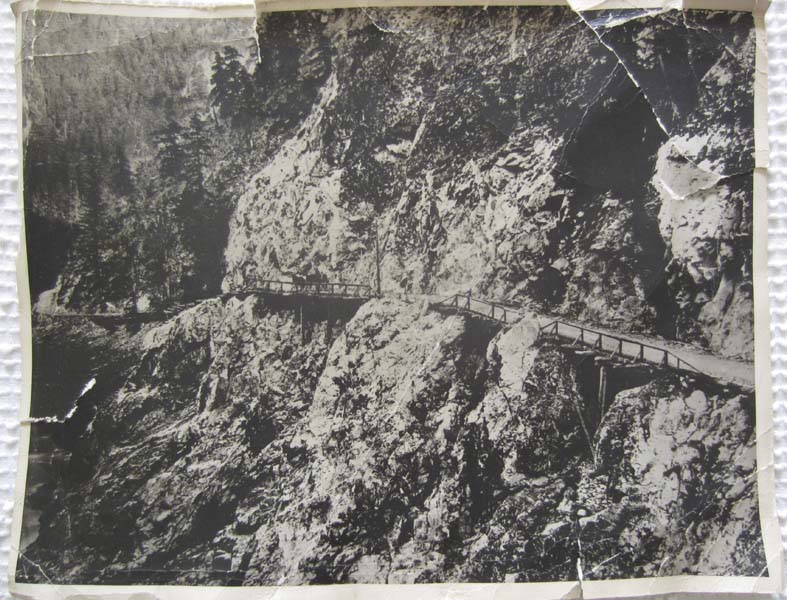
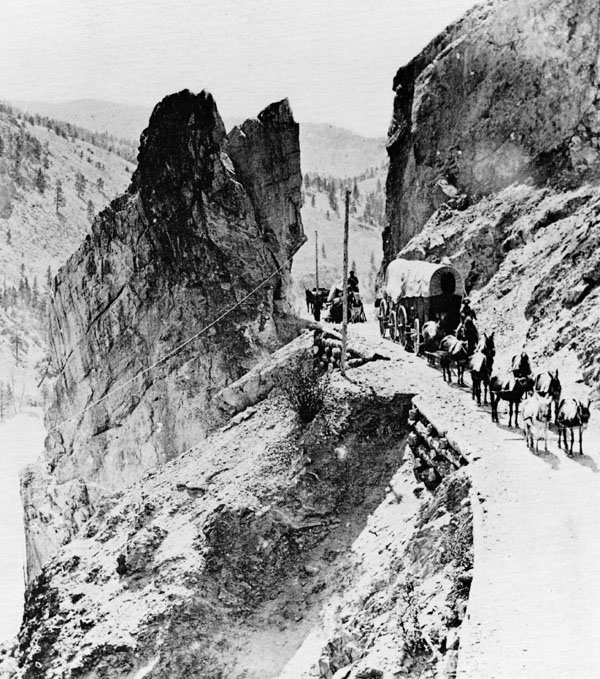
In 1807 Simon Fraser and a crew of voyageurs descended the river which now bears his name to its mouth at the Pacific. They were forced to abandon their birch bark canoes when they reached the Fraser Canyon and proceed by foot and canoes borrowed from local Indians along the river. On June 20^th, 1807 Fraser wrote in his journal: "I have been for a long period among the Rocky Mountains, but have never seen any thing equal to this country, for I cannot find words to describe our situation at times. We had to pass where no human being should venture. Yet in those places there is a regular footpath impressed, or rather indented, by frequent travelling upon the very rocks. And besides this steps which are formed like a ladder, or the shrouds of a ship, by poles hanging to one another and crossed at certain distances with twigs and wishes [tree boughs], suspended from the top to the foot of precipices, and fastened at both ends to stones and trees, furnished a safe and convenient passage to the Natives - but we, who had not the advantage of their experience, were often in imminent danger, when obliged to follow their example." Fraser later writes in his journal that in places he and his men were reduced to crawling on their knees as the carried packs on their backs (frequently weighing up to 90 pounds) as their Indian guide nonchalantly scampered ahead. Here are a few pictures of the wagon road that was cut along the Fraser Canyon during British Columbia's gold rush years. Note the timber cribbing used to support the road in places. Much of this cribbing was still in place and used during the 1940's. Picture One, Picture Two, Picture Three, Picture Four