If it has to with visibility why wouldn't that matter for the sea and ground forces as well?
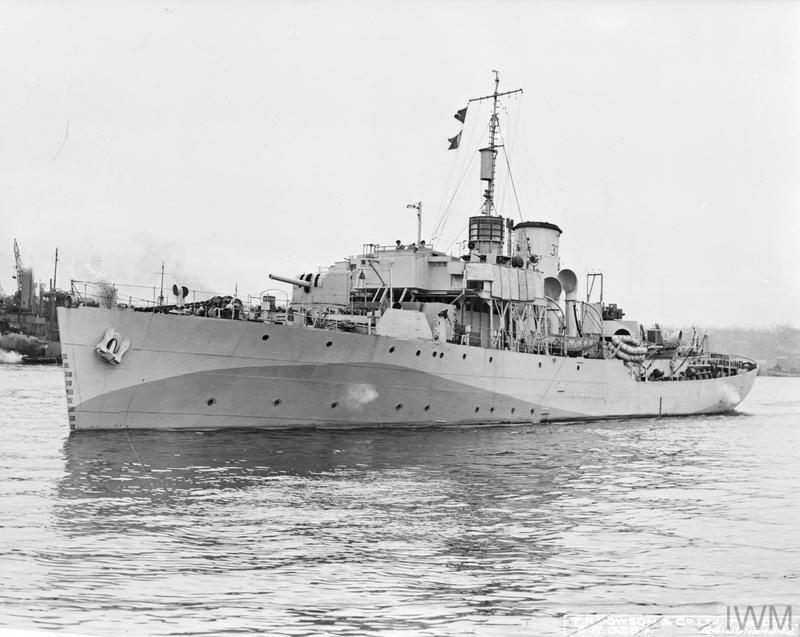
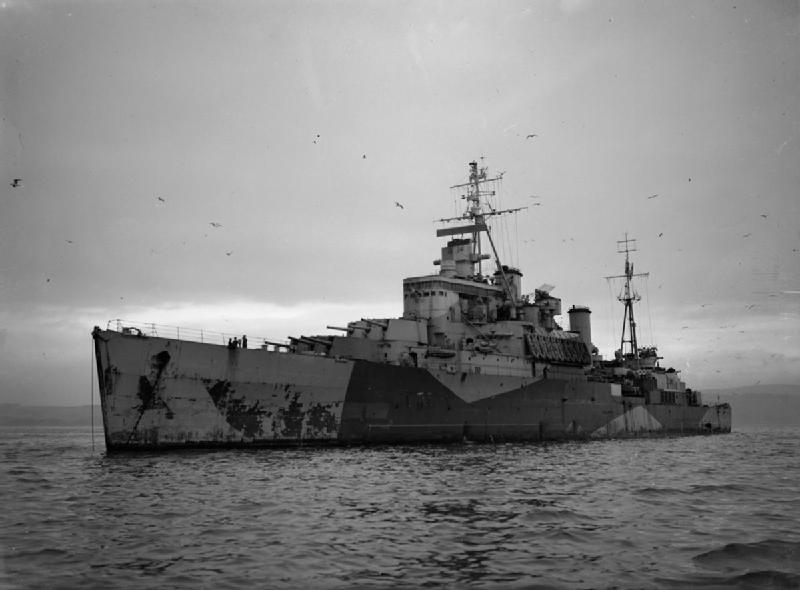
Warships tended to have a broad variety of paint schemes, matching the diversity of aircraft. While many were painted in simple, utilitarian schemes, others would receive complex, disruptive patterns in a wide variety of colours.
During peacetime, Royal Navy vessels were painted in simple schemes. Ships in British waters would be painted in a dark grey/blue colour, designated 507B (at the start of the war, this would be replaced with the less reflective 507A, which was otherwise the same shade). On most foreign stations, they would be painted a lighter grey, 507C. Ships on tropical stations would be painted white. These gave a smart appearance, were simple to maintain, and reflected or absorbed heat from the sun as needed. Once war began, most ships would remain in these colours, at least initially. At this point, camouflage was not centralised by the Admiralty; instead, it left paint schemes down to individual captains. Some camouflage schemes were promulgated by the Admiralty, but take-up was limited.
The first RN vessel to receive camouflage paint was the destroyer Grenville, painted in a disruptive scheme at Harwich in December 1939; the rest of her flotilla soon followed. Unfortunately, we don't have an accurate idea of the colours used on her, but it's likely that she was painted in a grey scheme using the paint available. As the flotilla was engaged in escorting coastal convoys, she might also have received some khaki or green paint. In April 1940, a brown and green scheme was proposed for the ships of Home Fleet. Intended to conceal the ships when at anchor in Scapa Flow, it proved to be useless at sea during the Norwegian campaign. Other ships participating in the campaign used more effective schemes; Devonshire's scheme, using lozenges of 507A on a 507C background was particularly notable. Most ships would return to their 507B colouring over the summer but interest in camouflage remained. Over time, four main unofficial schemes developed. The first, worn by a number of destroyers, was a return to the 'dazzle' schemes of WWI, with bold patterns of black, grey and white paint. The captain of HMS Repulse designed a two-tone 'contrast' scheme, using large square patches of 507A and 507C. It can be seen here on Repulse, and here, on Warspite (in the foreground), in slightly modified form. In Autumn 1940, Louis Mountbatten observed that a liner his destroyer flotilla was escorting seemed well camouflaged at dawn and dusk, a fact he attributed to the pink paint she retained from her peacetime livery. Mountbatten adopted the colour for his flotilla, and it soon saw more widespread use. Many ships used a two-tone version of the 'Mountbatten Pink' camouflage, with a lighter and darker shade - Kenya is a good example. The colour was made by mixing the red paint used for the hull with 507B, producing a greyish pink. It was dropped on larger vessels from 1942, but was very popular for smaller vessels. The last amateur scheme was the most famous, and successful of the bunch. It was developed by Peter Scott (son of Robert Falcon Scott of Antarctic fame, and later founder of the World Wildlife Fund), a naturalist serving aboard HMS Broke while she was escorting convoys in the North Atlantic. Scott used his experience spotting wildlife to devise a more effective camouflage scheme. Rather than using darker colours like grey, Scott suggested the use of light colours, mainly white, light grey, light blue and light green. These would fade into the overcast conditions typical in the North Atlantic. Broke was soon painted to Scott's ideas, despite much scoffing by onlookers. There are claims that these onlookers were proved wrong when Broke was involved in an accidental collision with another destroyer, whose captain claimed that Broke's paint scheme was so effective that he hadn't seen her until it was too late, but I can't corroborate this. Either way, Scott's scheme found popularity amongst crews in the Western Approaches. In the Mediterranean, meanwhile, things were less organised. Officers here took a more enthusiastic approach to camouflage, and to scrounging paint. There were few uniform schemes, with a broad variety in terms of complexity and colouring. Most tended to be simple schemes, as might be expected from those produced by amateurs, but there were a few masterpieces of complexity. Black paint on a pale grey (typically the light MS4 shade) in a variety of patterns was a common colour scheme, referred to as the 'Alexandria' type. Few ships carried the same scheme, and ships often had different designs on their port and starboard sides.
Faced with this burgeoning profusion of schemes, the Admiralty formed a camouflage section in October 1940. A number of artists, led by Claude Muncaster, were recruited. They were handed a rather vague directive to produce effective camouflage, and left to get on with it. Working with small-scale models, they produced a new set of paints to complement 507A, B and C. These included several shades of grey (MS1 - 4), two shades of blue (B4 and B5) and a green (MS4A). Using these, they then produced individualised colour schemes for a number of capital ships. Queen Elizabeth was the first to receive this scheme in January 1941. By the end of the year, they were common on capital ships, carriers and cruisers. However, it was found that these schemes, which used multiple small areas of different shades, tended to blend into a single homogeneous mass, as can be seen in the linked image of Queen Elizabeth. New patterns were produced moving into 1942, which were more effective. Meanwhile, Scott's camouflage scheme was adopted and formalised as the 'Western Approaches' scheme, used on destroyers and smaller engaged on ASW duties. The Western Approaches scheme used three colours, white, light green, and a pale blue, with the upperworks and upper part of the hull in white and green and blue areas breaking up the waterline. Examples of the Western Approaches scheme would include this image of Trillium, or this colourised image of Regina.
In 1942, the Camouflage Section began to fully enforce their new schemes. With the experience gained during 1941, they produced a detailed set of instructions on camouflage. Designs were produced for every class of ship in the fleet. The designs prevailing in 1942 were more simple than those suggested in 1941, with large areas of individual shades, fewer colours used, and simpler shapes. Furthermore, they were split into two main types: 'light disruptive' for use in areas where the prevailing weather was cloudy, and 'dark disruptive' for sunnier areas. Clear examples of the 'dark disruptive' type can be seen in this image, while Trinidad can be seen in the 'light disruptive' type here. These designs were widely adopted. By the middle of 1942, most ships would be in either Admiralty disruptive style, or in a Western Approaches design. However, the pressures of the war began to affect paint production. Shortages of pigment, especially in green, led to further simplifications. Many Western Approaches designs of 1942 dropped the green areas, using just blue and white, as seen in this image of Bluebell. A few ships were even just painted pure white, though only during the winter months. For 1943, the Admiralty introduced a new set of paints, which used less green. Instead, four grey paints, G5, G10, G20 and G45 and three blue paints, B15, B30 and B55 were used. The colour schemes also saw a similar simplification. Most used just three colours, with blue seeing much less use on large ships. Greater use was made of contrast, with the aim being to break up the outline of the ship rather than to conceal it, as can be seen on Newfoundland here. A modern interpretation of this scheme is seen on HMS Belfast, now preserved as a museum ship. As 1943 moved into 1944, there were a number of disagreements about the value of camouflage given the increasing presence of radar. Radar could detect ships regardless of camouflage, and could, with IFF systems, tell friend from foe, instantly obsoleting camouflage paint; against this, though, were the facts that radar could not be used effectively in all weathers, and often had to be switched off to avoid the enemy detecting its emissions. While the Admiralty generally swung towards the side favouring radar, it still recognised the value of camouflage. A simple camouflage scheme, applied universally to all ships, was produced. This consisted simply of a darker grey bar along the waterline, with the upperworks and ends of the hull in a lighter grey, and can be seen on Anson here. This was the last Admiralty camouflage scheme of the war. Following the war, the RN reverted to its simple greys.