I have seen a post in the about Japanese historic combat. The answers always mentioned some sort of archery being prevalent (before the late Sengoku period when muskets were used instead). So it seems reasonable to me that armies would counter archers with shields, seeing as they picked up spears against cavalry.
Did they just not have good enough materials to make a shield that could block arrows effectively or was it another reason?
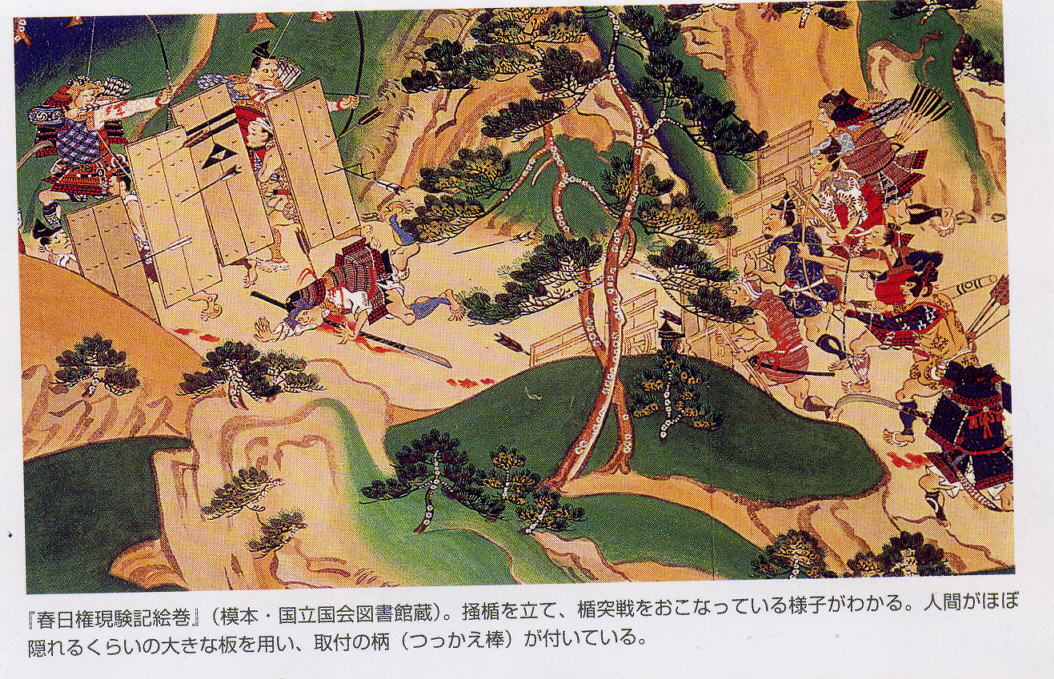
As a matter of fact, the medieval Japanese did heavily utilize large pavise-like shields. These were commonly called 掻楯(Kai-date) and were integral part of warfare since the Heian period all the way up to the Sengoku period. There are numerous mentions of them both in literary and iconographic sources. They were valuable not only in sieges but in field battles as well, since they could be used to create a mobile shield wall, where archers could fire behind cover. Many battles started with archers firing at each other behind a Kaidate wall, and literary sources usually refer this type of skirmish as 楯突戦 (Tate-tsuki-ikusa) or "battle with thrust shields". Even in modern Japanese, the verb 楯突く(Tate-tsuku)refers to the act of defying and insubordination against your social superior.
Below is a depiction of a Tate-tsuki-ikusa with Kaidate from the Kasuga Gongen Genki E, a set of painted scrolls made in the early 14th century.You can clearly see the large shield made out of nailed woods, and how troops are shooting behind cover.
Handheld shields called 手盾(Tedate) did exist as well. However, their use seem to have been relatively limited. Hōnen shōnin eden, another painted scroll from the early 14th century, depicts a foot soldier carrying a hand-held shield.But this shield does not seem to be anything more than a wooden board with a grip. IIRC, unlike the Kaidate its mention in literary sources are very limited.
A "proper" Japanese armor, whether if its a O-Yoroi or Do-Maru, would always come with a large shoulder guard which could be used as a shield. Since most samurais wearing such armors would be using bows or polearms anyway, a hand-held shield wouldn't have been much use for them. The common foot soldiers may have used the Tedate more frequently than the source suggests, since their armor, if they had one at all, would have been relatively light. Yet they too would have been using bows or polearms as their primary weapon, so I don't think they were that wide spread.
Unfortunately, all sources are in Japanese, and I cannot cite any English sources. I hear Prof. Thomas Conlan deals extensively with medieval Japanese warfare, so perhaps you can check his works if you are more interested.
Sources (translation of the titles is done by me):
・近藤好和,『騎兵と歩兵の中世史』(吉川弘文館、2004); Yoshikazu Kondo, The Medieval History of Cavalry and Infantry, (Yoshikawa-Kobunkan, 2004)
・近藤好和,『弓矢と刀剣―中世合戦の実像』(吉川弘文館、1997); Yoshikazu Kondo , Bows and Swords: The Reality of Medieval Battles, (Yoshikawa-Kobunkan, 1997)
・高橋典幸 et al.,『日本軍事史』(吉川弘文館、2006); Noriyuki Takahashi, Military History of Japan, (Yoshikawa-Kobunkan, 2006)
Hey there,
Just to let you know, your question is fine, and we're letting it stand. However, you should be aware that questions framed as 'Why didn't X do Y' relatively often don't get an answer that meets our standards (in our experience as moderators). There are a few reasons for this. Firstly, it often can be difficult to prove the counterfactual: historians know much more about what happened than what might have happened. Secondly, 'why didn't X do Y' questions are sometimes phrased in an ahistorical way. It's worth remembering that people in the past couldn't see into the future, and they generally didn't have all the information we now have about their situations; things that look obvious now didn't necessarily look that way at the time.
If you end up not getting a response after a day or two, consider asking a new question focusing instead on why what happened did happen (rather than why what didn't happen didn't happen) - this kind of question is more likely to get a response in our experience. Hope this helps!