There was no major public debate and the parliamentary vote in 1969 on the nationalization was unanimous: Every party voted in favor. How could that be?
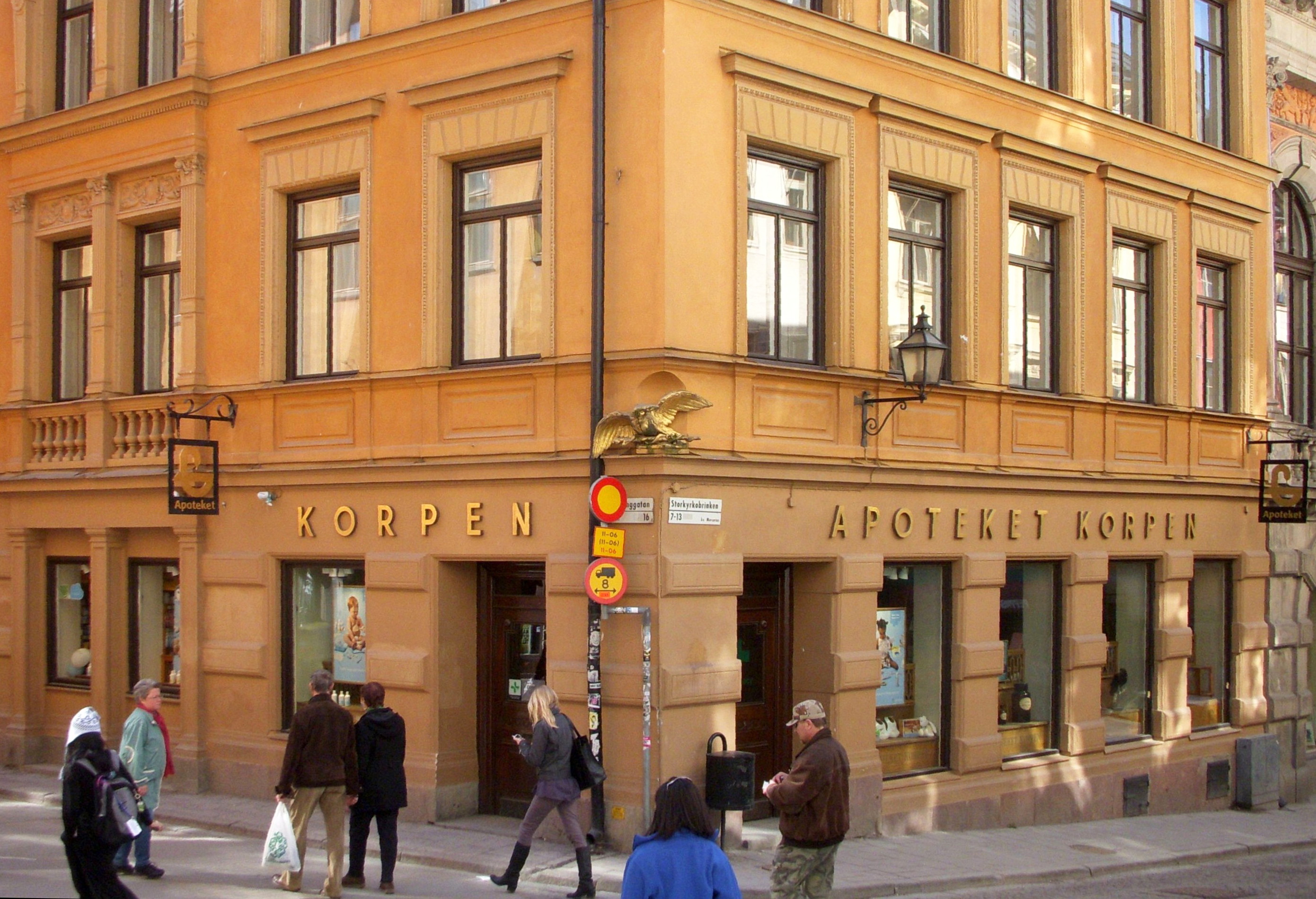
Well, just about every tourist in Stockholm walks past the pharmacy Korpen (the Raven) as it's on the main tourist drag. It was founded in 1674 and has been operating since. If they missed it, there's Ugglan (the Owl) farther up on Drottninggatan, in its present location since 1798.
Point is, the pharmacies have been old, and traditional. Although guilds (skråväsendet) had been abolished in 1864, that liberalization of trade didn't apply to the guild of pharmacists, Apotekarsocieteten. (today they translate their name as 'the Swedish Pharmaceutical Society' , literally it's the 'Apothecary Society'. In England they'd put 'Worshipful' in front and term it a livery company. I'll just call them 'the Society')
You had to be a member to be a pharmacist/apothecary. But merely being that did not give you the right to run a pharmacy. That was reserved for those with a royal Letter Patent. That patent was personal property; it could be inherited, or sold to the highest bidder. A poor apothecary who wanted his own pharmacy but who could not obtain a patent to start a new one, nor had any money to buy a patent, would have little choice but to find a widow of a pharmacist he could marry. That was changed by law in 1874 to a new system where patents could not be transferred but were instead awarded on the basis of the number of years of work experience. Some would have to wait nearly until retirement age before getting one.
To skip forward; by the 1960s this system is still in effect. Pharmacies are run by individual pharmacists who need government permission to do so. They are required to be members of the Society, to which they pay large fees. The Society in turn controls the 24 district laboratories that prepare medications that the pharmacies themselves could not do. The Society owned Vitrum (later Kabi, now Pfizer and others), a large pharmaceutical manufacturer that'd grown out of a common production of pharmaceutical glassware (hence the name 'vitrum' = glass). The Society held great sway over the financial situation of the pharmacies - they managed pensions, they set the retail drug prices. They bailed out and straightened out pharmacies that were failing economically. The society was run by the pharmacists, but were in some sense also franchisees of this co-op. But the Society, in turn, was heavily regulated by the government, who among other things set the fees the Society charged. So the fact that the pharmacies were privately owned doesn't mean there was any real freedom of trade here. In effect it was a highly-regulated, government sanctioned private co-op monopoly.
By the mid-20th century there was a broad consensus across the political spectrum that the existing system was antiquated, complicated and inefficient. For the Social Democratic party, in power from 1936-1975, socialization was the solution both to that, and would bring benefits of scale and reduced costs through greater bargaining clout. (drugs were considered expensive at that time (too)) The Pharmaceutical Inquiry of 1946 (completed in 1951) recommended socializing it, however the political opposition harshly criticized the inquiry as having been badly done and the recommendation of socialization having been a foregone conclusion.
Due to this, no action was taken at that time. But the question would become more pressing as the public health care system started subsidizing pharmaceutical costs in the 1950s, which lead to correspondingly greater government demands on the Society for greater oversight and influence on that money was being used.
The government commissioned Rune Lönngren, a pharmacist and Social Democratic party member to lead a one-man inquiry in 1963. Left-wing political winds got stronger through the 1960s. In the 1968 election, the Social Democrats were at their (hitherto) zenith of power, being the only election where they'd reached a lone majority with over 50% of the vote. (except the wartime election of 1940) There were broad demands for nationalization, the 1960s and early 70s would see the nationalization of large parts of the forestry, mining, steel and shipbuilding industries. Other demands frequently made were for the nationalization of investment banks, the pharmacies, and indeed the entire pharmaceutical industry. The latter mainly on the moral argument against profiting off the infirm, an argument applied to the pharmacies as well.
The 1968 party congress saw three motions to demand socialization of the pharmacies. The leadership succeeded in convincing the party to wait for the results of Lönngren's and other inquiries. The pressure was on and in the spring of 1969 Lönngren's working group and the government entered into negotiations with the Society. The political situation was such that the latter really had very little leverage; the Social Democratic party could have passed nationalization without them and obsoleted the entire organization. But they'd rather have the pharmacists with them than not. Leif H Eklund, the head of the Society at the time later put it this way:
"Naturally it was with a knife at our throats. But once we'd appreciated the situation we were in, it was wise to make the best possible of the situation. And I think we did." (interview in Läkemedelsvärlden )
The agreement was reached by September 1969. All pharmacies would be transferred to the government's new corporation Apoteksbolaget AB on January 1, 1971. This was to be partially owned by the Society. While the Society had demanded a 50-50 ownership stake, a state majority stake was a non-negotiable demand from the government, and what was eventually agreed was a 1/3rd stake. The government would buy Vitrum, the district labs and some other assets from the Society, which in turn would transfer the money to a foundation it controlled which would be allowed to buy a 1/3rd stake in Apoteksbolaget AB. But the government held an option to buy that third after 15 years. In all, the Apothecary Society would be reduced to its functions of promoting research, information and education in the pharmaceutical realm. The Society's governing body voted through the deal 33-4.
There was great resistance among the pharmacists themselves. But as said, the majority of the population considered reform long overdue by that point in time. The political opposition would've of course rather reformed things in a different manner. But they were not going to overrule a deal made by a private organization. Since negotiations had been held in secret there'd been no public debate over them and both the public and opposition were essentially faced with fait accompli.
The reform did succeed in creating much more efficient organization (within a decade a tripling of productivity by one estimate), to the extent that a hiring freeze was in place until well into the 1980s.
It is likely the least controversial of nationalizations of the period. Not least in comparison to the extended and unsuccessful attempts at saving the Swedish shipbuilding industry in the decade and a half of the "Shipyard crisis" crisis (Varvskrisen) from 1969-1985.