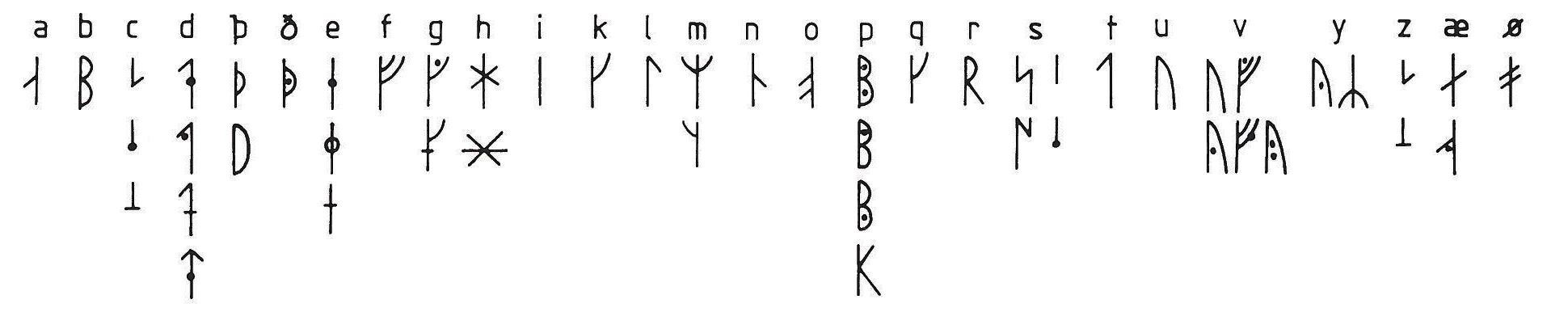
From what I know the language is based on either Old Italic script or an Etruscan script. There is this Etruscan Helmet (Negau Helmet B) from 160 BC which had the Germanic named Harigast carved in it, which could indicate it was this alphabet the runes were based on. Germanic mercenaries bringing the old italic script to their homelands is also a very likely.
Anyways, what was the origin of the runic alphabet and what caused it to spread? Do we know how long it took before it was spread across the lands of the Germanic tribes?
Bonus questions:
Were the old Italic script and Etruscan script still in use by the time the Romans first encountered the Germanic peoples? Or am I wrong to assume that it was via the Romans or Etruscans that they got this script? Did the Gauls play any role in this? The helmet I mentioned earlier was found with other helmets which had Celtic inscriptions in it, with the same alphabet however.
Do we have any indication of the amount of Germanic peoples that were literate in this runic alphabet? If not, what would be a reasonable guesstimation?
If the Old Italic and Etruscan script were the inspiration, wouldn't this mean that the Germanic tribes had writing roughly a century before Tacitus wrote Germania? Weren't the Germanic tribes described as being illiterate in this book? Was it the case of the Romans not knowing that they had a script, simply not caring, or just old fashioned Roman propaganda?
I understand that some of these questions might be impossible to answer because the Germanic people really hated writing things down despite having a script. Thanks in advance!
Here is an article with photos of the helmets I mentioned: https://balkancelts.wordpress.com/2014/03/14/the-negau-inscriptions/amp/
We don't really know where it came from, exactly when or by who. Many alphabets have been suggested as the main inspiration. That includes Old Italic and Etruscan scripts, but also various Greek scripts and not least Latin. (there are even more far fetched suggestions, such as Punic, that aren't taken very seriously though) There is no consensus among runologists on this. Or even how to approach it, whether one should primarily consider the sound-correspondences or ( as professor Henrik Williams has argued) take shapes into primary consideration. The 'o' rune ᛟ is a decent match for Greek omega Ω in both sound and form, while the 'r' rune ᚱ is an equally good match for Latin, and the 't' rune ᛏ could be any of the above.
It's important to have a 'null hypothesis' here too; coincidences are inevitable. if you have a writing system that's written horizontally, it's advantageous to have characters that are taller than they are wide, in order to fit more on a row. It's advantageous if you're cutting them into wood for all lines to be straight and of equal thickness, and to avoid horizontal lines that would disappear in the wood grain. (and runic characters are entirely or almost entirely without them) For the sake of writing speed it's beneficial to have as few strokes as possible. 1-5 perhaps. For the sake of legibility you want to avoid having ambiguous angles, so you restrict yourself to 90 and 45-degree angles between lines. If you go and invent 25 or so characters along those design criteria, odds are some of them will be identical to runes.
(Williams goes further in his argumentation, arguing that by merely adding a few more criteria, such as no line extending above the main stave, one can derive it all from Latin script)
Most would agree, though, that Runic letters are not a direct borrowing of any alphabet, because it doesn't preserve the letter order that's otherwise a highly conserved feature (from alpha-beta-gamma in Greek to aleph-beth-gimel in Hebrew). To runologists the futhark (or futhorc) is not termed an alphabet and the term "runic alphabet" refers to medieval rune use where they began to be placed in alphabetical order, under influence from Latin.
It's not so strange that it arrived when it did though, the first century BCE saw the beginning of the "Roman Iron Age" in Northern Europe (ending around 300). So named because the Germanic people start having a lot of contact and trade with the Roman world, such as serving in the Roman armies, and this leads to social and material changes that are quite evident in the Archaeological record. As you have an influx of Roman artifacts, from statues, glass and objets d'art, to coins, to farming implements, to breadmaking (Which reach Scandinavia in the second century AD). Roman influenced continued past the nominal 300 CE end of the Roman Iron Age though, with for instance the introduction of week-day names calqued from the Roman ones. (given 'sunday', it likely postdates the 274 introduction of the Sol Invictus cult) Anders Andrén has speculated that the introduction of temple worship in Scandinavia may have been influenced by Mithraism.
The first runes we have start showing up in the second century, mainly in Denmark and southern Sweden. (the German research site RunesDB has a nice map of finds which you can filter by period; note though that some undated finds count as zero, so you might want to exclude that year) The southernmost early find is the Frienstedt comb from mid-Germany in the 4th century. So scant evidence suggests it might've spread south from Scandinavia and the Baltic coast of Germany.
The oldest monumental stone inscriptions are from Norway (e..g the Tune stone, from 200-400), a century two later in Sweden (E.g. the Möjbro stone, 400-550), Gotland (Martebo Kyrka stone, 360-590) but do not show up in Denmark until the 7th century (Sölvesborg stone, DR356).
We have no real way of knowing how literate society was, although it was certainly never a majority. On the other hand, making monumental inscriptions is pointless unless you're reasonably sure someone will be around to read them. (if I'm permitted a wild guess, I think we're talking something like 1%-10% of the population)
Since we have runic inscriptions that were made within a century after Tacitus it's not unreasonable to believe they existed already in the first century (and some do believe that). They would need another century or two to overlap in time with use of the Etruscan and Old Italic scripts, but it its not outside the realm of the possible.
I don't recall Tacitus referring to Germanic people as being illiterate and can't quickly find such a passage. I do know on the other hand there's a well-known passage mentioning divination with sticks that had symbols on them, which New-Agey types have interpreted as meaning Elder Futhark runes. (indeed they interpret all talk of magical runes as meaning Futhark letter-runes, even though the term 'rune' in its Old Norse sense could mean any old symbol, or letter in any alphabet) In any case, Tacitus had not visited Germania so regardless of what it says his account cannot be taken uncritically as true. There are varying standards of literacy too; if Germanic peoples of Tacitus' day were neither writing on paper/papyrus/parchment nor making monumental inscriptions, then perhaps they were relatively illiterate compared to the Romans.
Which is another thing, it's not that they 'hated writing things down', they simply did not have the medium for doing so. Parchment, paper and ink-making were all things that were introduced with Christianity and also the Latin alphabet, and thus became associated with the latter once introduced. So there are only two (14th century) manuscripts of any length written in runes (one Danish, one Swedish) As no calligraphic version of runes were ever developed, they're both a bit clumsy looking and would've been even more time-consuming to write compared to blackletter Latin scripts. So runes were restricted to writing on objects like rock, bone and wood, out of which wood doesn't preserve well, and neither of which were used for long texts that were copied like manuscripts were.
Since monasticism and ink writing were not introduced in Scandinavia until the 12h century, the earliest manuscripts with any runes on them at al are from England and Germany.