I just finished Hale's outstanding Lords of the Sea, and one thing in particular has bugged me to no end: how were hoplites marines outfitted?
It's a significant logical leap (and one I can't get over) to assume that hoplites, traditionally land-borne fighters in a dense phalanx, would accept the same heavy panoply aboard a ship, where combat has the potential to be vastly different. It is easy to envision a hoplite marine jumping from one ship to another, periodically throwing javelins, disembarking into sandy, wet shores to combat the enemy, and then potentially boarding triremes again to depart and recover wounded or prisoners, all during the course of a single battle.
In my amateur enthusiast opinion, the typical panoply - aside from the open-face/Corinthian helm (for which there may be little substitute) - seems absolutely dreadful. Were I a marine, I would know that a heavy breastplate could mean death if I fell into the water, likewise with the heavy aspis with regards to rapid, flexible movement atop a ship or while boarding another. I might prefer a linothorax and a much lighter shield.
It seems to me there is not a lot of scholarship regarding this aspect of marine warfare in classical Greece, and if there is, I have not found it. Even Hale, whose research is outstanding, seems to fall short in this regard, and it's as if the body of research available simply assumes hoplite panoply was the same on land and at sea.
So what are the latest opinions on this? Lightweight marines, or fully armored like normal?
First, while I haven't read it myself, I've been told by at least one expert on Ancient Aegean history that Hale's book is actually... not great, to put it far more diplomatically than she did. Hale is by no means an expert on Greek warfare, or even Greek history, and his understanding of naval matters seems to lean largely on his own experience as a varsity rower at Yale. I would be very careful using his book as a point of reference.
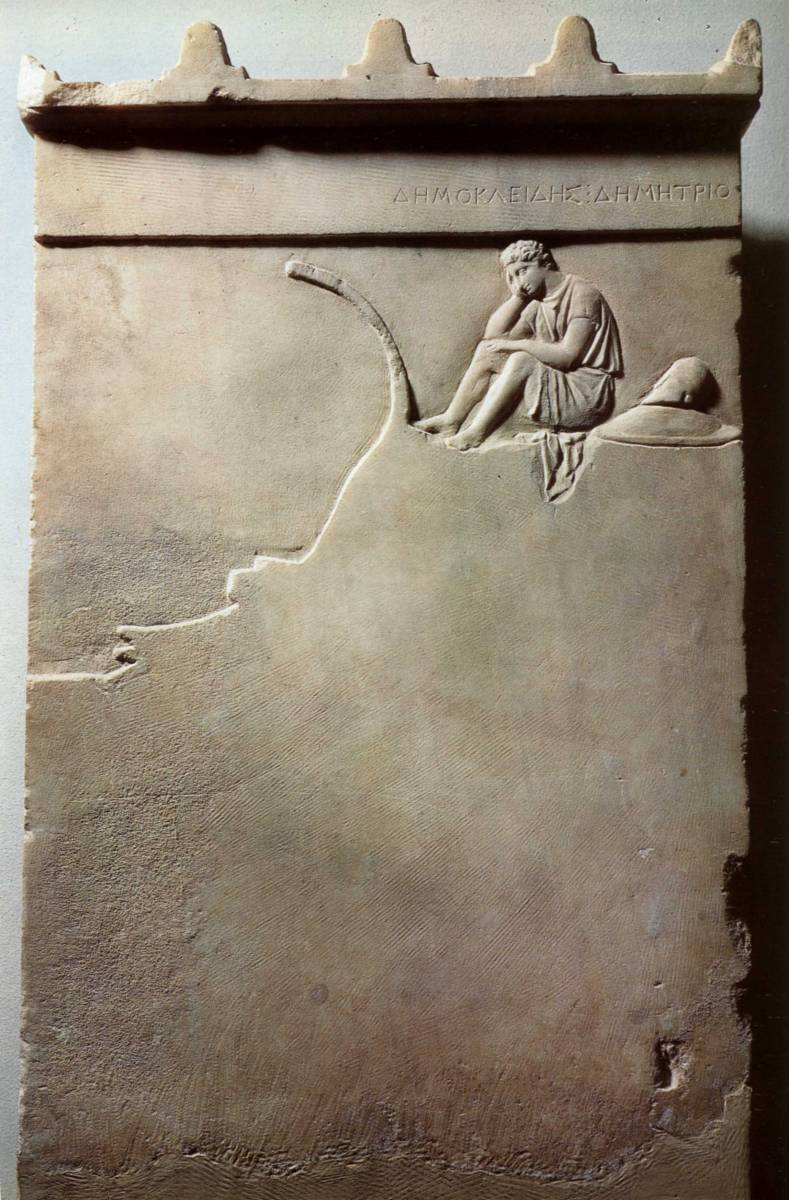
Now, we don't really know all that much about the Athenian deck-fighters (epibatai). That's why there isn't much scholarship dedicated to them. We'd love to have an instruction manual for their fighting style, or even just some depictions of these warriors in action, but sadly there's nothing like that. We rely on a few snippets of literary evidence along with sculpture like the grave stele of Demokleides son of Demetrios showing the dead man sitting next to a pile of hoplite gear on the prow of a trireme.
Still, if this relief can be taken as a reasonable reflection of epibates equipment, we can learn a lot from it. The large bowl-shaped aspis shield and the Corinthian helmet are easily identified. If Demokleides was indeed an epibates and not just a hoplite who liked boats, we can conclude that these deck-fighters still used these heavy items of bronze armour. On the other hand, there's no evidence of any other armour; the sitting figure is not wearing a cuirass or greaves. This might mean that epibatai restricted themselves to just the basic elements of the hoplite panoply, which could be easily discarded if needed.
It would be easy to explain the basic armour by citing Thucydides, who says that the epibatai drafted for the Sicilian Expedition came from the thetic class, the poorest citizens of Athens. These were men who likely couldn't afford more than the most basic elements of the panoply. They would have been hoplites in the most elementary sense: infantry carrying an aspis and a spear for close combat. Everything else was optional.
But this would be too simple. Judging by his funeral stele, Demokleides wasn't a poor man. It's likely that he could have afforded more armour. Indeed, the Corinthian helmet is a pretty elaborate and old-fashioned piece, and most depictions of hoplites from this period show lighter, open-faced helmets being used. So our epibates is actually not representative of either deck-fighters or regular hoplites; his lack of body armour might just be an artistic choice, not a depiction of his actual combat gear.
And there's other complications too. There's a controversial theory that the hoplites of the Classical period had stopped wearing the full traditional panoply, preferring mobility over protection and seeking safety in massed formations. Many images of hoplites from the 5th and 4th centuries BC show them with nothing but a shield, spear, and simple conical pilos helmet. They wear no greaves or body armour. The Corinthian helmet practically disappears from the archaeological record. In other words, we're probably wrong to assume that hoplites on land would still burden themselves with 14-22kg of bronze at the time of the Athenian Empire (though some scholars dispute this). Did deck-fighters follow this trend, or even encourage it, or did they defy it and stick with wearing lots of armour, since they could not rely on formations to protect them?
Individual examples like Demokleides don't help us answer the question. Neither does the story that Iphikrates first made his name at the battle of Knidos in 394 BC when he jumped into the sea in full armour while wounded in order to drag a captive enemy over to his own ship. What does "full armour" mean for Iphikrates, the mere son of a shoemaker? Can we even believe this story, given that it first pops up in Nepos' biography, written 400 years after the event?
So, unfortunately, a lot of unknowns. The most likely answer is that the armour of epibatai, like that of normal hoplites, was a matter of individual preference and means: some liked heavy and showy armour, others didn't or couldn't afford it. With deck-fighters the average probably skewed towards simple gear (only the aspis and an open helmet) because most of the men were poor. Even so, the equipment of men expected to fight hand-to-hand in Classical Greece was standardised in terms of the shield. There was no "medium" infantry. Smaller shields were used by light infantry, and sometimes they were issued to the rowers of triremes to turn them into an ad-hoc force of missile troops. But men who had to fight in close combat would invariably carry the heavy aspis, and deck-fighters were no exception.