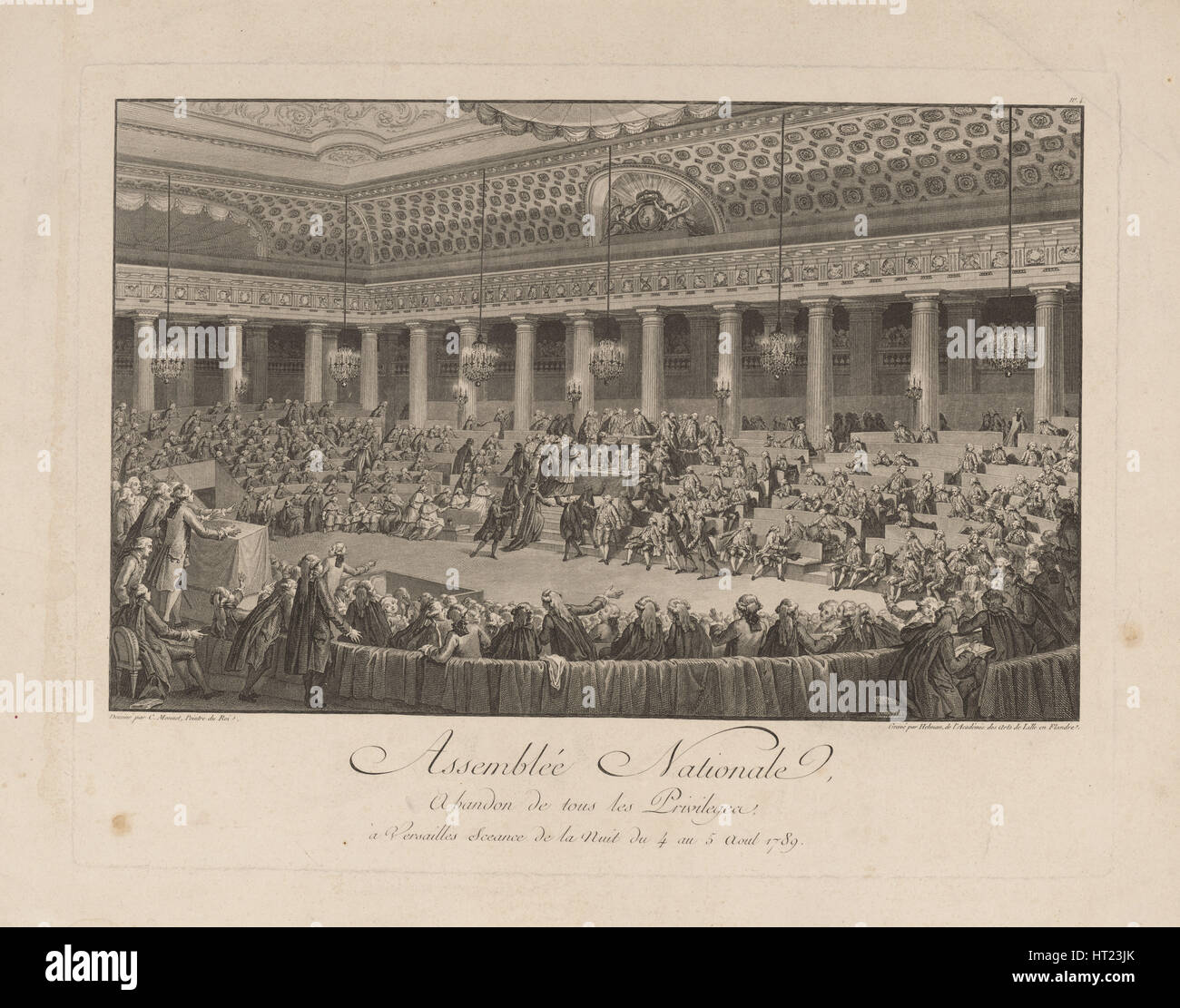
When we look at the paintings of Isidore-Stanislaus Helman or Charles Monnet we see a very large hall.
Is there such a big hall in Versailles? No matter how much I searched this hall, I couldn't find the place depicted.
Well I used to wonder what became of Queen Christina's triumphal arch here in Stockholm, as seen in this 17th century print. Until that is, I mentioned it to someone more well-versed than me, who shattered my notion by explaining that the arch had all been wood and painted cloth, plaster and papier-maché. An elaborate but purely temporary structure, but recorded for posterity in an engraving as if it were every bit as solid as the surrounding city. (the scale is also exaggerated on it, and other buildings; the House of Nobility in the background has for instance gained a story over the real-world building) So that's the kind of architectural deception one can end up dealing with with old pictures. Just as the portraits of the era might make someone taller and leave out an unsightly pimple or wart, the architectural images would stretch proportions, straighten lines and make things look more like they 'ought' to be.
Helman's engraving of the estates falls into this deceptive category. The hall did exist. But only temporarily. It was at Versailles. But not at the palace of Versailles. Or Trianon, or the Petit-Trianon, or at any palace. It wasn't even indoors! It was a temporary structure that Louis XVI had had erected in a courtyard of the Hôtel des Menus Plaisirs ('Mansion of small pleasures' - now the Centre de Musique Baroque de Versailles). This building, upwards of a kilometer west down Avenue de Paris from the actual Versailles Palace building, was at the time used as workshops and warehouses for material related to the king's 'small pleasures' - such as sports equipment (not least for the popular and also Estates-related jeu de paume) and theater props. But the buildings thus became part of a great prop themselves.
The 'floor' or ground consisted of stonework making an oval-shaped amphitheatre (seen more clearly in this print), and this (as the only part) is still there and quite visible today. (as it were there's apparently also informational signs readable on street view too, facing Rue des États Généraux)
For a written source: Denis Lemarié, Chroniques de Versailles, 2005, pp69