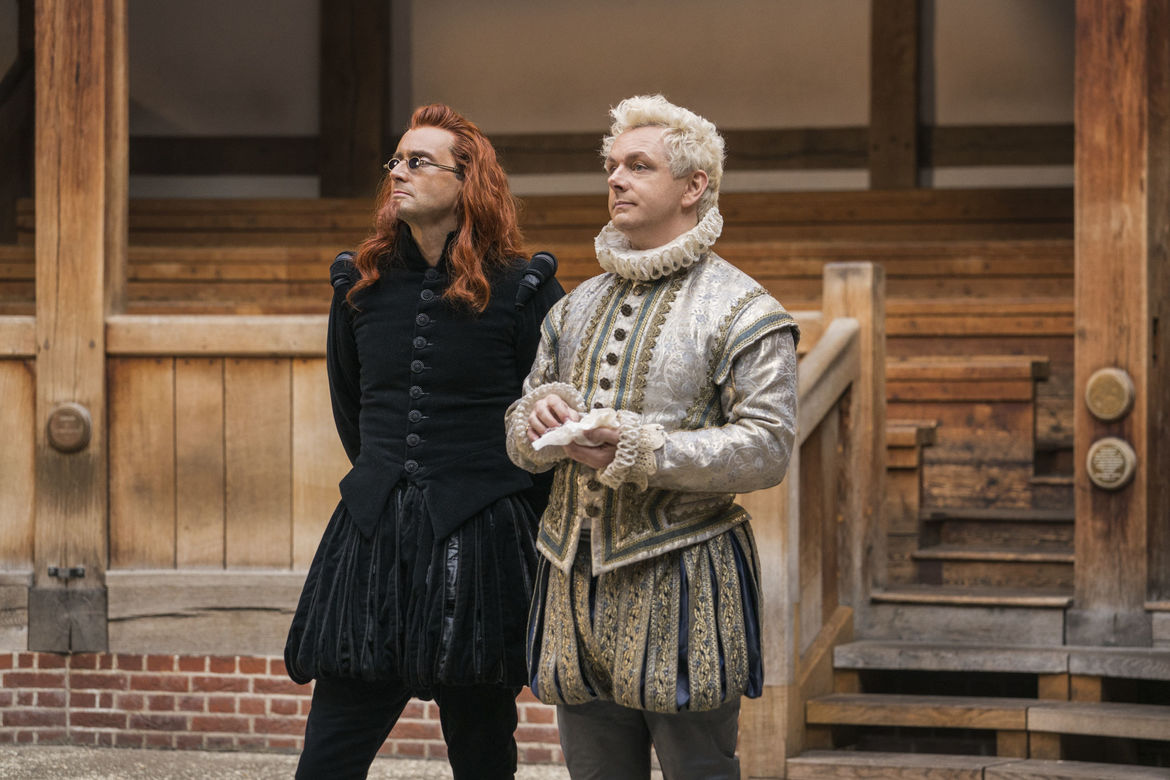
For reference,
Crowley in Elizabethan England
Crowley in revolution-era France
Did people commonly wear sunglasses in these times and places, and if so did they look like this? Or is this just how Crowley rolls?
(Also, is his Elizabethan era hairstyle- and beard-style- period accurate? Because that would be the only possible excuse.)
Sunglasses weren't "commonly worn" until the modern times because they were an extra expense, although we do know that they've been around for a few hundred years. There's no record of who invented eye-glasses but we know of several early examples. Ancient Rome might have been a bit of a stretch though. Pliny the Elder's "Natural History" mentions how Nero watched gladiator fights through a green gemstone. Even if you count that as "sunglasses" it didn't have the conventional design. They were still something you kept in your hand and put in front of your eyes on occasion. There was a similar thing in China 900 years ago, too: flat round pieces of smoky quartz which became framed by the 15th century, but they had special purpose: to conceal facial expressions at ceremonies.
And you didn't even need Marco Polo to bring you a pair of those from his travels. The first recorded glasses in Europe were made in 13th century Italy. The Italians had been mastering the fine grinding technology with the production of magnifying lenses since the beginning of the new millenium and the small island of Murano near Venice had long been a centre of glass manufacturing. And to make proper glasses you have to start with quality glass. Murano's expertise was secret, with the glassmakers forbidden to leave the island. The first glasses they made consisted of two convex lenses riveted on either side of a wooden ring. There was no way to attach those to a face, so you had to hold them in hand. A fresco painted 1352 in the Dominican monastery of San Nicolo in Treviso (Northern Italy) is considered the earliest depiction of glasses in art. It shows a single reading glass and the double-rivet glasses. Later the design evolved into a metal frame with a long handle on one side. They were used to correct vision so it wouldn't be unusual to see a pair around, for the people who could afford them.
So by the 14th century the skilled Italians just repurposed their craft. The invention of printing in 1450 came in handy, boosting demand as books became available to the wider population. To ensure their leading place in the new market, the Italian glassmakers had to adhere to strict rules if they wanted to be permitted to keep making eyewear. The earliest pair of glassess actually discovered is dated circa 1400. It was found at Wienhausen Abbey in Germany. They have rivets but no temples or ear stems and would simply clamp the nose between the two lenses. At first all lenses were convex, with the concave lenses appearing in the early 16th century, the first one created specially for Pope Leo X.
So in Elizabethan times glasses would have been widely available in Europe and you wouldn't stand out much for having a pair, altough it would be a display of wealth. Wearing them around your ears would have been a bit unusual until the 1600s though, when ribbons and strings replaced the handle in order to keep the glasses permanently up. The ribbons were added by the Spanish, who liked to use silk. They even send some to China with their missionaries where the Chinese improved the design: instead of looping ribbon around the year, they added a little weight at the end. Soon came other materials, such as lelather, tortoise shell, horn, whalebone and various metals - from iron and bronze to silver. Stuff that only the rich could afford.
In 1629 England, the Worshipful Company of Spectacle Makers was formed under the slogan: "A blessing for the aged". And since everybody was already convinced glasses were useful, it was time to start making them comfortable as well. The temple arms that go over the ears were only invented in 1700s. Unlike today's design, there were rigid rods and a metal ring behind the ear, to help keep the glasses in place. They first appeared in an advert in 1728, by a London optician, Edward Scarlett. The hinges enabling the temple arms to fold came 20 years later, invented by James Ayscough. He also added green and blue tint in 1752, for the purpose of reducing glare. He thought that such design improved vision.
Sunglasses in Elizabethan times might not be totally outrageous but will be a curiosity. The most unusual thing about them would be if you managed to keep them on your face in a comfortable manner, without them sliding about in irritating ways. So it's feasible that our tv character may have acquired a custom pair and sported the "John Lennon" look in Elizabethan times without creating too much fuss, but it would have definitely looked weird in Ancient Rome.
The first "common wear" of tinted glasses as protection from the sun and a bit of a fassion fad began much later, in 18th century Venice. Carlo Goldoni, the famous playwright with a love for a good joke and a flare for the theatrical, made them popular. They were also handy for the gondoliers who had to face constant glare on the canals. The "Goldoni Glasses" would have been a bit more chunky than the standard "John Lennon" design, but you could probably have a different design made to order as there were some great craftsmen around.
The modern eyewear design appeared in 1850 and remains pretty much unchanged, although comfort was lacking until the beginning of the 20th century. Count Dracula would have been perfectly fine in 18th century Britain as therapeutic glasses were just becoming popular. Produced by an English optician, James Ayscough, their dark blue or green lenses helped if bright glare caused you discomfort. There were even shades on the side of the eye, not just in front. It was considered okay to openly acknowledge you were sensitive to light. It was the time of invention and new things and even if the shape of your eyewear wasn't exactly common, it could still be acceptable.
"Spectacles And Other Vision Aids" by J.W.Rosenthal contains not only the history of glasses but also lots of illustrations to help visualize it. Also, "100 Inventions That Shaped World History" by B.Yenne and "Panati's Extraordinary Origins of Everyday Things" by C.Panati.
Possibly related, in Francis Ford Copolla's Bram Stoker's Dracula, The Count also rocked some dapper spectacles. Were these accurate for the Victorian/Edwardian Era? If not, could they be explained away by the notion that Transylvanians (or the undead) were simply preternaturally fashion-forward?