I was looking through old plane insignia's from around the 1940s, and I'm left wondering why Finnish and Lativan planes use the swastika as there main symbol to use on planes, just seems a little odd since they were both indirectly against Germany in second world war period?
If someone could fill me in then it would be greatly appreciated
The Swedish ethnographer, explorer and amateur pilot, Count Eric von Rosen (1879-1948) took the swastika as a charm and personal logo. A full history of the swastika would be beside the point here but to cut it short it'd come into vogue in the late 19th and early 20th century, not least through Schliemann finding them in the ruins of Troy (1876) and making them out to be an ancient Aryan symbol. In Sweden there was a (no longer current) theory that it'd been a symbol of Thor, in which capacity it was featured on this painting for instance. But by the 1910s it was also being used by the German nationalistic and esoteric völkisch movement as an 'ancient Germanic symbol' as well. But it was broadly popular and being used in corporate logos, on Russian revolutionary banknotes and other places. In a Finnish context its first use of note was this painting of the Aino myth from the Kalevala, painted by Akseli Gallen-Kallela.
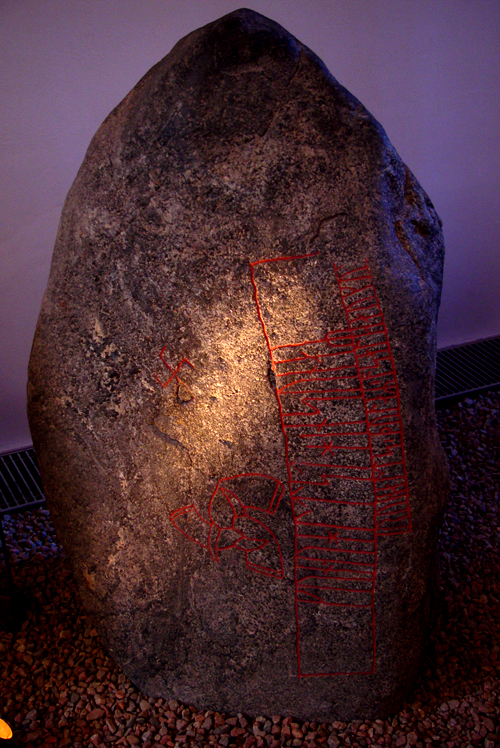
Anyway, point is the swastika is very popular at this point in time in the 1910s (and the Nazi party has yet to be formed) and doesn't have a very well-defined meaning. In von Rosen's case, he was a far-right nationalist and his use of it was probably related to the völkisch movement as a kind of Germanic or Old Norse symbol (one does occur on the Snodlev runestone from Denmark).
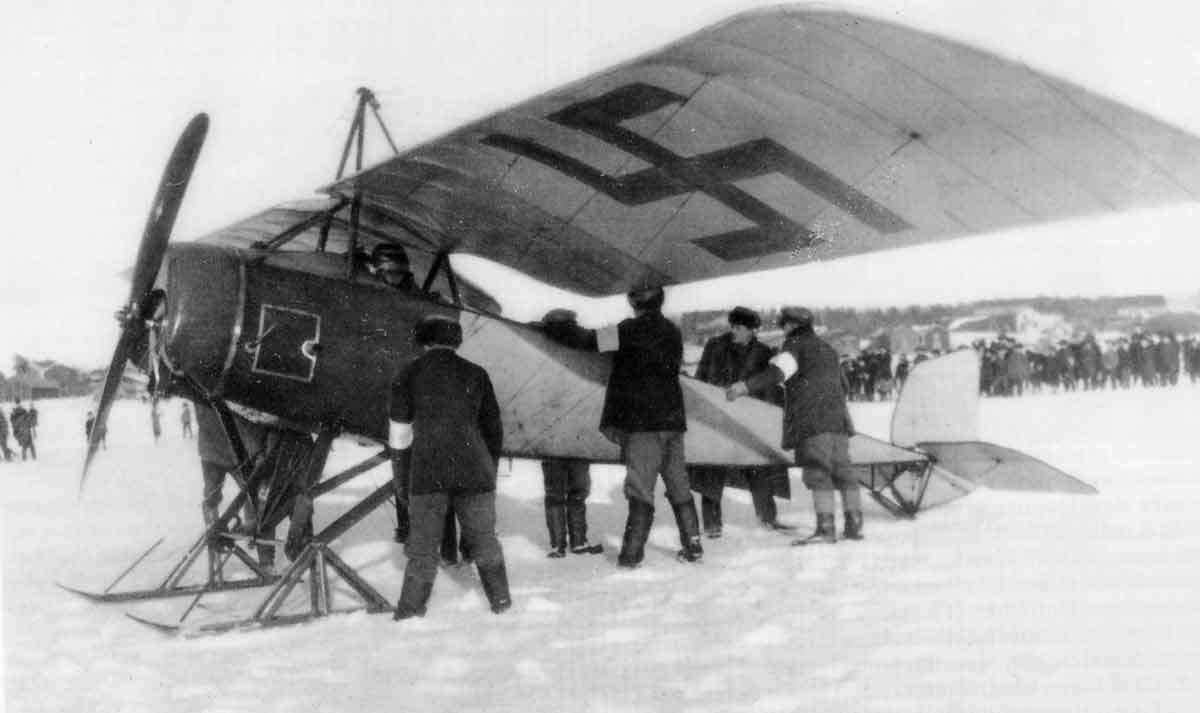
Von Rosen put his swastika on his personal affects, in the decor all over his castle Rockelstad, on the title pages of the books he authored, and - most significantly, on a Thulin aircraft that he bought and flew från Umeå in Sweden to Vasa (Vaasa) in Finland on March 6, 1918. (shown in this photo after landing in Finland). Civil war had broken out between the Red communist faction and the anti-communist Whites in Finland after their 1917 declaration of indepdence from Russia. (in an analogue to the more well-known Russian Civil War, but with a different outcome) Von Rosen's political inclinations were strongly opposed to the Reds of course, so the purpose of this flight was to donate the plane to the Whites as their first aircraft. (conveniently the swastika already had the Finnish colors of blue on a white background) This was the first plane the Whites acquired and they kept as an identifier on future planes, and after the Whites won the civil war (which lasted three months) it became the roundel of the Finnish national air force. Later the Swastika would also be adopted as a national symbol in some other contexts in Finland, such as on the Finnish Order of the Cross of Liberty and the logo for the women's military organization Lotta Svärd.
So the Finnish Air Force swastika did not derive from the Nazi use of the swastika, as it predates the 1920 founding of the Nazi party and its adoption of the swastika as a symbol. But they are not entirely unrelated either, since the Nazi use was based on the same earlier use in right-wing/nationalist/racialist circles that von Rosen had likely gotten it from. Von Rosen would befriend another pilot and far-right fellow, Hermann Göring, in 1920 who ended up marrying von Rosen's sister-in-law after meeting her at Rockelstad. By the 1930s, von Rosen was explictly a Nazi and an organizer of the Swedish National Socialist Bloc, one of the Swedish Nazi movements. (who were splintered and unpopular; not receiving more than 2% of the vote together in either of the 1932 and 1936 elections)
In the Second World War, Finland would be allied with the Axis powers for most of the war; being the duration of the continuation war 1941-1944. At the end of 1944, Germany declared war on Finland in retaliation for Finland making a separate peace with the Soviet Union, leading to the Lapland War between Finland and Germany from September 1944 until April 1945. During which the Finnish Air Force changed their roundel after demands from the Allied Control Commission in Helsinki (which'd been established by the peace treaty)
Someone else will have to tell you about Latvia's use, I have no idea.