I want to know what historical, geographical, political factors that lead the U.S to become a superpower while Australia which on surface has similar features like both being huge countries, both British colonies, disconnected from the most of the world for long period of time, etc.
The answer to this is population size, which is reliant on fresh water and soil fertility, which are both determined by geography.
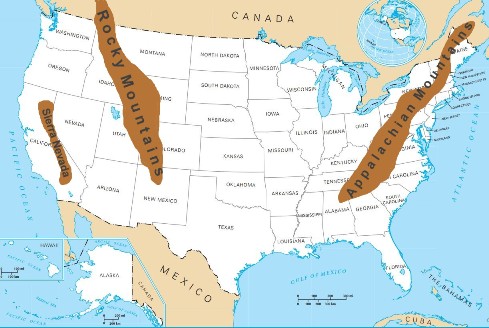
Australia and the US have quite a few geographic similarities - they are roughly the same size (excluding Alaska and the insular US), and if you flipped one upside down you'd have similar climates in similar locations. Another interesting bit of trivia is that the US and Oz both have long eastern mountain ranges that limited early colonial expansion.
The biggest differences are geologic history and stability. Australia has been in the center of its tectonic plate and isolated from other land masses for most of its geological history, meaning it hasn't bumped into anything to cause mountains, valleys or volcanoes to form for quite a long time. Compare mountainous and volcanic Indonesia, New Guinea and New Zealand - Australia's neighbours all sit on plate boundaries and suffer from frequent earthquakes and volcanic disruptions caused by geologic activity, but they are also far wetter and more fertile.
In Australia, the only significant mountain range we have is the Great Dividing Range, which runs from the Torres Strait all the way to Tasmania along the coasts of our eastern states. This mountain range was created by collision with New Zealand and South America 300 million years ago, and has been constantly eroded over time, meaning it isn't even that tall. The other two thirds of the country form the Western Plateau, which is flat, rocky and dry, with steep cliffs on some coasts and small plains in others.
In the US, the western Pacific coast is extremely active due to collision with the Pacific plate, causing the formation of huge mountains and valleys along the western coast, with continuing earthquakes and volcanism. The Appalachians of the eastern coast are far older and were created by collisions with lands and tectonic plates no longer there, very similar to Australia's GDR.
The reason mountains and geologic activity are important is because they create fresh water and soil fertility. Rain and snow fall on mountains and create rivers, depositing new sediments. Mountains also create or block rain patterns. In Australia, these effects are fairly obvious - the eastern coasts is far greener with many more rivers. Below the tropics, some of the mountains even have snow. The mountains also create orographic rainfall, where rain falls heavily on the eastern coastal side due to the dominant direction of the winds, leaving the western side of the mountains drier.
Geologic activity also brings new soil with more nutrients. This is why volcanic regions like Indonesia or Sicily generally have high fertility, as do areas where rivers deposit plenty of silt brought from upriver, like the Nile or the Mississippi. Australia doesn't have anything like this, and hasn't for most of its history.
Another major difference is latitude - Australia is closer to the equator, with 1/3 of Australia within the tropical zone, meaning Australia is far warmer than the US. During the Ice Ages of the past, glaciers covered most of the US, carving out lakes and valleys which channeled or retained fresh water, and the northern US has plenty of snow melt to create fresh water. Australia's glaciers were mostly limited to the southern island of Tasmania, meaning it has far fewer lakes, and its mountains too warm to have a great deal of snow melt. Many of Australia's rivers and lakes are seasonal - they fill with winter rains, bringing the land to life, before the sun and soil leach it all away, leaving it dry.
Putting these elements together, the US has an extreme abundance of fresh water and fertile soils, especially in the central plains and Mississippi region, hemmed in by mountains and fed by the Great Lakes and Canada. This means the US can support an enormous amount of people with ample fresh food and water. Australia on the other hand is incredibly flat, dry and infertile by comparison, with our 'Mississippi' being the Murray-Darling river system in the southeast, which is currently being destroyed via drainage for irrigation. Tasmania and eastern Queensland are also good farm land, but other locations around Australia like the southwest are highly reliant on irrigation and fertiliser to boost soil nutrition, and all of Australia is extremely susceptible to drought, which hits often and hard. Much of rural Australia relies on pastoralism, similar to the American southwest. Desert makes up 35% of Australia, meaning much of it is uninhabitable for a settled and agricultural society.
One could also make the argument that Australia was/is hampered by later colonisation and its geographic isolation, but the ability to support an enormous population and attractiveness to migrants are the biggest factors. While Australia's fertile southeast saw rapid colonisation (to the point where squatters, people who colonised illegally, were the norm), the western colony along the Swan River stagnated until gold and iron were found, and attempts at northern colonies collapsed - many colonists who attempted settlement in these areas later moved to the eastern states, or on to NZ, Canada or the US. Although both countries have long, proud and continuing reliance on primary industries like mining and agriculture, the US at 327 million people has a far larger labour force, domestic market and capital base than Australia's 24 million, making manufacturing and innovation easier. Australia and the US both have large global cities along their coasts, but the US has 53 metro areas above 1 million people compared to Australia's five. The US interior is highly productive and inhabitable, our desert interior is not, and Australia's rural population is statistically insignificant - 40% of Australians live in Sydney or Melbourne, 2/3 of people in large coastal cities and 85% within 50km of the coast.