Hello, so I just started watching “Vikings” and I had a question about the medieval armor. In the show Saxon soldiers were wearing chain mails or armor made from metal scales, but vikings were still cutting them like a hot knife through butter. Wouldn’t this armor stop an axe or a sword strike?
It's important to note the the armour in Vikings is about as historical as Dungeons and Dragons. In short, no, it wouldn't have worked like that.
In long, we'll examine scale and maille armours as they appeared in period, their construction and how they would handle attacks.
For maille, from the small bits of the show I've seen and from the images I'm looking up now, they generally either depict a) rings laid flat and sewn onto a garment, which is incredibly wrong, or b) maille constructed more or less appropriately but only used in small segments, often the shoulders.
The 10th century Gjermundbu shirt (or, rather, shirt fragments) is the best example of Viking maille that we have: housed at the Oslo Museum of Cultural History, some images of surviving bits can be seen here and here. It's made up of a combination of rings that have been overlapped and a small rivet driven through the overlap and peened on the other side, and rings that have been overlapped, heated to glowing, and hammered together to essentialy fuse them, a process known as forge-welding. The rings were all connected into a mesh, with each ring connecting to 4 around it. The riveted Gjermundbu rings average about 7.6mm diameter made of 1.2mm wire, while the welded rings are around 8mm, made of 1.6mm wire (there is variation, these are just rough averages). So sticking a sword - which in the Viking era had wide, spatulate tips - into a maille shirt would likely not even see the point come out the other side of the ring at all. If you're interested in that information, once I'm off mobile I can put up the pdf. It's also important to note that all evidence points to fairly short, short-sleeved maille armour, covering approximately like a modern T-shirt, so arms and legs are fair game, which is why their shields were very well suited to protecting extremities.
To actually get to the person underneath, the weapons has to go through a series of steps, losing energy at each point.
To summarize, maille is an extremely effective armour, which is why it was the armour of choice from the Romans clear through the widespread use of plate armours, and even then it was still used as a supplement or on secondary types of troops.
For scale, from what I gather the show's depiction is plates laid out in a grid and attached to a foundation garmet with small gaps between each plate. This isn't really how scale was made. Archaeological evidence is nonexistent, as far as I'm aware, but we'll look at the 9th century Carolingian Stuttgart Psalter for some continental evidence, because it shows quite a bit of detail: two prime images are this picture and this one. The first major thing to note is that each plate is attached to the foundation garment at the top, and overlaps with several around it: this disappates to force of a blow over a larger area than a single plate. Secondly, we see attempts to fortify each individual plate, with a mid-rib on the first image and dishing on the second, making each scale more resistant to being crushed or crumpled than a flat plate.
Getting through scale is easier, which is likely why it is relatively rare in the period, and almost nonexistent by around the 11th century, occasionally popping up here and there in small amounts. A point going upwards may potentially get stuck in the rivets connecting the plates to the foundation (if indeed they are even riveted, rather than sewn), but is fairly likely to penetrate the garment underneath to as wide as a gap there is between two scales.
So again, with scale, even though it may be a bit easier, there's still a bit of a process in overcoming it.
However, metal torso armour would only have been for the wealthiest: the other 90% would likely have had, at most, a thick wool tunic and a linen under kyrtle.
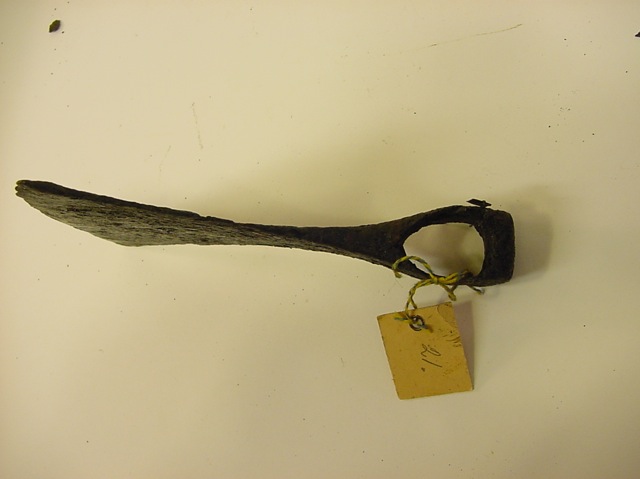
Now, axes in particular deserve their own paragraph. War axes of the time were much thinner than we'd imagine, designed for cutting through fabric and flesh rather than armour. This example from The British Museum is an exceptionally large specimen of an axe head, and weighs only 2.1lbs/ slightly less than 1kg! In this image you can really see the narrowness, and this one-handed piece from the Danish Narional Museum is thick at the top near the haft, but narrows rapidly. These aren't wood axes, these are weapons carefully crafted and designed to slice through fabric and flesh. They're not going to cut through a maille or scale shirt, though they could easily break bones or crush organs. But against the vastly unarmoured majority, they would have been very effective.
Also please forgive any typos, long responses are tough on a phone.
Thank you for this detailed response