“Cavalry” is an immense topic that spans continents and millennia, so I’m going to limit my answer to snapshots from the broad European tradition of horsemanship beginning with Ancient Greece.
As much as a shield provides necessary protection in battle, there are clear downsides to carrying one as a mounted soldier. A cavalryman needs to juggle the reins in one hand and a weapon in the other. Thus, a shield would need to be carried on the arm that holds the reins. The manual of arms for a shield is not always congruent with the manual of arms for the rider’s hand. Additionally, large shields would put the rider at risk of becoming unbalanced, especially before the invention of the modern saddle. At times then the choice to field a horse soldier without a shield would have been just as rational as the choice to field one with a shield.
There is evidence to suggest that Classical Greek horsemen and horsemen of the Macedonians under Phillip and Alexander did not employ shields. Depictions on vases of armored horsemen from the Fifth Century BCE onward do not show Greek cavalrymen with shields. Neither does Xenophon in his treatise on horsemanship recommend shields to protect horse and rider. Protection of the rider was left up to armor: a well fitting breastplate, a helmet, a gauntlet to cover the left hand and arm, which would have held the reins, armor worn by the horse that would also serve to protect the rider’s thighs, and leather boots. However, the evidence is not conclusive enough to absolutely say that no Ancient Greek cavalryman ever carried a shield.
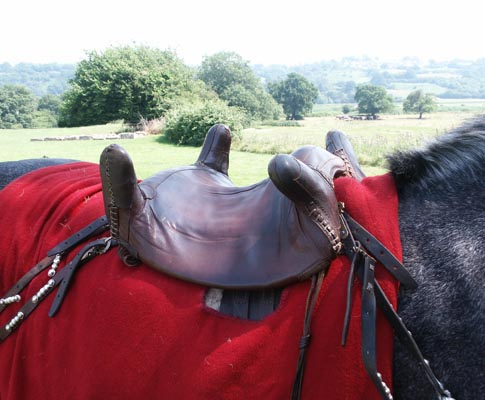
Greek cavalries did begin to field shields beginning about 150 years after Alexander’s death. One theory suggests that shields were adopted from the Romans, or from Celtic invaders. It is also possible that shields began to be used as a consequence of the adoption of the early structured saddle from the Scythians. The development of the heavy cataphract cavalry, which fielded shields as part of their turnout, was indeed influenced by the development of the modern saddle.
Roman horse soldiers have been depicted on gravestones, monuments, and coins as both carrying shields and not carrying shields. One early description of Roman cavalry armament comes from Polybius, circa 160 BCE. In it he states that Roman cavalrymen first employed round shields made from oxhide, but switched to a heavier design -- also possibly inspired by the shields of Celtic invaders -- that proved more effective in combat. However, the Roman cavalry was drawn from the moneyed, landowning class. They were responsible for providing their own equipment. It has been hypothesized that an individual Roman cavalryman may have eschewed a shield -- or other piece of armor -- due to cost, personal attitude, or skill in the saddle.
Both the Iberian and Numidian horsemen in Hannibal’s cavalry, it should be noted, fielded small, light, round shields.
Imperial Roman horsemen carried shields that slightly differed in design from their citizen cavalry forebearers. The shields were oval instead of round, and flat. The design of the shield made hanging it off of one of the horns of the Roman four-horned saddle, which had become the dominant type of saddle for its increased stability, when not in use.
With the adoption of the stirrup and the development of the modern treed saddle with very high cantle and pommel, the concept of the armored mounted warrior reached its zenith. Shields grew large and supported by a strap around the shoulders, and by the Battle of Hastings had adopted the stereotypical kite shape that we associate with “knights in shining armor”. While bulky, the left side of the cavalryman was wholly protected. The stirrup allowed the knight weighed down by armor to mount more easily, and the high pommel and cantle of the saddle helped to keep him centered in the saddle despite the imbalancing effects of the shield.
The widespread adoption of gunpowder signified the beginning of the end of the age of the cavalry. Horse soldiers became lighter, ultimately trading a full suit of armor and a lance for a breastplate, a pistol, and a sabre. The cavalryman’s shield, made obsolete by volleys of musket fire, was ultimately set aside.
Sources:
Felton, W. Sidney, Masters of Equitation
Nyland, A., The Art of Horsemanship: Xenophon and Other Classical Writers
Sage, Michael, Warfare in Ancient Greece: A Sourcebook
Sidnell, Philip, Warhorse: Cavalry in Ancient Warfare