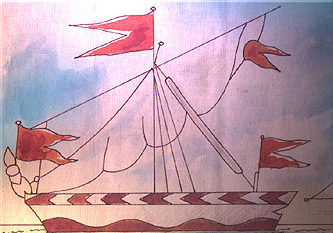
So I've been curious to how naval warfare was conducted in the Indian Ocean as I'm only familiar with the calm-water war galleys, and the modern era sailing ships of Europe.
I've read that the Arabs and Indians used the Dhow to transport goods, but was there something like the War Dhow?
One particular aspect of maritime situation in the Indian ocean in the second half of fifteenth century which is often emphasized by scholars, is the relative peacefulness and absence of large scale naval conflicts. The accent here is really on the word relative as piracy was abundant and there was plenty of naval combat in the form of smaller neighboring states fighting each other, or a commercial center port subjugating its immediate surroundings.
But what you won't see, is the kind of power projection across the seas, sending combat fleets far way from home, or establishment of maritime empires backed by sea domination which you might associate with, for example Italian medieval merchant states. Again, before someone gets their pitchforks out, I am mostly referring to the fifteenth century and the setting in place in time of European arrival. It is quite possible somewhere back in time Indian ocean was full of such naval empires, I really wouldn't know.
The following consequence of such situation is that there really wasn't much large scale naval battles (like e.g. battle of Zonchio in 1499 in Mediterrenean) and for that matter, there were no clear large dedicated warships that might be considered an analgoue to European galleys, or later galleons or ship-of-the-line. And that's perfectly fine! In fact it is probably the Mediterrenean that was an outlier as in 14th century both England and France were raising their navies by commandeer and adapting merchant ships rather then having dedicated warships.
In those conditions, the naval fleets, when assembled, had usually consisted of a number of large merchant sailing ships taken for the occasion and filled with soldiers, augmented with a large number of oared vessels. Such combined fleet of smaller oared ships together with larger merchant ships were encountered several times by the Portuguese, in their fights at Hormuz, Chaul/Diu, Malacca, etc.
The smaller oared ships could vary in size (and have a mast with a sail, same as galleys) but were as a rule smaller then galleys as Portuguese often applied the term fusta to describe them, and fusta was a European type of small galley. if anything would be considered a warship of Indian ocean, it would be these oared vessels. Unfortunately, I can't find much information on them as they seemed to pass under the radar of most works.
The merchant ships, primarily propelled by sailing would be what you term dhows. That is if we are talking about the western part of the Indian ocean - the Arabian sea - where most ships were of this type. Most of the Portuguese descriptions (sorry for dealing with Portuguese sources, but it seems those are the main sources most of scholarship draws from. Hopefully the situation has changed and I am just out of date...) describe them as well built ships built, and particularly accent that they were built without nails (actually some sources disagree, but vast majority confirm) and instead either wooden pegs were used or the planks were sewn together, another interesting feature many sources agree with. By size those ships were just as big, and on more then one occasion even bigger then Portuguese naus they were up against. Yet unlike Portuguese ships it seems that the ship board artillery wasn't really a thing. Or it was, but the artillery it self was much weaker then the ones brought from Europe.
In the eastern part of Indian ocean, there was a considerable additional influx of SE Asian designs of such large ships, which Portuguese dubbed "junks" (juncos). Those had some Chinese influence in origins, but were actually heavily influenced by native SE Asian design. Unlike dhows, those are much more often described as having nails and in general had a different look and feel. They also had two side rudders instead of a stern rudder, a fact Portuguese wrote down with interest as they considered it a weakness in battle. They were also larger then Portuguese ships, and had multiple layers of planking which allowed some of those junks to resist even the largest cannon fire from Portuguese ships. The ships were still at a disadvantage against the Portuguese, and seems in the early days when Portuguese conquered Malacca they also succeeded in winning most of the few naval battles they had.
To conclude here are some of the 16th century (european) images of the ships. We are not sure if those are realistic first hand accounts or just imaginations of authors back in Europe.
Ships of the Arabian sea: a dhow and a 9-masted large ship - 1519
In medieval India, the Muslim rulers (such as the Deccan Sultanates and Mughal Sultanate) had mostly ignored the naval arm of their military forces. It may be because they came overland from the North and won decisively in land battles.
This scenario changed, however, when the Portuguese arrived in India and started monopolizing and controlling trade on the western coast of the continent. Chhatrapati Shivaji (known as the father of the Indian navy) realized the importance of a strong navy; the first keel of a Maratha naval vessel was laid down in a creek near Kalyan circa 1654.
Shivaji took up the task of constructing multiple naval bases along the coast of present-day Maharashtra. He organized two fleets – one under the command of Admiral Mainak Bhandari and the other under Daulet Khan.
The Maratha Navy consisted mostly of native Konkani sailors; however, it was commanded mostly by mercenaries, including Siddi and Portuguese. Circa 1659, the Maratha Navy consisted of around 20 warships.
Hiring mercenaries was relatively common in Maratha military culture and the Navy was no exception to this practice. Portuguese naval officer Rui Leitão Viegas was hired as fleet commander, in part because the Maratha wanted to get insight into the Portuguese naval technology and capabilities.
The Maratha Navy was primarily a coastal “green water” navy, compared to an ocean-going or "blue water" navy. Their ships were dependent on land/sea breezes. The Maratha did not build ships large enough to engage the British out at sea far from the coastal waters.
As for the ships. here are three:
Galbat: The Galbats were larger row boats but of smaller dimensions. These rarely exceeded seventy tons. They had two masts of which the mizzen was very slight. The main mast had one large triangular sail. When hoisted, its peak went much higher than the mast itself. The Galbats were usually covered with a spar-deck, made up of split bamboos for lightness. They carried only 'patteraroes' which were mounted with six or eight pieces of cannon ranging from two to four pounders.
Gurab: The Gurabs had usually not more than two masts, although some had three masts. The capacity of three masted Gurabs was about 300 tons, and that of smaller ones, the capacity was about 150 tons. These warships were covered with a strong deck which was on the same level as that of the main deck of the vessel. On the main deck, under the fore-castle there were two pieces of cannon from nine to twelve pounders pointing forward through the portholes cut in the bulk head.
Pal:The Pal was the biggest battleship of Marathas. The Pal had three masts perpendicular to the hull. They were made up of two pieces joined together just below the square sails. The stern of the Pal was square and had a spacious decorated deck. This was meant for the captain. The broadside of the Pal had four guns peeping through the portholes.
Sources: