The fall of the Roman empire is a complex one. Firstly we have to think of the Roman empire as the West and East halves. We then have to decide what we believe, was it a collapse or was it a gradual decline? Such questions are widely debated and I think the most common opinion in modern historiography is the idea of a long antiquity, a long decline of the empire, the idea of continuity comes to mind here.
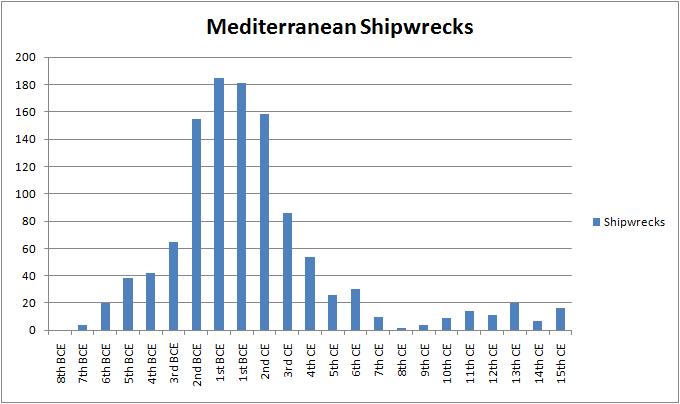
The west I personally find hard to explain due to the intricacies that link back to many centuries before what is usually counted as the Fall of the West 476 AD with the overthrowing of Romulus Augustulus by Odovacar. A major one that comes to mind for me personally would be the gradual incorporation and continuous yielding to the many different tribes that came from Eastern Europe. While I will not go into detail with the many different invasions/trespassing of the different peoples, I can possibly explain what is was like for those under their rule. Using collapse for the West is much more apt then for the East. Via the use of pottery and most notably ARS pottery we can also see the reduction in the complexity of such centralised government. While there are some arguments against using shipwrecks for explaining the economic situation of the empire, I believe we can draw some notion of reality from them, Graph, what we can see here is that the Mediterranean mercantile trade networks started to decline towards the so called collapse of the Empire. This combined with the arguably devolution of the society under the barbarians in both administrative but also socio-economically should start to explain why a collapse happened. However, such devolution had started many years before 476 AD. We can look back Valen allowing the entry of the Tervingi around 376 AD, and how this was managed, using Marcellinus as a source (Histories, xxxi.5) it is said:
‘Men of flawed character were collected and put in command. At their head were Lupicinus and Maximus, the one commander in Thrace and the other a disastrous general, both equally reckless. Their sinister greed was the source of all our troubles…. The barbarians after crossing the river were distressed by want of food, and these loathsome generals devised an abominable form of barter. They collected all the dogs that their insatiable greed could find and exchanged each of them for a slave, and among these slaves were some sons of leading men.’
Clearly a breakdown in relations between the Gothic refugees and the Roman local commanders started, as Fritigern led the Tervingi in a revolt against the empire, leading to the First Gothic War. Which led to the fateful battle of Adrianople 378 AD, where according to Marcellinus (Histories xxxi.12) Was jealous Gratian, Valens engage before Gratian arrived to bolster his force. The battle was a major defeat for Valen which allowed for continous plundering of the Thracian countryside while Rome sat behind their walls till a settlement was made in 382 AD, where they granted them a large area of land in the Balkans, Dacia where they had autonomy.
We then have Alaric's rise to prominence, along with the strained relationship between Arcadius and Honorius which I again, will not get into. However, the aforementioned events led to a riot in Constainople in 400 AD which was related to Gainas' regime as he was a Gothic General. The East grew continously hostile towards Barbarians. Here we can look to Synesius of Cyrene:
‘Your father [Theodosius I] raised them [the Goths] up from their prostate position, made allies of them, and accounted them worthy of citizenship. Moreover, he threw open public offices to them, and made over some part of the Roman territory to their bloodstained hands, expending the magnanimity and nobility of his nature upon a work of clemency….. [But] you [Arcadius] must remove the foreign cause of the disease before the festering abscess actually declares itself…. The army must be purified by the emperor, as is a heap of wheat from which we separate the coarse grain and what other elements sprout side by side with it, ruinous to the noble and legitimate seed….’
As mentioned the West experienced continuous Barbarian-isation. The conquering and dividing of the West between the many different people such as Ostrogoths, Visigoths, Burgundians, Vandals and Alans roamed effectively free. Coupled with the royal divides, we can start to see the politics that start to weaken the Roman empire. The West also experienced great economic failure, the annual gold available to the West was 45,000 pounds towards its fall, in comparison to the 2700,000 pounds of the East:
‘It has been estimated that by the middle of the fifth century, the total annual revenues of the eastern half of the Empire, were around 270,000 gold pounds, of which 45,000 pounds were for the military. At the same time, in the West the entire annual budget was approximately 20,000 gold pounds—an almost insignificant figure when one considers that a single wealthy Italian senator could easily have an annual income of 12,500 pounds.’
Patrick Geary, Before France and Germany, p. 29, obviously the figures are approximations
One can easily see the economic collapse is related to the loss of control of Gual and Hispania and later even parts of Africa. But also the invasion of the Huns, which is interlinked with the rise of Aetius who used Hunnic mercenaries to regain Authority of Gaul. Obviously there is a problem here, Rome was not in control, and could not fund a military to face so many different Barbarian tribes. Eventually Aetius required a large Gallo-Roamn/Barbarian force to repel Attila at the Battle of Catalaunian Plains 451 AD. The loss of Africa to the Vandals was also major, as it meant Rome and Italy could not feed itself, which weakened the West further. Finally the West was in no position to rebuilds it hegemony of Gaul, and Leo I had to step in and try to attempt to recapture the west, which failed. Put simply, it is thought the failure of the expedition to recapture the West, roughly cost 130,000 pounds (again amounts vary) of gold and put the East in a dire financial state. This failure sealed the fate of the West, for it was now in the hands of the Barbarians.
Having tried to cover such a large period in such a few words is a struggle and I apologise if it is hard to follow or make sense of, however I have tried my best with limited time. But to briefly sum the West up,
The East is another area which is hard to explain, the idea continuity is a major theme for the East, we can see such parallels with the Arabian Empire and the Roman one. Therefore, it is hard to say the East fell like the West did. The East was more incorporated into a new empire and society, we can see such things in the fact that Greek was the main language used by the early Arabian empire in administrative matters. There was also major religious autonomy with the Jizya tax being the cost of this. The same families also continued to reign in the early Islamic society, which has been recorded in many papyrus records that have been preserved by the desert, some families even continuing to rule 300 years after the conquering of the East. Again there are Parallels with the cultures, the palaces, the rituals and structures were still very much Roman style till around around 700 ad when Abd al-Malik started to start the transition to one of a Islamic culture. It is for reasons like this, that is hard to pinpoint the fall of the East, maybe we say the Plague of Justinian weakening the East being one of the many contributing factors. However, how do we define an empire? If the same lifestyle continued under new leadership, sometimes even becoming better with the revitalisation of many lost trade routes and the reduction of taxes in some areas, did the East fall? Or was it merely amalgamated into Early Islamic society and history? Personally I prefer to follow the idea of continuity and long-antiquity for the East, however the fall of the West for me is very clear when we consider the factors such as pottery, the decentralisation and reduction in coinage.
Hopefully I haven't waffled too much and there is some semblance of explanation to your question, but it is quite late and I only had a few notes at hand to throw this together, so sorry if it does not.