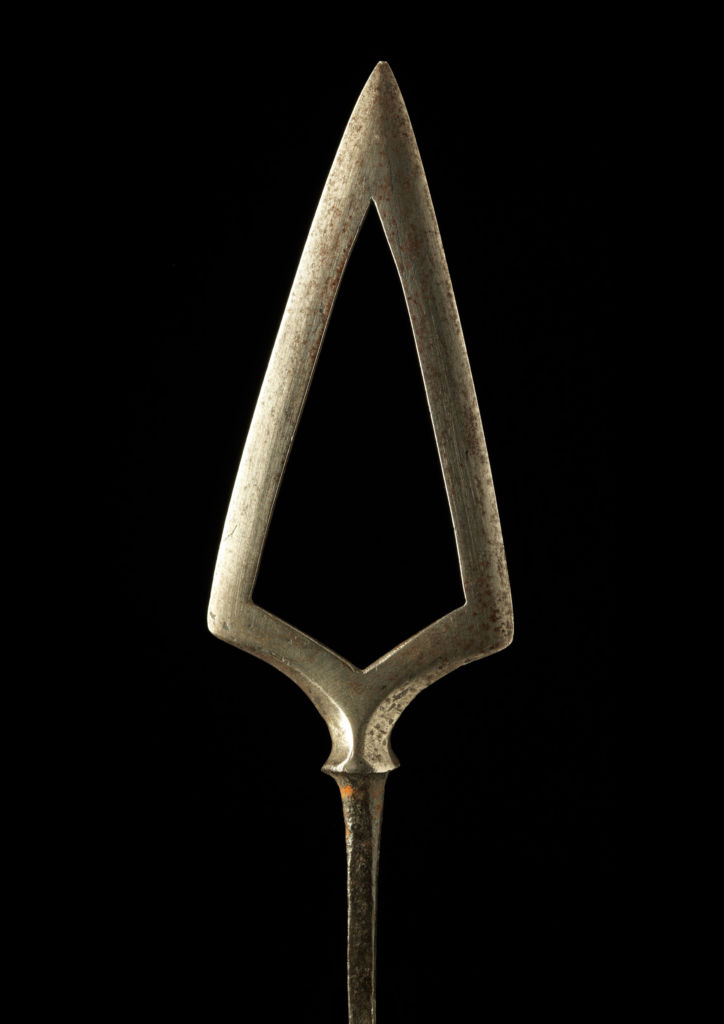
Dallas has a museum dedicated to Samurai armor and weapons. It is apparently the largest collection of such outside Japan (or so they claim).
One of there displays showed a collection of arrowheads that I had questions about. The arrowheads weren't dated but most of the items in the collection dated during or after the early Tokugawa period so I'm guessing they might be the same. The plaque next to the display was very short on information
First, these arrowheads seem way too decorative to be practical. Are these ceremonial? Is there such a thing as a ceremonial arrowhead? What was the idea behind making such intricately decorated arrowheads.
My second question is about the arrowheads shaped like a Y, the 4th and 5th ones from the right. The accompanying plaque said that they were made to slice through straps holding armor together and so reducing their targets' fighting ability. That sounds very far-fetched. It would take an incredibly precise shot to target an armor's strap. Presumably those straps would not be in an easily accessible place to begin with and I doubt that during combat a bowman could make such a difficult shot to such a hard to reach place. What would these arrowheads have actually been used for?
Third, how well did samurai armor stand up to arrows? Were they vulnerable to any specific kind of arrowhead?
First, these arrowheads seem way too decorative to be practical. Are these ceremonial?
These were often votive arrowheads, offerings to shrines. Others were gifts, intended for display rather than shooting (see curator's comments at http://www.higgins-collection.org/artifacts/3367 ). Lighter, often less ornate, ones were used for hunting. Wide arrowheads are often a good choice for hunting (depending on the game sought); wide heads produce wide wounds with lots of bleeding. Cut-outs allow a wider head while keeping the weight down. A head like http://ificah-blog.com/wp-content/uploads/2019/04/P7-724x1024.jpg is a good example of a cut-out head probably intended for hunting (photo from http://ificah-blog.com/yanone/ which has good info and other photos).
My second question is about the arrowheads shaped like a Y, the 4th and 5th ones from the right.
These were mainly used for hunting (and also on the battlefield, perhaps mostly intended for use against horses). As with wide broadheads, the width of the head can result in wide wounds with lots of bleeding. They are often described as "rope-cutters", but there doesn't seem to be much evidence. The cords connecting sections of lamellar armour were often exposed, and some of them could have been cut by such heads, but it would be very unlikely for even multiple hits to cut enough cords to seriously impair the armour. If one had the accuracy to hit the cords, it would be simpler to shoot the lightly protected face (or the unprotected eyes) or other gaps in the armour. Given the advice to military archers to aim at horses rather than riders because they were larger targets, such accuracy was not typical.
Similar forked and crescent shaped heads were used in Europe. Soar (2006) reports tests of various arrowheads, including forked heads. They can indeed cut rope, but the demands on accuracy are high. mark Stretton (who performed and reported the tests) discovered that these heads were effective for bird-hunting. Small game (both mammals and birds) were often hunted with blunts (blunt-tipped arrows) or pellets (using pellet bows and pellet crossbows), to avoid damaging the meat too much. A broadhead can make quite a mess of small game, rendering it much less table-friendly. The forked heads typically failed to penetrate the feathers, functioning much as blunts (breaking bones, etc.), while perhaps being less likely to skid off feather if hitting at an angle compared to an ordinary blunt.
Judging by their weight, some of the very large forked arrowheads were votive.
Third, how well did samurai armor stand up to arrows? Were they vulnerable to any specific kind of arrowhead?
Arrows were the main thing that the armour was made to keep out (before guns, arrows were the main cause of wounds - it was worth making armour to keep them out). It worked well.
That said, archers did try to put arrows through armour in battle. If the armour would reliably keep out an average arrow, an arrow shot at close range from a more-powerful-than-average bow might have a chance. In any case, while the main body armour and helmet bowl might stop arrows, arm, leg, and face armour was often thinner (as was the case in Europe, especially for arms and legs, where plate might be only 1/3 the thickness of the breastplate), and could be penetrated.
Different types of arrowheads appear to be optimised for different types of armour. Consider these arrowheads:
https://commons.wikimedia.org/wiki/File:Fleches-japonaises-p1000615.jpg
Counting from the left, 1-3 are not armour-piercing. 3 is a classic wide broadhead, designed to cause large wounds on unarmoured targets; these were used for hunting and also in warfare where they could be quite effective against horses. 4 is a classical type that is optimised for piercing iron/steel armour - a pyramid, as the tip of this is, is optimal for piercing steel plates (Atkins, 2009). Another example of this type: http://www.higgins-collection.org/artifacts/3370 A more slender, and narrow, pyramid is better for penetration, as long as it is strong enough to not break before the armour. Against hard armour, a quite stout pyramid is needed to avoid such breakage. 5 and 8 are either narrower pyramids, risking such breakage against plate, and/or slender points designed to pierce mail. 6 is a cutting point, but much smaller than 3; a point like this would be one of the best choices for at piercing rawhide lamellar armour, and would still give good penetration of textile armour (as used on arms and legs, often reinforced by mail). 7 looks like a compromise between the 3 preceding types - a general purpose anti-armour arrowhead. 9, due to its small size (and therefore light weight) might be the head of a flight arrow, for long-distance shooting.
References:
Tony Atkins, The Science and Engineering of Cutting: The Mechanics and Processes of Separating, Scratching and Puncturing Biomaterials, Metals and Non-metals, Butterworth-Heinemann, 2009.
Hugh D. G. Soar, Secrets of the English War Bow, Westholme, 2010.