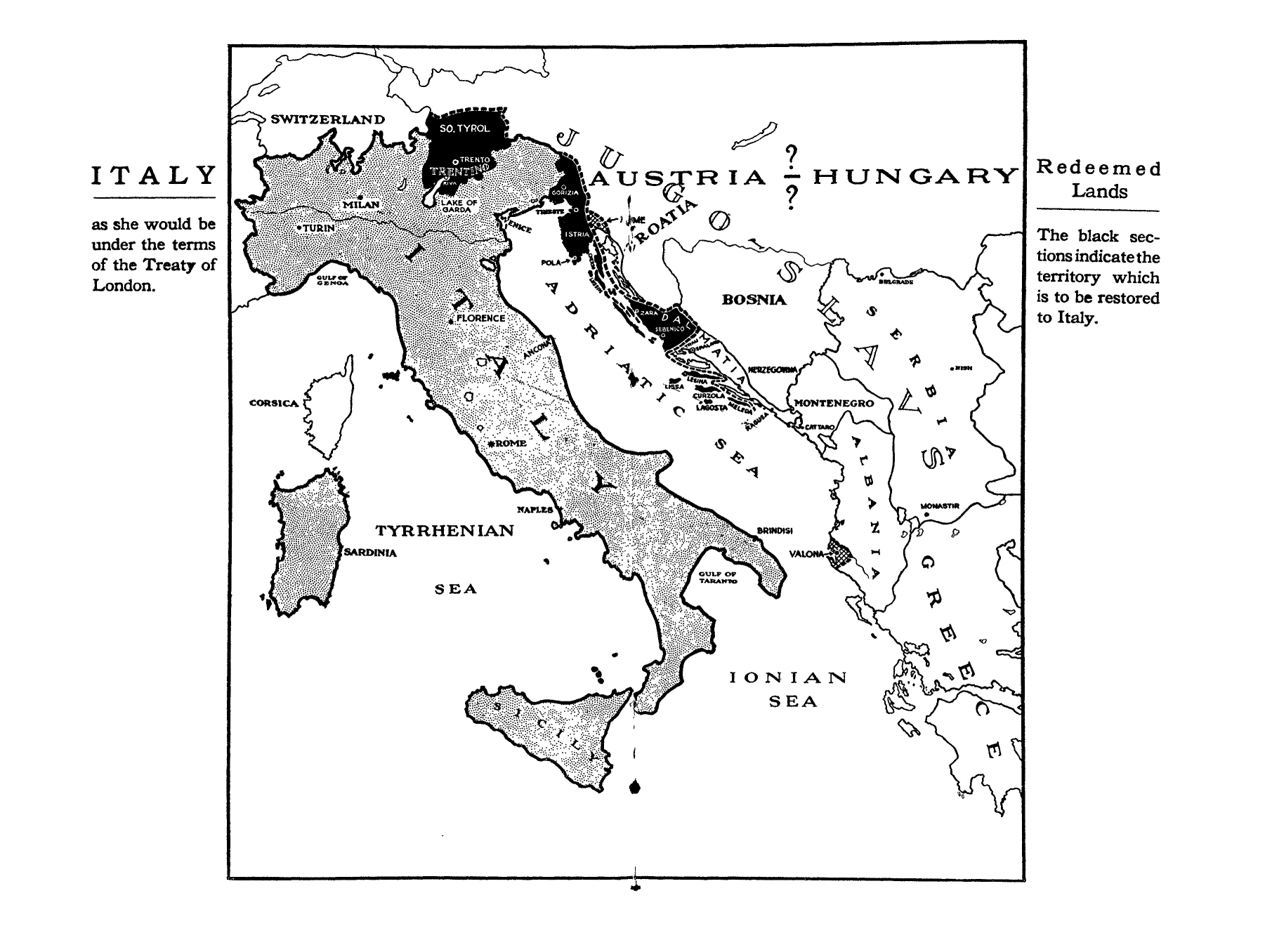
In WW1 Italy was promised by the Entente powers large parts of Austria-Hungary land to the north of Italy and to the east across the Adriatic if they joinend their side. why was this not given to them at the treaty of versailles and instead given to Serbia?
In fairness, most of the large parts of Austria-Hungary promised to Italy were indeed given to Her. This map gives a general picture of the proposed acquisitions - notably, Trent and South Tyrol to the Brenner pass, the Venezia-Giulia with Gorizia and Trieste.
Those were also the main aspirations of the Italian irredentist movement - representing the completion of the Italian national unification - and the regions (with the exception of South Tyrol, which was nonetheless added for strategic and geographic considerations) where existed a significant, if not overwhelming, Italian ethnic presence (an aspect which, no matter how tenuous could its definitions be at times, was certainly present in the minds of the Allied and Associated delegations).
Also from the map - which doesn't show a precise comparison (but actually most maps on the internet appear to draw somewhat arbitrary lines) - the most glaring omission was the northern portion of Dalmatia, which went to the Kingdom (or State, accordingly) of the Serbs, Croats and Slovenes (and not to the Kingdom of Serbia), the whole lot of the islands, which the Italian navy regarded as strategically valuable, a few minor rectifications on the Istrian border and one (possibly less minor one) concerning the assignation of the so called "Assling triangle", connected to a relevant railroad junction (which might have been more relevant if the Klagenfurt plebiscite had not assigned the neighboring region to Austria), to Yugoslavia.
In addition to the provisions of the Treaty of London, Italy gained (through much labor nonetheless) the city of Fiume - which had been originally reserved (ex parte, under the formula "shall be assigned" - but the Kingdom of Serbia was not part to the Treaty) in an additional note to art. 5 for "Croatia, Serbia and Montenegro".
With this picture in mind, we can see how Italy received satisfaction to what claims she had which were compatible with principles of nationality and self-determination and was largely rejected (with the aforementioned exception of South Tyrol) those claims which were made for strategic reasons.
This was, unfortunately for the Italian Foreign Office (and especially for the aspirations of the nationalists who had foresaw in the collapse of the Austro-Hungarian, Russian and Ottoman Empire a good chance to extend the Italian presence substantially from Venice to Baku) a consequence of the new ideals and principles which had begun to inspire the Entente (or better the Allied and Associated Powers) efforts during the last year of the war. There is little doubt that those "abstract principles" had also a political character and that they represented for the US a possible ideological counterpart of their growing financial influence and for the British and French a way to maintain (if possible) part of their position of privilege.
But they also answered to social and political needs which had became apparent during the conflict - with revolution occurring in Russia, social tension growing within every European country, dissatisfaction against those political classes which had brought about a war which promised ever more dread than bounty, there was a substantial need for both practical and ideal adaptations. In this sense, no matter how "practical" and straightforward the nationalist designs may appear, they certainly weren't enough to satisfy the aspirations of the people. It's a telling sign that the Italian government had to keep the preparations for an expedition to Batumi secret from the troops themselves, for fear of an insurrection (which would later occurr, this time for a new planned expedition to Albania). And when certain ideas of the Italian nationalist field entered the public mind, it didn't happen in the brutal and mechanical form of Rocco and Coppola's manifesto of might, but with the surreptitious character of a violated national right, of a betrayal - the symbol of which was D'Annunzio's famous "Mutilated Victory".
Now, it would be naive to assume that Wilson, Clemenceau and Lloyd George opposed this part of the Italian aspirations merely for ideal purposes - Clemenceau had his vision of a corral of states to prevent the spread of Bolshevism (and maybe to keep in check some unspecified nation right at the center of the map) - Lloyd George had more urgent things to attend to - Wilson was, more than anyone else, the champion of the new ideals (of his own fourteen principles), and could not really give any ground on an issue that symbolized the "old diplomacy" which the American intervention aimed at striking down even more than the Central Empires.
Which leads to the more practical consideration - that, no matter how committed and constrained were the British and French to the stipulations of the Treaty of London, the US of America were not. They had not signed the Treaty, they had not recognized it, they very often made a deliberate effort to ignore it and (almost embarassingly at times) the American delegation betrayed a deep discomfort and distaste for the entire thing. To the point where the (unjustified) reassurances coming from the Italian government that "the Italian demands were in perfect agreement" with Wilson's principles might have actually worsened the disposition of the American delegation.
(continues)