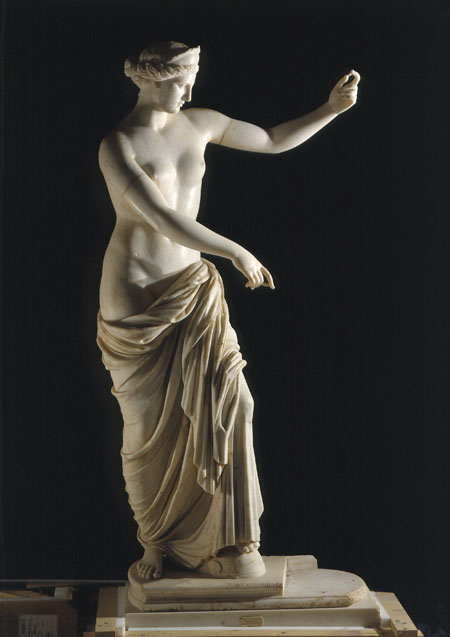
At the time of the excavation of the the statue, a separate fragment of a hand holding a small fruit was found. Even though the hand was executed in the exact same marble as the Aphrodite, and had very similar weathering patterns, and in addition was precisely the right size to belong to the torso, it was argued to be unrelated by early investigators. The most powerful argument in the modern world suggests that the hand in fact does belong with the torso, and that the Aphrodite of Melos was from a ruined Hellenistic gymnasium complex on Melos. She was holding a golden apple up in her left hand, while her right arm pointed gently down across her right hip. This "type" (this pose) is very well known from this period and is typical. Here is a 2nd-c. CE Roman copy of this very popular style, to give you an idea.
The apple probably relates to the well-known story of the marriage of Peleus and Thetis, when Eris threw a golden apple into the festivities with the inscription "for the most beautiful." Aphrodite, Hera, and Athena all vied for it, and they made poor Paris choose. He chose Aphrodite and was awarded Helen, thus sowing the seeds of the Trojan War.
A good modern synthesis of this argument is Rachel Kousser, "Creating the Past: The Vénus de Milo and the Hellenistic Reception of Classical Greece" in American Journal of Archaeology 109.2 (2005). There she talks about the statue's history, its context in Hellenistic art, and especially the context of Aphrodite in a Hellenistic Aegean gymnasium setting.