I sort of held off answering because you're really asking about technology ("planned obsolescence"), but yes, this was certainly true regarding clothing. I won't make generalizations about "all of human history", but certainly during recent centuries, clothing was made to last, and to be altered or mended rather than replaced.
Layers of clothing were worn, so that only the inner layers really needed to be washed. Laundering was (and still is) very hard on clothes, both because of the hot water and because of the agitation and scrubbing. If just the shirts and shifts/chemises had to be washed, the outer clothing could be hung up and perhaps brushed down, and spared harsh treatment.
Linen and hemp were used to make essentially all shirts, shifts, and drawers (when worn) as well as many outer garments, and to line gown bodices, coats, and waistcoats in the eighteenth and early nineteenth centuries. These fabrics are made from thread spun from very long, thin fibers, which makes the resulting cloth very durable - I've handled linens of this period that are obviously old, but just as supple and strong as ever despite being 200+ years old. To some extent, this was done out of necessity: cotton was being imported from the east and was rather affordable by the mid-eighteenth century, but not affordable enough to replace linen as an all-purpose fabric, and wool is not suitable for any garment worn next to the skin or near enough the skin to pick up sweat, since it can't take the heavy laundering linen and hemp can. But whether it was done out of necessity or for choice, it served to make these garments last a lot longer than they would have if they'd been made of other fabrics.
Later in the nineteenth century, it was replaced with a fairly strong form of cotton for underclothing and cotton twill for linings. These weren't quite as durable as linen and hemp, but still represent a way of drawing out the use of clothes and protecting them.
Clothes were intended to last for longer than they "needed" to - to be altered when they no longer fit or needed to be updated to be in line with fashion. In some cases, they were made specifically to allow for size alterations (a larger seam allowance leaves room for letting-out).
The factors in clothes becoming made to wear out quickly and be replaced largely come down to the ready-to-wear industry finding ways to make garments more and more quickly and cheaply, culminating in today's fast fashion. This has been quite recent, so it's hard for me to be sure if it's within our twenty-year-rule, to be honest, so I won't go into too much detail.
And technology does tie in, because the original Singer sewing machines were in fact made without planned obsolescence. Until sometime in the late twentieth century (the 1960s-1970s), they were made entirely of metal, with the only breakable parts - needles, springs, treadle belt or motor - easily replaced and the rods hidden inside the cast-iron body virtually unbreakable. The only thing that will kill an antique Singer is rust: everything else can be fixed. (I myself do all my sewing on an 1891 vibrating shuttle model.) These were extremely expensive machines - bought in installments even by middle- and upper-class consumers - and part of the justification for their cost was that they could be used for the rest of a purchaser's life, and probably her daughter's and grand-daughter's.
I can contribute from an engineering perspective (caveat being I'm an engineer, not a historian). I'll start with a bit of context for planned obsolescence in general.
Planned obsolescence is absolutely a standard part of engineering design these days, though it's generally captured under the banner of "design life", and was taught throughout my engineering degree. I don't work in consumer products, so can't comment personally on those industries, but I regularly have to look at the cradle-to-grave lifecycle of designs, with a life of 20 years for machinery not uncommon. When you look at planned obsolescence, there are essentially two main factors you should consider - the first is what generally springs to mind when you hear the term, companies driving sales through repeat purchases of the same or similar product, for less than the cost of repair, and the second being that technology is advancing so quickly that in many industries designing something "made to last" is uneconomical, as people upgrade to better, more efficient products.
Let's look a bit closer at the first one. The rise of planned obsolescence is often attributed to the automobile industry, with Ford and GM starting to release 'updated models' in the '20s, (preferring the term 'dynamic obsolescence'), such as the 1923 Chevrolet which is essentially a new body with fresh styling over technology that was largely unchanged from 1915 (Gartman). It's not an original idea though, as the bicycle industry was already employing it (Babaian). What did make the difference for the automobile industry is the use of the production line, and the ability to roll cars off the line at a speed, efficiency and scale not seen before. This comes in to play a few years later when the Great Depression hits, with Bernard London arguing in a series of essays that "Planned Obsolescence" was a way of stimulating the economy out of the depression. This is generally considered to be the first use of the term 'planned obsolescence' in written records, though whether London coined it, or used a term that was circulating in the NY business community has not been established (Slade). London argues: "Wouldn't it be profitable to spend a sum of—say—two billion dollars to buy up, immediately, obsolete and useless buildings, machinery, automobiles and other outworn junk, and in their place create from twenty to thirty billion dollars worth of work in the construction field and in the factory? Such a process would put the entire country on the road to recovery and eventually would restore normal employment and business prosperity."
Whether planned obsolescence did play a part in the economic recovery post the Great Depression, I can't say, but the concept definitely took off. By the time the 40s and 50s come along, mass consumption is becoming a way of life, and branding and advertising selling products as status symbols, which are all supported by mass production at rates not seen before in history. [Here](https://2.bp.blogspot.com/-w3IvURKJHUQ/Wy3CKEyfUjI/AAAAAAABdt4/rsBsQNTXBN4YpdYjB-uvkhVwCn_7BEmOgCLcBGAs/s1600/TV%2BAdvertisements%2BFrom%2Bthe%2B1950s%2B%252824%2529.jpg) is an example of advertising from the 50s as an example of brands linking to social status. You also start to see more frequent usage of celebrity endorsements [like these](http://www.vintageadbrowser.com/celebrities-ads-1950s). When you also consider the increased purchasing power from your average household, replacing things with the "newer, updated, more fashionable model" became more and more accessible. Fast forward to now and you're seeing new car models yearly, and new smartphone models almost as frequently, examples of how the above concepts have taken hold.
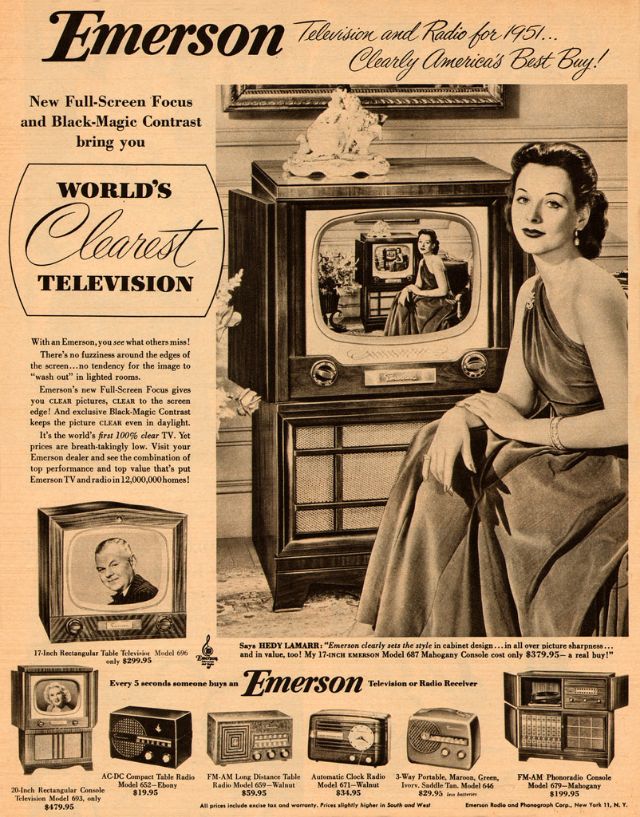
The second aspect to consider when looking at products no longer being "made to last", is the rate of technology advancement. Moore's Law jumps to mind for computer tech, but also things like the rise and fall of CFCs and leaded petrol, Vinyls to cassettes to CDs, VHS to DVD to Bluray etc. Designing a DVD player to last the next 50 years isn't practical because you can almost guarantee the technology will be obsolete by then, but radios made during the 1920-40s (Golden Age of Radio) were built to last (albeit with anticipated parts needing replacement), and TV repair used to be a profession. Part of this comes back to the increased purchasing power again, historically, buying a TV was a significant investment - [Here](https://3.bp.blogspot.com/-w6CWzXZBapQ/Wy3COlOafTI/AAAAAAABdvA/uRo3kkko_E4kSbuAEtudo4dNZKvS5QArgCLcBGAs/s1600/TV%2BAdvertisements%2BFrom%2Bthe%2B1950s%2B%25289%2529.jpg) is an ad from 1951 selling a tv for $299.95, which the Bureau of Labor Statistics calculates as the equivalent of $2,899.25 in 2019.
Technological advancement has also allowed for mass production of products where durability has been traded for low costs. Again Ford gets mentioned for the production line, but things like plywood, MDF and other engineered woods have also changed norms across industries like furniture and construction, and plastics, which are cheap, versatile and easy to make, are another example that's completely changed the consumer goods market from 100 years ago. When it's easier and cheaper to replace something than repairing it, that's what people do, so there's little motivation for companies to invest the money into making things to last.
So TL:DR - planned obsolescence is a relatively new concept, evolving with mass production and mass consumption over the last century or so.
Gartman, D. (1994). Auto-Opium: A Social History of American Automobile Design. London: Routledge, https://doi.org/10.4324/9780203411841
Babaian, S. (1999). The Most Benevolent Machines: An Historical Assessment of Cycles in Canada. Ottawa: National Museum of Science and Technology
London, B. (1932). Ending the depression through planned obsolescence. New York http://classify.oclc.org/classify2/ClassifyDemo?owi=20971786
Slade, G. (2006). Made to Break: Technology and Obsolescence in America. Cambridge, Mass.: Harvard University Press