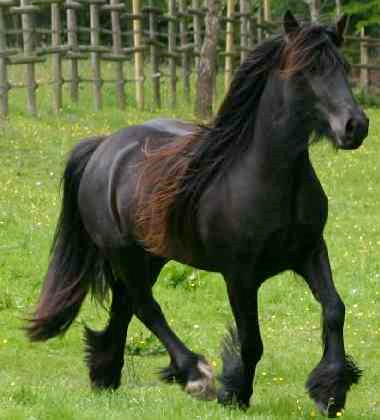
Did they trade for them from Central Asia, like China and India, or were they breeding enough horses on their own in Europe?
In the 4th Century CE, the Western Roman writer Vegetius described in his veterinary text, Digestorum Artis Mulomedicinae four types of horse that were particularly suited for the purpose of warfare. Three were native to western Europe; one from Thüringen, one from Burgundy, and one from Frisia. Only the Hunnish horse was descended from minimally managed nomadic stock, and Vegetius described that beast as particularly ugly. However, the decline of the Roman Empire corresponded with a decline in the quality of bloodstock across Europe. An organized culture of horse breeding would not be revived until the 8th Century, when the Frankish cavalry coalesced after Charles Martel’s victory over Abd-er-Rahman at the Battle of Poiters.
Western European elites, not possessing such fine horses as one could find in the hands of Muslim rulers, both imported and captured Arabian, Turkomen, and Barb stallions to cross on the local marebase as improvers. The genetic influence of oriental horses on European stock began during the 7th Century with early Islamic conquests and the Byzantine-Sasanian War. However, Medieval breeders favored oriental stallions so much so that sire line genetic diversity plummeted to the point where almost every modern horse today is clustered in the genetic haplogroup that those imported blood stallions were part of in the Middle Ages. Further infusions of oriental blood came throughout the Middle Ages as a result of the Spanish Reconquista and the Norman conquest of Sicily.
Even with the penchant for Arabian and Barb stallions, the Medieval warhorse was still only as tall as a large pony or a small horse, perhaps 14.2 to 15 hands. British horsemen in particular mounted themselves on hardy native ponies, ranging from 12 to 14 hands, that had only seen minimal infusions of outside blood from Roman stock. Warhorses would not begin to grow taller until the second half of the 11th Century. The stock of “great horses” began to increase as French breeders imported larger animals from Holland, Frisia, and Denmark. The Medieval warhorse par excellence, however, was not the clumsy, lumbering behemoth one commonly imagines, but an animal with proportions similar to a modern heavy hunter. Such a horse stood about 16 hands, was stout, and had dense bone, but maintained agility on the battlefield.
Warhorses were not just combatants, they were agricultural products. Landowners with a duty of mounted service could breed their own charger, or purchase one from another nobleman if they lacked the means to support broodmares. The organization of breeding programs remained consistent throughout the Middle Ages. The Capitulare de Villis, which regulated royal estates during the later years of Charlemagne’s reign, hints at a system of breeding that strikingly resembles the production of thoroughbred racehorses today. Stallions alone were fielded in combat; mares were needed for the breeding sheds. Highly selective breeding ensured that only the finest stallions would cover mares. And those stallions were shuttled from estate to estate, not necessarily covering the same mare bands two seasons in a row.
Breeding was an industry every member of the noblesse was obliged to participate in. Mares only produce a single foal a year, and may produce just nine or ten offspring in a lifetime, so state intervention was necessary to maintain an appropriate supply of horseflesh for war. Davis describes in his book The Medieval Warhorse one such measure undertaken by France’s King Philip III in 1279:
[E]very knight or noble with 200 pounds worth of land and every bourgeois with goods or property worth 1,500 pounds should possess a brood mare; and that every baron, abbot, count or duke with sufficient pasture should have a stud of four to six mares by...1281.
Similarly, the Croyland Chronicle lists heriots that nobles would have owed to the crown upon death during the reign of William the Conqueror. An earl would owe eight horses and a baron four horses. A vavasour would owe his liege lord a single horse. The heriots were based on those that had been in place for over a hundred years before the Norman conquest of England. Horses were one of the most important bequeaths one could make upon death.
The breeding of horses in Medieval Europe had become an organized industry under the Frankish and Norman elites. The influence of oriental blood, combined with the subjugation of fine grazing lands in Apulia and Calabria, and the importation of larger stock from the Low Countries contributed to a nascent equine industry with mechanics not dissimilar to those breeders and managers employ today. By the end of the 13th Century, thousands of horses were being bought and sold a year, and by the 14th Century the great horse and his knight had reached their zenith. Western Europe had developed an equine tradition, which laid the groundwork for the development of the modern light breeds that would follow the revolutionary introduction of gunpowder into combat.
Sources
Davis, R.H.C. The Medieval Warhorse
Fages, Antoine, et. al. “Tracking Five Millennia of Horse Management with Extensive Ancient Genome Time Series.” Cell
Hyland, Ann. Medieval Warhorse: From Byzantium to the Crusades
Sidnell, Phil. Warhorse: Cavalry in Ancient Warfare
Wallner, Barbara, et. al. “Y Chromosome Uncovers the Recent Oriental Origin of Modern Stallions.” Current Biology
(Now edited to include links illustrating the approximate types of horses I reference)