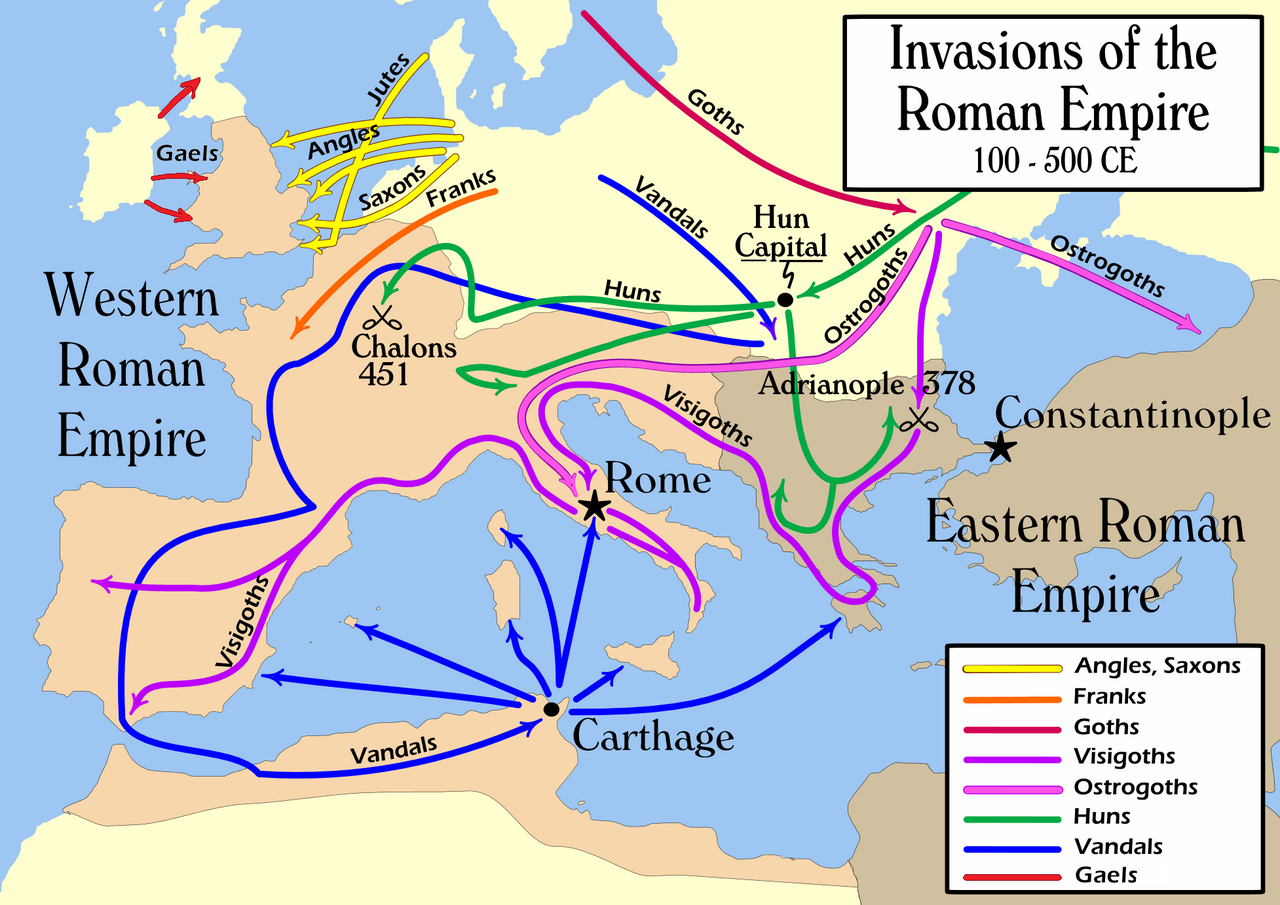
How did things like power and economical structures, culture and landscape change with these sudden mass exoduses? Do we have sources about it? If not, what does archaeology tell us?
I'm mainly interested in the peoples that had a major impact on the Roman world, whose migrations get a large amount of interest in academia and popular history. But if you have a related answer about other migration events, do answer; this question has been asked before by others, but afaik they never got an answer.
This is what you're thinking about isn't it? Large numbers of ethnically distinct peoples moving around in more or less unified wholes across the Roman world in Late Antiquity. Clearly these people had to leave others behind. Those who could not move across the Roman world and as you say, change the world, after all not the entire population of Germany, Scandinavia, and Eastern Europe could possibly just move. What about those people?
Well I'm sorry to tell you, but that map is a lie, or more charitably, a gross oversimplification of an incredibly more nuanced period of time than is commonly understood. Let's start with the most important assumption that you make in your question
What happened to the societies that saw a sudden departure of a significant portion of their population, never to return?
To this I ask, why do you think these people never returned? The first part of Peter Heather's Empires and Barbarians is replete with examples from the archaeological record that shows that movement across the border and into the Roman world was not a one way street. Plenty of individuals sought their fortune in the Roman world, be it as mercenaries, raiders, traders, or some combination of all three, but returned home. He points specifically to the presence of Roman army belt buckles in burials across the Germanic world that show that plenty of individuals went to the Roman empire, served in the military, and then went home, bearing the evidence of their service even into the grave. Many more people probably met their end before being able to return admittedly, or never were able to accumulate the status and importance that was on display in these furnished burials, but there is no reason to assume that all of the people who were moving into the Roman empire in Late Antiquity necessarily assumed they would never return home.
Now later on in the migration period the nature of this movement seems to change, all of a sudden we start to see large groups of men on the move, armies, refugees, something in between on occasion. What about these people? For example the Goths are often the "quintessential" migration group, an ethnic group put to flight by the Huns, some are subjugated, others escape to the relative safety of the Roman empire before being oppressed and abused at the hands of the callous administration. Only again, this isn't the whole truth.
A traditional reading of Jordane's history of the Goths would have you believe that a separate Gothic identity moved across Eastern Europe from Scandinavia to the Black Sea, then attacked by the Huns they fled into the Balkans or were subjugated.
Only that isn't what the archaeological evidence tells us. To his credit, some parts of Jordanes's history are born out, there was a partially Germanic culture on the Black Sea that was ended through a series of disruptions associated with violent conflicts. But did the inhabitants pick up whole sale and move into Dacia and eventually Roman territory as a unique whole? No. For example Peter Heather discusses how the formation of "Ostrogoth" and "Visigoth" identity was a later construction of these disparate peoples once they had arrived in Roman land and were suddenly under pressure to assimilate into a more cohesive cultural unit.
The Visigoths and Ostrogoths couldn't have left a population behind to examine because the Visigoth and Ostrogoth identities did not coalesce until after these groups had entered Roman territory.
England is another useful case study. The Venerable Bede tells us in his history of the English People and Church that different tribes from continental Europe came to England to make their homes and that certain parts of the country were settled by certain tribes, the Angles, jutes, and Saxons, hence names like West Saxons, East Anglians, and so on. Only this isn't how it happened.
Robin Fleming talks about how the "Anglo-Saxon migration" was really a broader movement of North Sea adjacent peoples into Roman Britain. This included people from Denmark (Jutland), and Northern Germany (Saxony), but also people from Norway, Ireland, and Sweden.
Other scholars, though the trend is less pronounced, would even question whether these movements can be categorized as "mass" migrations at all! Indeed, the numbers of people who moved into places such as England, or the Ostrogothic kingdom in Italy, or the Vandal kingdom in North Africa are completely unknown. There have been genetic studies to see for example how much of the population of England is derived from Germanic populations as opposed to "native" British populations, but the results have been mixed and controversial.
But all of this is about what we know, and don't, about the people who did move into the Roman world. What can we know about those who didn't move into Roman territory?
In many cases there is little archaeological work and even less literary evidence (and often the literary evidence that is available is unreliable, having been compiled centuries after the events it intends to convey). In some cases such as Northern Germany, Frisia, and Scandinavia, life seems to have gone on more or less the same way that it had been going for centuries. After all the Roman Empire did not collapse over night, and the changes in the Roman economy away from a specialized urban economy towards a subsistence method of survival was not an instant change, and in the marginal parts of Europe, ie. Northern Germany and Scandinavia the changes were relatively minimal in the grand scheme of Late Antiquity. That is not to say that changes did not occur, human populations always change over time. For example in Scandinavia there are changes in the deities who have place names named after them, but is this because large numbers of Scandinavians ran off to the Roman world? Hard to say.
The major changes in political and economic structures, culture, and so on occurred in those populations that did move into Roman land. Through more direct exposure to the Roman economy, religion (Christianity), legal (and literary) culture, and way of life these people changed. Not immediately, but slowly overtime. In some parts of the Empire, Roman civilization maintained its cultural cachet and the new barbarian rulers went to great pains to portray themselves as Roman rulers, but in other parts of the Empire, Roman civilization utterly collapsed and new cultures, drawing from both the migrants and the native inhabitants were slowly formed. We know that in some cases deliberate cultural ties were maintained between the new inhabitants of some lands and their ancestral antecedents. For example, the material culture of East Anglia in the 6th and 7th centuries is still greatly tied to changes in material culture that were going on in Sweden.
It was only with the later total disintegration of the Roman economy in Northern Gaul and Britain that we see some changes in the populations that stayed behind. These changes are often somewhat obscure to us though, changes in house building patterns for example. What does this tell us about the lived experiences of those people who stayed behind? Admittedly not very much.
In short it is very difficult to discuss the populations of the migratory people who did not migrate. There is a lack of literary evidence almost across the board and archaeological evidence is not always entirely conclusive. (Not to mention how fragmented the world of archeological research is). In many places it seems that life continued much as the way it had for some time until new forces started to be exerted, such as Christianity, the trade emporia of the North Sea, trade with the Islamic world, the consolidation of Frankish hegemony in western Europe, the rise of the Slavs in eastern Europe, and so on. In other places such as the Black Sea there is evidence of violent change, consistent with warfare. All in all the situation is complex and it is difficult to make generalizations across such a large time frame and geographic space.