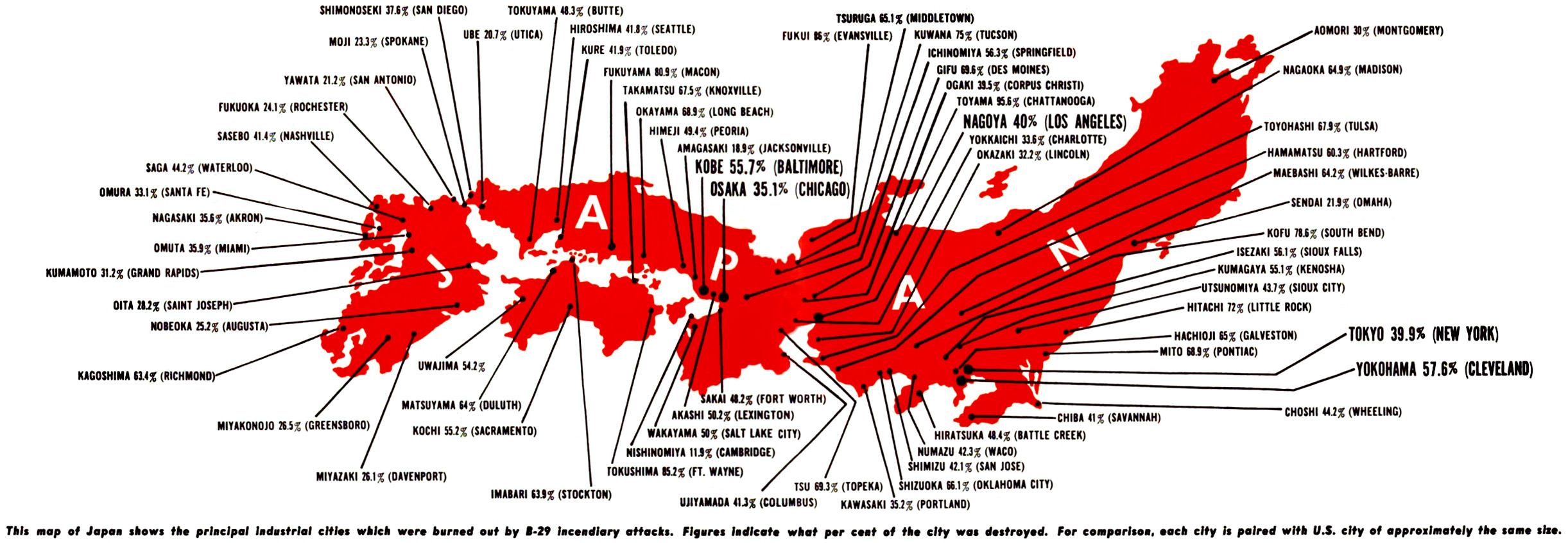
The bombing of Tokyo was not seen as the beginning of a new era, but the beginning of a new form of "business as usual." It was followed up by the firebombing of some 65 other Japanese cities. True, none of these later bombing campaigns matched Tokyo (the Japanese got better at making incendiary raids less deadly, and Tokyo — one of the largest cities of the world — would have had a high death toll no matter what, just as a matter of percentages).
The US itself downplayed the "specialness" of the Tokyo raids, because it wanted to make clear that it did not consider them a violation of any kind of international norm or treaty, and that they were merely another form of warfare. (It is worth noting there were some high-ranking US officials, notably Secretary of War Stimson, who did not see it quite this way; privately, he later spoke to Truman about how such indiscriminate warfare could cause the US to gain a reputation for outclassing Hitler in atrocities.) It is worth noting that the change in strategy that Tokyo represented (low-altitude incendiary area-bombing) was handled entirely by the military; no political figure (e.g., the Secretary of War, the President) was consulted first. It was handled internally as a military tactic (Stimson actually tried to stop further bombings of this sort, to no avail), and not a "political" act.
By contrast, the atomic bomb was handled very differently. The high-ranking civilians (Stimson, Truman, others) did see it as a "political" activity and not a purely military tactic. In one instance (the question of targeting Kyoto), Stimson explicitly asserted civilian prerogative over military judgment and got Truman to back him up on it, to the frustration of the military representative (General Groves). The use of the atomic bomb was not "sold" as "business as usual" but rather as the creation of an entirely new world, both for World War II and beyond. This "publicity"/propaganda campaign was very deliberately plotted in the months prior to the use of the atomic bombs, and was executed within hours of it having been used. The general gist was: the atomic bomb is "special," it is not another form of warfare, therefore Japan should surrender, and the world should get serious about regulated nuclear weapons as a future form of warfare.
But that "specialness" could go too far — when the Japanese started to report large number of radiation-sickness casualties, something that the US government scientists had thought was unlikely to occur, those in charge of the atomic bombings raced to initially deny and then "spin" the radiation-related effects. Today people suggest the radiation is what makes the atomic bombings different, though from a strictly health perspective it's not clear how firm a line that it (there are long-term consequences from radiation exposure, but they are generally not as dramatic as most people think; there are also long-term consequences from regular burns, as well). A lot of the immediate discussion of the atomic bombs by US officials tried to walk a careful line of "this is very new and special" but "this is not unusually cruel or some kind of poison warfare."
It is of note that many in the military, notably General LeMay (the architect of the Tokyo raid and later incendiary raids) resented this spin on things. That map I linked to above was created by the US Army Air Forces as a way to "brag" about their accomplishments — notice that Hiroshima and Nagasaki are just two additional data points in a sea of destruction. The motivation is fairly clear: they didn't want the scientists to take credit for "winning the war" with a new wonder weapon when they, the conventional forces, had done all of the really hard work (at best, they might concede the atomic bombs had "ended" the war but not "won" the war; at worst, many of them actively disputed that the atomic bombings were necessary at all, and that Japan was already "on its last legs").
I bring this up just to indicate that the coding and framing of the atomic bombs is not something one can take for granted. Different historical actors have had different motivations for emphasizing or deemphasizing their "special" nature, depending on the nature of the argument (historical, political, moral, whatever) they are trying to make. In the end, the "atomic bomb is special" argument won out, by a long shot, because of the perceived role it had in the ending of World War II and its later evolution over the course of the Cold War. But there were many who, even after Hiroshima, disputed it was anything more than a more efficient means of doing what conventional raids could already do.
I also feel it is important to note that the atomic bombs were more deadly than the firebombs, even if the death toll was roughly comparable. What I mean by this is, in terms of casualties per square mile, the atomic bombs were far more casualty-producing than the firebombing campaigns, even Tokyo. I have written some length on this here. I only bring it up because there is a misconception that the atomic bombs were somehow less dangerous or deadly, or exactly comparable in their effects. Your odds of surviving firebombing were much higher than your odds of surviving the atomic bombs. The reason that Tokyo had such high death tolls is that the city was one of the most populous in the world. It is the difference between, say, destroying a random block in Manhattan and a random block in Akron, Ohio. Even with the same area of damage, the former would be far more deadly than the latter. Tokyo had a population density of some 130,000 people per square mile; Hiroshima was only 35,000 people per square mile. Nearly 50% of the population of Hiroshima died, compared to about 2% of Tokyo (7% if you count only the people who lived in the directly targeted areas).
On the framing of the "specialness" of the atomic bomb, Michael Gordin's Five Days in August is the source to cite. [I wrote a review of it some years ago if you are interested in my more detailed "take."](http://alexwellerstein.com/publications/wellerstein_ourspecialbomb(endeavour).pdf)
Lastly, I would just note that the Japanese, from about 1954 onward (post end of the US Occupation, spurred also by the Castle Bravo accident), specifically mobilized their status as "atomic victims" in the pursuit of global peace and anti-nuclear weapons activism. The firebombing, though awful, does not seem to be taken up with such potency, at least for international audiences (for internal audiences, there are certainly many Japanese forms of media that engage the firebombings too). Again, there are "stakes" to making the case for the "specialness" of the atomic bombings, even today, just as there are "stakes" for those who would prefer to emphasize Tokyo (usually as a way to head off criticism of the atomic bombings). None of these framings are "neutral" — so we must take care with them, and our reasons for deploying one framing versus another.