I cannot answer to the breadth of your question, but I can speak to the specific situation of the history of Westernized fashion and clothing in Japan.
The transition toward adopting Western fashion began in Japan during the early Meiji period. When the Meiji system rose to power in 1868, Japan was at a heavily weakened place in global politics. Following the “opening” of Japan by the American expeditionary force led by Commodore Perry in 1852, the Japanese were forced to sign a number of treaties with European and American powers that granted exclusive trading rights and extraterritoriality provisions to Western powers. One of the primary goals of the Meiji state was to renegotiate an end to these treaties, which they rightfully saw as exhortative and colonialistic. However, in order to do this, the Meiji elites recognized that they needed to project a degree of authority and power on the world stage that they did not currently have. One of the major ways that they did this was by reforming governmental and military dress to more closely align with Western norms.
Historian Jason Karlin has done a lot of work on this topic, and argues in an article he wrote on masculinities during the Meiji period that the Meiji elite “rationalized the adoption of Western fashion as necessary for reversing foreign perceptions of Japan as backward and uncivilized. The Japanese gentleman's cultivation of civilization through fashion and manner was thus a calculated response to the political need of the state to improve Japan's international status.” By reforming standards of fashion at the highest levels of society and governance, the Meiji government sought to make a claim to equal power in the face of European and American powers. The relationships between power and fashion here was tied up with notions of gender. During this period, Japan was often derided as being feminine and weak by Western nations. The Meiji elite were aware of this perception, and attempted to subvert it by realigning their displays of power and masculinity to more closely align with Western understandings.
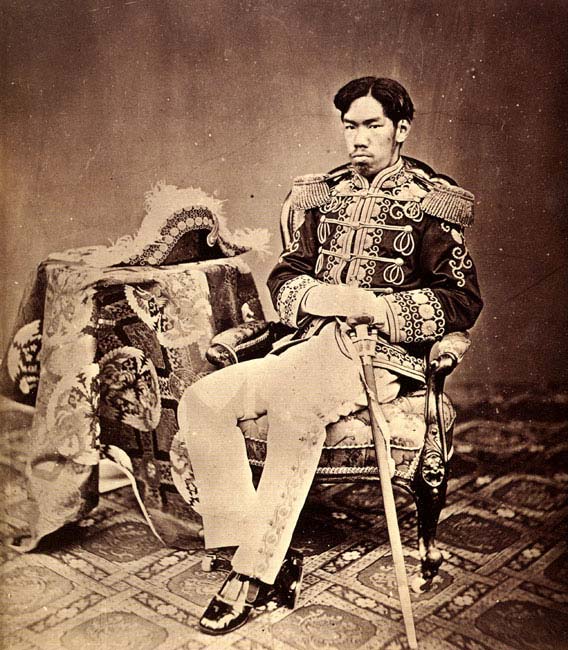
In an imperial rescript issued in 1871, Emperor Meiji declared that he was going to reform the court uniform, because the earlier clothing (which was in a modified Chinese style) “gave the impression of weakness.” Before this rescript, the court clothing was distinctly non-Western--it included flowing robes, sandals, and large hair and headpieces. But, within two years following the emperor’s declaration, the standard official garb of the Meiji elite had completely transitioned toward Western military-style uniforms. This rapid transition is very much evident by comparing two official portraits of the emperor from 1872 and 1873. The 1872 portrait (here) shows the emperor in the traditional garb of the Edo-period emperor. One year later, however, in the 1873 portrait (here), the emperor is shown wearing a Western-style military uniform. Here, he is dressed in a very similar way to other European leaders. He is wearing pants, a military jacket with decorations, a European haircut, and some late 19th century-style facial hair. This transition shows that the emperor was concerned with his outward appearance, and its legibility to those outside of Japan.
At its earliest point, the transition from traditional Japanese fashion to Western fashion was a top-down process that began with the emperor and Meiji elites, and slowly spread to the layperson. Around 1884, the standard uniform for schoolboys became a stripped down version of a Prussian-style military uniform, mirroring the standard uniform in the Imperial Army. Interestingly enough, however, uniforms for girls did not switch to a Western style until the Taisho period (1930s). The adoption of Western clothing outside of the government and government-run facilities was a slow process. This was most due to the fact that Western suits and garments were most often too expensive for the average person to own. But, reticence on the part of the average Japanese to completely change their style cannot be discounted. By 1890, however, the suit was widespread throughout professional life in Japan’s major cities. Businessmen, doctors, and lawyers, all wore suits to their “modern” professions, projecting the same power and masculinity that the Meiji elites sought to perform. Even then, however, the kimono did not disappear from Japanese life. Many, especially those with less wealth, continued to wear traditional Japanese clothing in their day-to-day lives. Moreover, while Western clothing was worn to work and out in public, kimono continued to be the preferred form of loungewear in the home.
But, I have only talked about men, haven’t I? Well, yes. Men’s fashion Westernized (modernized) much more quickly than women’s fashion. Because the Westernization of fashion in Japan was propelled by a desire for a more legible display of political power and masculinity, the same pressures that transformed men’s fashion were not present for female fashion. Kimono continued to be the standard form of dress for women, both in public and in the privacy of the home. Even an increase in the number of women that entered the workforce during the first decades of the twentieth century did not change anything sartorially. Women’s fashion in Japan only really began to change after an event known as the Shirokiya Department Store fire. On December 16, 1932, the Shirokiya Department Store in Tokyo caught fire. Fourteen people died in the ensuing chaos. Only one died from the fire itself, while the other thirteen died from tripping and falling out of windows. The Japanese press seized on the story and depicted the deaths and chaos as a product of the kimono that the female workers were wearing at the time. The media, clothing stores, and employers all began to push women to adopt Western style fashion in order to prevent another event like the Shirokiya fire. Women’s adoption of Western dress proceeded much faster than it did for men. By the outbreak of World War II, working women and many housewives were wearing shorter Western dresses rather than kimono.
To address the second part of your question briefly, I do not think it is accurate to say that traditional Japanese dress did not modernize alongside the shift toward Westernization. Early on during the Meiji period, new textiles and fabrics introduced from expanded trade with the West began to shape traditional Japanese styles. Sheep’s wool, most predominantly, was introduced from European markets and was used to make warmer kimono that had a different texture and feel from existing silk and cotton. Although I cannot speak authoritatively to it, I would be willing to bet that there are many contemporary kimono that are currently being made with synthetic fibres, which were an innovation of the mid-1900s.
Bibliography
Cheng, Eileen J. “Performing the Revolutionary: Lu Xun and the Meiji Discourse on Masculinity.” Modern Chinese Literature and Culture 27, no. 1 (2015): 1–43.
Cook, Jr., Theodore F. “Making ‘Soldiers’: The Imperial Army and the Japanese Man in Meiji Society and State.” In Gendering Modern Japanese History, edited by Barbara Molony and Kathleen Uno, 259–94. Cambridge, MA: Harvard University Asia Center, 2005.
Fujitani, Takashi. Splendid Monarchy: Power and Pageantry in Modern Japan. Berkeley, CA: University of California Press, 1996.
Hirayama, Mikiko. “The Emperor’s New Clothes: Japanese Visuality and Imperial Portrait Photography.” History of Photography 33, no. 2 (May 19, 2009): 165–84. https://doi.org/10.1080/03087290902768099.
Karlin, Jason G. Gender and Nation in Meiji Japan: Modernity, Loss, and the Doing of History. Honolulu: University of Hawaii Press, 2014. http://ezproxy.whitman.edu/login?url=.
———. “The Gender of Nationalism: Competing Masculinities in Meiji Japan.” Journal of Japanese Studies 28, no. 1 (2002): 41–77. https://doi.org/10.2307/4126775.
Roden, Donald. “Thoughts on the Early Meiji Gentleman.” In Gendering Modern Japanese History, edited by Barbara Molony and Kathleen Uno, 61–98. Cambridge, MA: Harvard University Asia Center, 2005.
Schirokauer, Conrad, and Donald N. Clark. Modern East Asia: A Brief History. Boston: Thomson Wadsworth, 2004.
Slade, Toby. Japanese Fashion: A Cultural History. New York, NY: Berg, 2009.
Follow up question:
Why did Asian men adopt very similar outfits as Western men while you can see some differences in female fashion in Asia compared to the western world?