For me one of the best stories out of WWII is the 442nd Regimental Combat Team. I can’t even hope to do their entire story justice, so read up on them if you want more. I don’t know if this is a well known story, but for anyone who has never heard of them, here is a very brief summary.
After the Attack on Pearl Harbour, more then 100k people of Japanese ancestry where relocated from the west coast to camps further inland. On Pearl Harbour itself this was not practical, since about a third of the overall population was of Japanese decent and they where vital to the industry and commerce there. Two regiments of national guard that had about 1300 Japanese Americans(Nisei) in them where sent to the mainland because of fears they might change sides when Japan attacks the island. These two regiments formed the core of the 442nd Infantry Regiment and the 100th Infantry Battalion (Separate).
After a call for volunteers to join the Regiment an overwhelming 10000 Hawaiian Nisei volunteered, of which about 3000 where inducted into the army. The 442nd had white officers and Japanese American troops and NCOs.
They where shipped of to Italy and began fighting there in August of 1944. The Regiment soon became renowned for their tenacity and the 100th Battalion got nicknamed “Purple Heart battalion” for their high casualty rate during fighting around Monte Cassino and Anzio. The 442nd continued to fight in Italy and later France, helping to rescue the “Lost Battalion”, during which they took losses of 140 killed and 1800 wounded in three weeks.
The 442nd is the most decorated unit of the US Army, receiving eight Presidential Unit Citations. The soldiers of the 442nd where awarded 9486 Purple Hearts, 4000 bronze stars and 21 Medal of Honours during WWII. Sadly after the war many veterans where discriminated against when returning to the US, the American Legion for example refused to allow Nisei to join until their white officers protested.
What I find so amazing about the story of the 442nd is that even though Japanese Americans where put in camps during the war, the Nisei still decided they wanted to serve their country and did so in a spectacular fashion.
Some military history anecdotes from Sengoku Japan:
The tea ceremony (chanoyu) was an influential traditional art in premodern Japan, and elites devoted significant time and money to study its choreography and to collecting artworks for use in its ritual gatherings. For warlords of the Sengoku period, tea was pursued alongside other social and cultural rituals like banqueting, falconry, and gift-exchange as a means of maintaining warrior hierarchy and social organization during a period of extreme violence and warfare. In late medieval Japan, cultural practices were not completely separate from military activities but vital to their successful operation. A few anecdotes, taken from my 2016 book Spectacular Accumulation, illustrate this.
In 1574, the warlord Oda Nobunaga was celebrating his victory over the Asakura and Azai armies who had opposed Nobunaga’s brash campaign to pacify Japan. He held a large public celebration on New Year’s day in Gifu, his headquarters, followed by a private party for his elite bodyguards, the Horse Guards or umamawarishu. All present made merry and enjoyed themselves, reciting lines from plays, eating, and drinking from lacquered and gilt objects that were passed around to mark the special occasion. But these were no ordinary cups: upon examination, the lacquered and gilt vessels were revealed to be the decorated, severed heads of the warlords Asakura Yoshikage, Azai Hisamasa, and his son Azai Nagamasa. Nobunaga and his men were literally drinking out of the skulls of their enemies.
In late 1577, the general Toyotomi Hideyoshi, who served Oda Nobunaga, distinguished himself by laying siege to Kozuki Castle (present-day Hyogo Prefecture). When the barricaded soldiers inside realized the desperation of their plight, they killed their own commander and presented the head to Hideyoshi. He accepted, and had it sent to Nobunaga and then proceeded to crucify all of the enemy soldiers including those who had just welcome him. He then toppled the neighboring Fukuokano castle, took 250 heads, and had them all sent to Nobunaga. Nobunaga rewarded his vassal for these military endeavors with a famous and well known metal kettle used for boiling water during the tea ceremony (now in the collection of the Tokugawa Art Museum in Nagoya).
Jumping forward, in 1615, Tokugawa Ieyasu and his son Hidetada launched their second attack on the remnants of the Toyotomi family who were installed in the mighty Osaka Castle. After two days of fighting and siege, the castle fell, and most of those inside fled or took their own lives. The castle, and its huge rooms full of Chinese, Japanese, and even European treasures were destroyed or in some rare cases looted. Ieyasu turned to the task of creating the new legal codes that would guide the Tokugawa shogunate for generations, but he also spared the time to send some of his most trusted vassals back into the still smoking ashes of Osaka Castle to look for the remains of the great Toyotomi treasures. The shards of ceramic tea caddies and the melted lumps of famous swords that they did manage to salvage were then painstakingly remade and preserved with pride in the Tokugawa collection all the way up to the present day. Perhaps owning the swords and tea utensils of the Toyotomi gave the Tokugawa a kind of imagined authority over the memory of their vanquished enemies.
(For more, please check out the book, available in ebook, paperback, and hardback. Spectacular Accumulation: Material Culture, Tokugawa Ieyasu, and Samurai Sociability. Honolulu, HI: University of Hawai’i Press, 2016. Winner, 2016 Book Prize, Southeastern Conference of the Association of Asian Studies.)
While many stereotypes exist about the performance of the Soviet Red Army in WWII, for the men and women of the Narodnoe Opolcheniye (people's militia), many accounts exist that portray an ill-equipped and under-trained band that was thrown away by the thousands in order to buy time for regular army units to be mobilized and deployed.
These men and women were not an insignificant number for the Red Army. Richard Overy estimates that 159,000 fought outside Leningrad, with another 120,00 fighting outside Moscow (Richard Overy, Russia's War 80).
The training, equipment, and performance of these units was tragic and dire. The 1st Division of the Leningrad Army of People’s Militia gives us an example of how ill-prepared these units were. It had a higher than normal number of communist party and communist youth (komsomol) in its ranks, but only 20 full cadre officers. (Alexander Hill, The Red Army 229-231).
By the Red Army’s own evaluation, the commanders at best had experience from the Civil War or World War I, and were said to be “insufficiently clear on the nature and character of modern combat.”
A “significant number” of the infantry “were completely lacking military education or had not gone through pre-conscript training.” David Glantz noted that the militia often lacked the physical ability and stamina necessary for soldiering. (David Glantz, When Titans Clashed 81).
There are accounts at Leningrad of rifle sharing, with the shortfall being made up of grenades, molotov cocktails, or melee weapons. The 1st Leningrad Division (a militia unit) “completely lacks anti-tank artillery and anti-aircraft resources.” Even light artillery and machine-guns were limited. Despite the report estimating that at best the unit was suited for 1-2 days of defensive fighting, it was thrown into the attack twice. Only making it to within 1000 meters of the enemy, the unauthorized withdrawal was chaotic.
In Ukraine in 1941, political commissar Nikita Khrushchev messaged Stalin and the Stavka (Red Army high command) and asked for weapons in order to set up a militia unit and block the German advance. He was told to use "pikes, swords, anything you can make." (Richard Overy, Russia's War 80).
Abraham Evseevich Gordon fought in one of these units outside Moscow and describes a similar scene. According to Gordon, the men showed up in a hodgepodge manner, some on bikes, some walking. They wore black uniforms, which may have been captured from Poland. Many of their rifles were definitely of Polish design, though Gordon noted that not every man was armed. Part of his training included riding horses bareback. Some of the militia outside of Moscow included women and men in their fifties.
An opelcheniye unit near Kursk had assembled in July 1941 and still had not received training by September.
In August, Gordon’s unit was absorbed into the Red Army and renamed the 113th division, but even then, the men weren’t trained well. Gordon reports that he fired a rifle twice by that time.
In October, the 113th was tasked with blocking the Warsaw to Moscow highway against German panzers. The ill-trained men got nervous and fired most of their ammunition before the enemy was in proper range. For the tanks, they had a small supply of molotov cocktails, which were used up as the panzers bore down on them. By that night, the division was down to only 300 men, and Gordon was eventually captured by the Germans, though he later escaped. (Catherine Merridale, Ivan's War, 120-124).
This wasn’t limited to 1941, either. According to Antony Beevor, workers were pulled off the assembly line at Stalingrad during the German approach in September. He describes the scene saying:
“Those workers not directly involved in producing weapons for immediate use were mobilized in militia ‘special brigades’ under the commander of the l0th NKVD Division, Colonel Sarayev. Ammunition and rifles were distributed, but many men received a weapon only after a comrade was killed. In the northern industrial suburb of Spartakovka, badly armed worker militia battalions were sent into battle against the 16th Panzer Division with predictable results.” (Antony Beevor - Stalingrad: The Fateful Siege 109-110).
Out of around 150,000 militia at Leningrad, estimates for three months of fighting range from 43,000 dead to half of their men killed.
Even if these ill-trained, under-equipped, and poorly led men and women survived, it wasn't always a rosy picture. Merridale also notes that even men who lived through the opolcheniye and transitioned to the regular Red Army weren’t guaranteed to be respected. She argues that many lost their paperwork and then were considered MIA or deserters, losing their family any chance at a pension and having increased stigma and scrutiny. (Ivan's War 124).
Sources used:
David Glantz and Jonathon House - When Titan's Clashed
Richard Overy - Russia's War
Alexander Hill - The Red Army
Antony Beevor - Stalingrad: The Fateful Siege
Catherine Merridale - Ivan's War
I want to talk about the Battle of Dien Bien Phu, what is arguably one of the worst military blunders of the 20th century. In my mind it stands alongside such tragic events such as Gallipoli or the ill fated Operation Market Garden. It is also all the more tragic for what it would entail for the future, being one of the major motivators that would land US troops in Da Nang 11 years later. I will open my story with a quote from the French commander of forces in Indochina on the eve of the titular battle: "A year ago none of us could see victory. There wasn't a prayer. Now we see it clearly - like light at the end of a tunnel."
Context
I always like to begin my little essays with a bit of contextualization. After all we need to see the battle in its context to understand the tragedy of it all and why I might class it as a blunder.
The year is 1953 and General Henri Navarre has just been appointed by French PM Rene Mayer to command French forces in Indochina. His goal is to create conditions for an "honorable" withdrawal from Vietnam. By this point the war had been going on between the French colonial forces and the Viet Minh for around 7 years. There were no clear signs of victory for the French even with massive assistance via funds, equipment, and advisers from the United States. In what would be echoed by President Richard Nixon nearly two decades later, the French were seeking a way to exit Vietnam with their reputation still intact. Both would meet the same fate.
General Navarre devised a plan to cut off Viet Minh supply lines coming out of Laos as far North as he could go. He decided to make his stand in the northwest of Vietnam at Dien Bien Phu. The area had been floated as it already had a Japanese airfield leftover from the second world war. His overall strategy hinged on lessons learned at the battle of Na San in 1952, when forces under Vo Nguten Giap suffered great losses when attacking the isolated French outpost. The outpost at Na San was entirely supplied by air and utilized superior French artillery to deliver crushing losses to the forces under Giap. Navarre wanted to draw Giap into a similar situation at Dien Bien Phu by emulating the conditions at Na San.
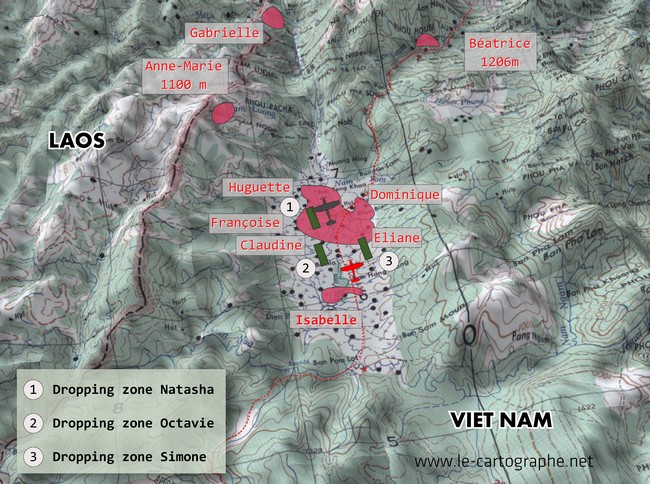
General Navarre would rely on a strategy called the "hedgehog defense." This is a defense in depth strategy meant to create interdependent strong points that would drain enemy resources over time. The thinking was that you have spread out strong points that are very costly to attack, eventually draining the attack of momentum and resources before the main target can be reached. Here is one of the clearer images of the defenses set up at Dien Bien Phu I could find. Beatrice would be the first of the outposts to be attacked by the Viet Minh. Within 4 days later both Gabrielle and Anne-Marie would be silenced by the Viet Minh cutting off any overland supply routes the French possessed.
Lessons Learned
We must now talk about what General Navarre missed about the lesson at Na San. In what is oddly foreshadowing of the failure of the US to learn the right lessons at the battle of the Ia Drang, Navarre ignored several crucial factors. One of the most important was the fact that Na San occupied much of the high ground and was able to catch Giap's forces out in the open with artillery. Dien Bien Phu lay at the bottom of a valley, something that is deeply troubling from the start. The only positions holding any sort of high ground were lost within the first 5 days of battle. This is due to a crucial underestimation of Viet Minh forces strength and ability at this point of the war. We might say that Giap learned the right lessons from Na San. Navarre assumed that the Viet Minh lacked anti-aircraft and proper artillery. Both of which were untrue as the People's Republic of China had supplied the Viet Minh with fresh weaponry. Giap had learned the hard way the value of holding the high ground over your enemy. Giap's forces meticulously dug camouflaged fighting positions above the French in the highlands for AA and artillery. They were arranged such that the artillery could practice direct fire, where artillery teams spotted their own targets. This combination of high ground and camouflage allowed the Viet Minh to see exactly where French artillery pieces were but did not allow the French the same advantage. (This situation supposedly led directly to the suicide of the French artillery commander at Dien Bien Phu.) This is very important as the French relied heavily upon their artillery at Na San to inflict devastating losses on Giap.
Navarre also failed to keep the air supply routes open for his forces. Giap had concealed and amassed his antiaircraft guns in such a way that resupply was extremely costly to the French. This would lead to a severe imbalance in the total force strength between the French and Viet Minh. According to a 1994 US Army report (Pg. 33-36) investigating the battle there were at their peak 15,108 French troops to 50,000 Viet Minh supported by 10-15,000 logistics troops. By the last attack launched by the Viet Minh, only 3,000 exhausted French troops faced down 25,000 Vietnamese troops. Grimly, 3,000 would be the estimated amount of French survivors from the battle by the time all prisoners were returned. By that time French ammunition and even water stores were running drastically low. Nearly two months after the first outpost fell, Dien Bien Phu had been overrun.
Conclusion
I will not go into a detailed accounting of the week to week combat, as books like Hell in a Very Small Place or the above cited report on the Generalship of Navarre have. At times Viet Minh morale wavered, especially as the French resorted to trench warfare. Ultimately the French would find themselves outgunned, out manned, and outmaneuvered. Giap had learned valuable lessons whereas Navarre had ignored to most crucial points of his own. It led to crushing defeat for the French and began the peace talks that would end the war for France and divide Vietnam in two. The French government that had backed Navarre resigned and a new center-left government would negotiate peace with the support of the French Communist Party. The division of Vietnam would set the stage for a long and bloody civil war that was only an extension of the fight Ho Chi Minh began against the Japanese in the 1940s. This would ultimately mire the United States in what is, in my opinion, the most tragic and painful period of American history since the Civil War. Dien Bien Phu was not only a tragedy for the French, but a tragedy for all involved and who would be involved in the future. Vietnam had not earned its independence that day, but had begun the next stage of the fight.
I will close with a reminder of the opening quotation:
I see light at the end of the tunnel.
- Walt W. Rostow, National Security Adviser, Dec. 1967
Since this floating feature concerns military history, it would be remiss of me not take this opportunity to discuss one of my favorite late Antique sources. A source which has exerted a great deal of influence on the history of European military thought particularly during Medieval times. I am, of course, talking about Vegetius and his epitome which is most commonly referred to as the De Re Militari. My impression is that Vegetius, at least amongst the general populace, is somewhat unknown. In this text I want to present Vegetius to those of you who may not know much about him. To those of you who are well aware of him and the importance of his work, I offer an interpretation and theoretical perspective of the De Re Militari that I have found particularly fruitful in my own studies as a (now former) grad student. Hopefully someone finds this an interesting read if nothing else.
Publius Flavius Vegetius Renatus
It should be noted that very little is actually known about Vegetius. Most of the information about him is uncertain and almost every detail about his life has been and continues to be debated by scholars. That said, Vegetius was most likely born in Spain or at least in the western parts of the Empire. Of the texts he authored, two survive to our day; his Epitome of Military Science known as the De Re Militari, which called for several reforms of the Roman military, and a compendium on veterinary medicine for horses and cattle known as the Digesta Artis Mulomedicinae. The latter work has proved to be an invaluable source of information on Vegetius as a historical figure. For instance, thanks to the Mulomedicinae, we know that Vegetius was a great landowner and an excellent horse breeder who travelled all over the Empire. This is quite clear since he dedicated a great deal of attention to the Hunnic warhorse in his veterinary manual. In addition, Vegetius seems to be very knowledgeable of the Western barbarian world which is in part reflected in his familiarity with Celtic and Germanic vocabulary. This is interesting since Vegetius, as those of you who have read this works know, had a rather negative view of non-Romans in the army.
In addition to his surviving texts, Vegetius' full name Publius Flavius Vegetius Renatus as well as his titles also reveal some notable details about him. It is known that he was a Christian since he alludes to God on several occasions in the De Re Militari. However, this is also shown by his name Renatus which means “born again”. His name Flavius is perhaps the most telling in this context. Real Flavii, that is members of the ancient family of Flavius, were exceptionally uncommon during late Antiquity. Nevertheless, it became common in the West to call imperial servants Flavius in combination with their last name. However, if Vegetius had been a western imperial servant then he should have been recorded as having the name Flavius Renatus, which is not the case. This may instead suggest that he had ties to the imperial government in Constantinople since in the eastern parts of the empire imperial servants adopted Flavius simply as an extra name. Furthermore, Vegetius is documented as a vir inlustris comes, a title reserved for the highest ranking individuals within the imperial bureaucracy. By Vegetius' own words he was not a military official and made no claims of having great military knowledge. It is important to note that during late Roman times magistrates were no longer, generally speaking, military commanders as was the case (at least for consuls and praetors) during the Roman republic. Hence, it is not strange that a high-ranking late Roman imperial bureaucrat would lack military competence.
There is no scholarly consensus in regard to the question of when Vegetius lived and the related issue of what emperor he dedicated his De Re Militari to. N. P. Milner provides an excellent overview of the different arguments on this issue in the introduction to his translation of Vegetius' chef d'oeuvre. Most scholars agree that the De Re Militari cannot have been written before the death of Gratian (AD 383), since Vegetius mentions Gratian as divus Gratianus, or after the mid-fifth century. The most common candidates mentioned as the dedicatees of Vegetius' text are Theodosius I (379-395) and Valentinian III (425-455). The modern-day proponents of Valentinian III (i.e as the dedicatee) often draw attention to the fact that Vegetius, in the first book of the De Re Militari, refers to a long period of peace that had led to a decline in military training. The most plausible period of long peace that Vegetius could be referring to, according to scholars like Goffart, must have been the time between Gratian's death and Alaric's offensive in Italy that culminated in the sack of Rome (410). Since no satisfactory Roman response to Alaric's invasion could be carried out during the reign of Honorius the most likely dedicatee of Vegetius' work was Valentinian III. Milner disagrees with this view and instead maintains that Theodosius I is a far more feasible dedicatee. This is partly because Theodosius I seems to better fit with the references Vegetius gives in his text. For instance, Vegetius hints at the battle of Adrianople but does not mention the sack of Rome. As such, he is probably writing after 378 but before 410 which makes Theodosius I the most likely dedicatee. I tend to agree with Milner, even though it should be noted that a study by M. B. Charles from 2007, which analyzed Vegetius' language use, dates the De Re Militari to the mid-fifth century. I suspect this debate about the dating of Vegetius’ work will never be completely settled.
Interestingly, and perhaps rather ironically, Vegetius and his work had greater influence during the Middle Ages than it ever did during late Antiquity. Of course, it had a tremendous legacy concerning military thought in Medieval Europe, but as Christopher Allmand and others have shown, the De Re Militari had an even wider influence. The text was copied, commented upon, translated into different languages and coupled with other texts like Giles of Rome's De Regimine Principum. Its ideas were continuously reinterpreted in accordance with the needs of the time. The De Re Militari, and ultimately Vegetius himself, helped shape ideas about the status and role of the soldier in society, the need of permanent national armies, how societies should be governed and how force could be used for the common good.
The story of Sergeant Candelaria Pérez
Candelaria Pérez was born in Santiago de Chile in 1810. Beyond small details, such as the fact that she grew up in poverty in the neighbourhood of la Chimba and that she was illiterate, considerably little is known about her childhood. Unfortunately, this makes it difficult to paint a complete picture of this extraordinary woman's life outside of her martial career. What is certain is that she moved to the port city of Valparaiso as a child where she, as a young woman, began to work as a domestic servant. In the early 1830s, she was hired by a Dutch family who in 1833 relocated to Callao, Peru. Details are sparse, but Pérez apparently began to work in the business run by the family she was employed by, which likely put her in contact with other members of the foreign families living in Callao at the time. When Pérez ended her employment with the Dutch family is unknown, but she remained in Callao and thanks to the help of a British friend, opened her own food stall which she named Fonda de la chilena. It attracted all sorts of customers in the port city, but it most importantly attracted plenty of Chilean customers who flocked to the stall for a piece of home. This would unfortunately lead to her downfall and subsequent change of career.
While Pérez went from being a domestic servant to becoming a businesswoman in her own right, the nation of Chile was undergoing new challenges after a recent civil war in 1829-1830. One of these challenges came in the shape of her neighbour, Peru. In the early 1830s, unresolved matters of debt promptly caused a tariff war between the two nations that was resolved in 1835, only to be immediately followed a year later by a sudden change in geopolitics. 1836 saw the unification of Peru and Bolivia into a confederation, effectively becoming a threat to Chilean geopolitical interests. If that wasn't enough of a serious threat, remnants of the late civil war in the form of a military force led by the exiled General Freire crossed into Chile from Peruvian territory. Although the force was defeated, its choice of Peru as a staging point was as good as any reason for Chile to set out to destroy the Peru-Bolivian Confederation once and for all. After initial hostilities (in which Chilean forces seized Peruvian ships in Callao), Chile gave the confederation an ultimatum that required its dissolution. This was rejected. War was declared.
As a Chilean woman running a business that was explicitly Chilean and attracting Chilean customers in Peru, Pérez became a target almost immediately. Her stall was sacked and emptied by Peruvian soldiers. This hostile act made Pérez turn completely on the confederation and as an act of defiance, she made the choice to assist Chilean forces in the war. She began by providing intelligence to the nearby Chilean fleet, but Pérez was caught and imprisoned. After being released months later, ostensibly for reasons of mercy, Pérez immediately sought and found the Chilean army in Lima (occupied by Chile since late August 1838). Pérez offered her services to the Chilean army which promptly accepted her into their ranks on basis of her local knowledge and contacts with people still in Callao (where Peruvian forces had retreated to). From that day on, Pérez served in two roles. Her first role was that of a cantinera, a role that could be defined in the Chilean context as an imbedded regimental nurse. Her second role, however, was similar to a reconnaissance scout; she accompanied skirmishers as she helped them, as well as the battalion she was imbedded in, to find the enemy. No matter where she was, she was always at the very front. Although Pérez had so far mostly served in an unarmed role, this would all change on January 20, 1839. In the fight for the the hill Pan de Azúcar, part of the battle of Yungay, Pérez participated as part of the Carampangue battalion. In the assault on the hill, Pérez walked in the first line. Yet this time, she did not participate as a guide. This time, she participated as a soldier. With a musket in her hands, she walked alongside the men as they climbed the heights and encountered the heavy fire of the enemy which caused many casualties in the battalion. Yet Pérez did not falter. She rallied the men, shouting for them to fight for their country while at the same time throwing "coarse insults" (in the words of one of her biographers) back at their enemies. In the end, the defenders of the hill were driven away at the point of Chilean bayonets. The battle of Yungay was to be the final battle of the war. It was a decisive Chilean victory. The bravery and tenacity shown by Pérez during the battle was immediately recognized by everyone who had witnessed her actions. For her actions, Pérez was promoted to the rank of sergeant. From then on, she would be known as "La sargento".
As the war came to an end, the Chilean people showed their appreciation. Pérez not only joined the rest of the triumphant Chilean army on a victory march down the main avenue in Santiago while wearing a uniform, but she was also granted a pension by the Chilean congress as well as yet another promotion. Her fame was immediate and only the triumphant General Manuel Búlnes could claim to have acquired a higher fame than Pérez during the war that would ultimately be known as the War of the Confederation (Guerra de la Confederación). Her legend as a Chilean Joan of Arc, however, was constructed over time, reaching its climax within her own lifetime in the play La acción de Yungay (1849) in which her actions during the battle were reenacted. Pérez herself attended one performance. The audience gave her a standing ovation in acknowledgement of her service. This, however, was the last act of appreciation. Her military pension did not make it possible for her to live comfortably. She lived out the last decades of her life in isolation and neglect, receiving her meals from a nearby convent while suffering from several illnesses. When famed Chilean historian Benjamín Vicuña Mackenna came to visit her in 1869, he met a small, humble old woman who spoke for two hours straight about her life and her experiences while smoking a cigar. A year later, the illnesses that defined her last decades of her life ultimately took it for good. The date was March 28, 1870. Two days later, Pérez was buried. Only five people attended her funeral, but a member of the party had alerted the commander of the Buin battalion. Ultimately, she would be buried accompanied by a honor guard from the battalion, providing her with the proper rites fitting for a military veteran.
Although Pérez would go down in historical memory and legend as a patriotic hero, she also had a more tangible legacy in the Chilean army. She was the first cantinera, the first woman officially integrated in the Chilean army. She wouldn't be the last. 9 years after her death, many more women would follow in her footsteps as Chile went to war against Peru and Bolivia yet again. They would all have Pérez to thanks for paving their way for their integration and making it possible for them to not only wear the uniform of a cantinera, but also to be entitled to a military pension after the war was over and done with. Many of those women would also take up arms in some of the pivotal engagements of the war. Some would also pay the ultimate price for their participation.
Sources:
Most of what we know about Pérez are drawn from contemporary accounts in Chilean newspapers, military communications during the war, as well as post-war accounts given on her life. Only one biography has been written about her.
La Sarjento Candelaria in Miscelanea: Collecion de Articulos by Benjamín Vicuña Mackenna (1872).
La Sarjento Candelaria Perez by Luis Ignacio Silva Arriagada (1904).
"De héroes y mártires. Guerra, modelos heroicos y socialización nacionalista en Chile (1836-1923)" by Gabriel Cid in Mélanges de la Casa de Velázquez, 46-2 (2016), 57-78.
A History of Chile, 1818-2002 by Simon Collier and William F. Sater (2004).
La Presencia de la Mujer Chilena en la Guerra del Pacífico by Paz Larraín Mira (2006)
I want to highlight the US Coast Guard's role in World War II, starting with Captain Quentin Walsh, who will be the namesake of US Navy Arleigh Burke-class destroyer DDG 132.
CAPT Walsh, then a Lieutenant Commander, served on the staff of Commander, US Naval Forces Europe, and helped with Operation Overlord (D-Day invasion) planning. One of his tasks was to create a plan to resupply troops via ship after the initial invasion. LCDR Walsh formed Navy Task Unit 127.2.8 with 50 Navy Seabees (CB = Construction Battalion, combat engineers).
Landing on Utah Beach four days after D-Day, LCDR Walsh led this unit to capture the port of Cherbourg, France and prepare it for supply ships. His task force fought their way through the city, suffering 25% casualties, and captured the harbor and 400 German troops.
LCDR Walsh now learned of American paratroopers being held prisoner in Cherbourg's citadel. When asked by Navy LT Frank Lauer how he planned to capture the fort with so few men, he responded by asking if he had ever played poker. LCDR Walsh and LT Lauer approached the citadel under flag of truce, using a captured German to lead them through the minefield around the fort, and convinced the German commander to surrender, capturing another 350 Germans and liberating 52 American soldiers. They then began clearing the harbor of mines and debris. His actions here earned him the Navy Cross, the second highest award in the Navy/Coast Guard.
His unit was disbanded days later, and LCDR Walsh became Cherbourg's assistant port director, keeping the supply lines open as the Allied forces pushed deeper into France. A month later, LCDR Walsh was pulled from this duty to lead a party of 400 men in General Patton's Third Army to inspect other ports. Together with the First Canadian Army they captured and reopened the port of Le Havre.
LCDR Walsh later contracted pneumonia and was hosiptalized, ending his part in the war. He later oversaw the transfer of the Bureau of Marine Inspection and Navigation from the Commerce Department to the Coast Guard. In 1946, he was retired due to physical disabilities.
In 1951, he returned to active duty for the Korean War, serving as a liaison between the USCG and Treasury Department (the Department the USCG was under at the time). He also served as an aide to the Assistant Secretary of the Treasury overseeing the USCG. He retired for good in 1960.
The announcement of the naming of USS Quentin Walsh (DDG 132) marks the first Arleigh Burke-class ship named for a USCG member, although there have been several other Navy ships with USCG namesakes. The announcement was made on the 75th anniversary of D-Day onboard the USCGC Eagle (a former Nazi sail training ship) , while moored at Cherbourg, the port CAPT Walsh captured.
Sources: https://www.navy.mil/submit/display.asp?story_id=109820
https://coastguard.dodlive.mil/2016/07/the-long-blue-line-quentin-walshs-long-colorful-career/
https://www.military.com/coast-guard/capt-quentin-r-walsh.html
http://www.victoryinstitute.net/blogs/utb/1944/06/26/quentin-r-walsh-navy-cross-citation/
Before he started writing, Leo Tolstoy was a young nobleman who spent his time womanising (in particular, with peasant girls on his estate), drinking and gambling. His gambling habits led to severe debt. On one occasion in 1850, Tolstoy lost 4,000 rubles playing cards - a huge amount, considering the average monthly salary in Russia at that time was around 25 rubles. So when his brother Nikolay invited Tolstoy to join him on a military campaign in the Caucasus, Tolstoy jumped at the opportunity to start from a clean slate. Since the 1800s, Russia was involved in a campaign of suppression against Chechens, Avars and Circassians. Arriving in 1851, Tolstoy found himself fighting in Chechnya with the rank of Bombardier, 4th class, in the 4th Battery of the Russian Army's 20th Artillery Brigade.
The Russian army, similar to all other ‘Great Power’ armies in the 19th century, was wholly unsuited to fight an insurgency. However, bitter experience had forced the Russian army to adapt, and under Prince Mikhail Vorontsov, a brutal strategy was utilised. The Russians cleared woodlands and decimated villages, sweeping areas in which Chechen fighters could hide and rest. Tolstoy was involved in several raids against insurgents, and recounted his experiences in the short work ‘The Raid: A Volunteer's Story,’ which was published anonymously. ‘The Raid’ contains many observations of the Russian military that Tolstoy would return to in his Sevastopol writings. Disgust at the pretensions of the Russian officer class was a major theme, with sarcastic portrayals of the romanticism of newly arrived officers, as well as the cynicism of older officers. In one particularly stinging sentence, Tolstoy wrote:
The battalion commander, expressing his rank on his fat face, set to eating.
The absurdity of fighting, and by extension the Caucasian campaign, is highlighted by the actual raid in the story. The Russian party encounters little resistance; the only captive they manage to take was a helpless old man; and the loot found consists of a rag, a tin basin, two hens, and a white goat.
But what Tolstoy discusses the most is the concept of courage. In ‘The Raid,’ the narrator redefines his idea of bravery under fire. At first, he takes the ‘the absence of fear when in danger’ as bravery, and admires a Spaniard who rushes into the thick of battle in bright apparel. However, under the influence of his captain, who suggests that courage is linked with discipline, and that it is not brave to push in where one is not ordered, the narrator comes to a new definition:
It seems to me that in any dangerous situation there is a choice, and a choice made under the influence, for example, of a sense of duty shows bravery, while a choice made under the influence of a base feeling shows cowardice. A man, therefore, who risks his life out of vanity, or curiosity, or cupidity cannot be called brave, and, conversely, a man who turns away from danger under the influence of an honourable feeling of family obligation or simply conviction cannot be called a coward.
These themes would be further explored when Tolstoy marched east to participate in the Crimean War. The immediate cause of the war was a dispute between Russia, France and the Ottoman Empire over access to holy sites in Jerusalem and the protection of Christians in the Ottoman Empire. However, more fundamentally, the war came about due to French and British concerns over Russian expansionism in the Caucasus and the Balkans. Wishing for a change in scenery, Tolstoy applied for transfer to the Danubian front, and his request was granted in January 1854, along with a promotion to the rank of ensign.
Involved in the siege of the Ottoman fortress town of Silistra, Tolstoy was bitterly disappointed when Russia was forced to pull back due to diplomatic pressure from Austria. Retreating with the main Russian force to Kishinyov, capital of Bessarabia, Tolstoy expressed his irritation at the luxurious living of the officer class, in particular two balls thrown for visiting Grand Dukes. Applying for transfer once again, he was assigned to the 14th Light Artillery Brigade. Arriving at Sevastopol in mid-November 1854, Tolstoy, although not on active duty, was able to visit the fortifications and rear areas, from which he drew inspiration for his first Sevastopol piece, ‘Sevastopol in December, 1854.’
‘Sevastopol in December’ was in the vein of the realistic war reporting that emerged in the Crimean War. Tolstoy writes of the narrator’s visit to the amputation room:
In yonder room they are applying bandages and performing operations. There, you will see doctors with their arms blood-stained above the elbow, and with pale, stern faces, busied about a cot, upon which, with eyes widely opened, and uttering, as in delirium, incoherent, sometimes simple and touching words, lies a wounded man under the influence of chloroform. The doctors are busy with the repulsive but beneficent work of amputation. You see the sharp, curved knife enter the healthy, white body, you see the wounded man suddenly regain consciousness with a piercing cry and curses, you see the army surgeon fling the amputated arm into a corner, you see another wounded man, lying in a litter in the same apartment, shrink convulsively and groan as he gazes at the operation upon his comrade, not so much from physical pain as from the moral torture of anticipation.
In another passage, Tolstoy writes of the inevitable differences in opinion of frontline troops and those in rear areas, especially in regards to the ‘fourth bastion,’ the focal point of attacks due to its proximity to French lines.
On the whole, two totally different opinions exist with regard to this terrible bastion; one is held by those who have never been in it, and who are convinced that the fourth bastion is a regular grave for every one who enters it, and the other by those who live in it, like the white-lashed midshipman, and who, when they mention the fourth bastion, will tell you whether it is dry or muddy there, whether it is warm or cold in the mud hut, and so forth.
Yet, ‘Sevastopol in December’ is unabashedly patriotic. Tolstoy describes the stoicism and cheerfulness of the officers and conscripts stationed at the fourth bastion, and is convinced of the inevitable victory of Russia.
Men will not accept these frightful conditions for the sake of a cross or a title, nor because of threats; there must be another lofty incentive as a cause, and this cause is the feeling which rarely appears, of which a Russian is ashamed, that which lies at the bottom of each man's soul - love for his country...You comprehend clearly, you figure to yourself, those men whom you have just seen, as the very heroes of those grievous times, who have not fallen, but have been raised by the spirit, and have joyfully prepared for death, not for the sake of the city, but of the country.
‘Sevastopol in December’ was published anonymously in St. Petersburg through the literary journal The Contemporary, and was received with much praise by a public yearning to understand the realities of the conflict. The Tsar himself read it, and ordered it to be published in the government’s own official journal, Le Nord. By that time, Tolstoy was already fully involved in the fighting due to another transfer to the 3rd Battery of the 11th Artillery Brigade in January 1855. Stationed at the fourth bastion that he had spent much ink on from 5 April onwards, he was submitted to a continuous bombardment by French and British artillery. Rotating in and out of the fourth bastion, Tolstoy was involved in a battle on 10 May that resulted in 2,500 casualties on both sides. New orders to command the artillery section of a mountain platoon twelve miles out of Sevastopol on 15 May meant that his stint at the fourth bastion was over, but he already had a strong grasp on the realities of war.
Continuing with the theme I’ve been following so far, today I’m diverging slightly from the world of Mausers though to look at one of my favorite bolt-action designs of the early 20th century, the M1903 Mannlicher–Schönauer.
In the late 19th century, after a failed attempt at adopting a domestic design known as the M1872 Mylonas, which saw only 8,000 or so built by Nagant in Belgium, the Greek military decided on the Gras M1874 as their weapon of choice. A sturdy French design, it was state of the art at the time, and a reliable backbone to arm ones infantry with. Fatefully though, the French factories couldn’t built them for Greece, who lacked the facilities to do so themselves, resulting in a contract with Steyr in Austria-Hungary, who built at least 123,600 rifles for Greece over the next decade.
At the turn of the century, when 11x59mmR, single-shot rifles were showing their age, most armies by now having moved to magazine-fed designs in smaller calibers, Greece again needed to seek out a new arm for their soldiers. The strong relationship established with Steyr led them to simply look directly to the Austrians rather than the multi-party arrangement of the past. Attempts were made though to again bring in a domestic design, this time the Philippidis Rifle, named after the 17 year old designer. Unlike the Mylonas, it even looked promising,. But although it would have been built by Steyr in any case, they objected as the Mannlicher influenced design infringed patents, they claimed, and after heated Parliamentary debates, a more proven design was accepted instead.
Although the Austro-Hungarian military fielded an excellent rifle in the M1895 Mannlicher, a reliable 8x56mmR straight-pull rifle, this didn’t appeal to them as much as the newer turn-bolt Mannlicher–Schönauer Model 1900, itself influenced by the earlier German Model 1888 ‘Commission Rifle’. To be sure, it had much to recommend itself in terms of quality, but less so in terms of the needs of a military, let alone one on a budget. A complicated design, and expensive to produce, the Mannlicher–Schönauer was billed both for sporting and military purposes, and the action even today remains sought-after by hunters looking for a high-quality rifle, with a quiet and smooth action, not to mention reliable feed from the magazine. The fairly unique rotary-spool magazine, the Schönauer element of the design, is an exquisite curiosity, but there is a reason it is rarely found in a military rifle! While it might offer reliability, it also added to the cost. as did the use of an unusual 6.5x54mm round. Never mind all that though, the Greeks wanted it, and duly accepted it as the M1903, the lone large-scale military client for the design (Portugal purchased a small number but never fielded it as their primary arm).
Greece likely had buyers remorse almost immediately. The shipments, beginning in 1906, were slow, a reflection on the high costs which prevented Greece from swapping in the new arm immediately. The 148,536 M1903 Rifles and M1905 Carbines shipped by 1914 were staggered throughout the period, a number that while in line with the order Gras numbers, and a 25,000 man peacetime army, seems a bit more shocking when you consider Greece fought multiple wars in the intervening period, so was hardly lacking in immediate need. 150,000 men were mobilized in the first month of the war alone. As a result, many reserves and militia units continued to carry the Gras during the Balkan Wars, or anything better they could get their hands on.
It only got worse from there when in the fall of 1914, Steyr ceased all further deliveries as they now had to focus fully on domestic production for the war that had just broken out, and a few years later of course, Greece now found itself involved as well… on the opposite side of its principal arms manufacturer! The Greek Army had to make do with what M1903s and M1903/14s they had, not to mention older Gras rifles still in storage, and a hodgepodge of armaments captured in battle or supplied by the Entente powers.
After the war though, Greece remained committed to the design, if less so to Steyr who was under international sanctions. Although there was talk of reviving the Philippidis, they came to nothing, and more MS were instead ordered. Contracting with the Italian producer Breda, older rifles were refurbished, and new ones were built as well, the M1903/14/27. The Greeks just couldn’t stay away though, and when it came time to modernize the design, chopping 9” of the barrel for what is called the “M1930 System”, it was once again Steyr that provided the new manufactures… and once again a few years later Greece would find itself at war, although by that time, perhaps finally rethinking the entire arrangement, they had begun to also arm themselves with a more conventional design, the M1930 FN, a Mauser design contracted with Fabrique National in Belgium, of which some 25,000 or so were purchased.
After World War II, Greece finally abandoned the path completely, falling into the umbrella of the Western Powers and eventually NATO, and adopting a mixture of British and American surplus, with the British Enfield being especially popular during the Civil War period. The Mannlicher–Schönauer would continue on as a high-end sporting rifle however. Purpose built hunting rifles in several calibers were built throughout the century, and when the Greeks began selling of their stores to the surplus market in the ‘60s, they proved fairly popular, despite wear and tear, with many gunsmiths who saw an opportunity to build a MS sporter on the cheap.
###The smallest aircraft carrier:
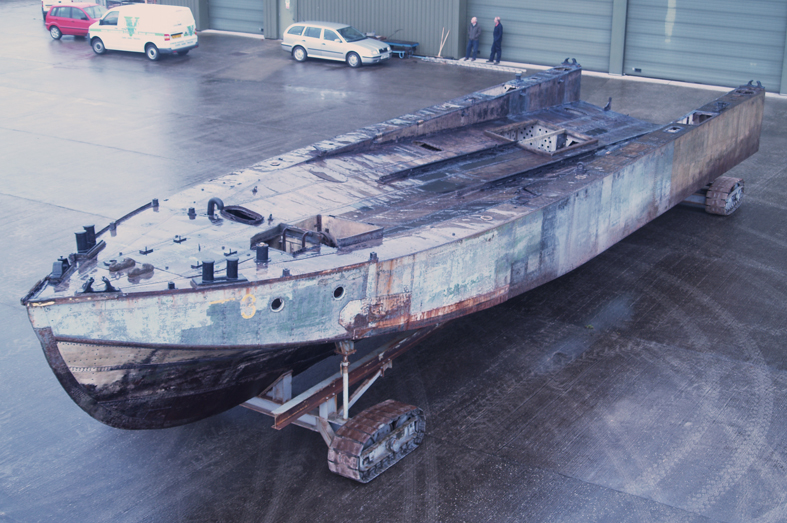
When I say that, you probably think of the escort carriers of WWII. If you know a bit more, you might think of the MAC ships (merchantmen with flight decks bodged on) or even the landing ships modified to launch light observation aircraft. The answer is actually this craft
That, to answer all the questions you have, is H-21, a Royal Navy Seaplane Towing Lighter. She’s just 58ft long and has a draught of no more than 3ft. H-21 was built in 1918, making her the oldest aircraft carrier to be preserved to this day.
Lighters like these were built to carry seaplanes and be towed behind destroyers, extending the range over which British aircraft could reach; several were further converted to launch landplane fighters.
She had a floodable tank in the stern, allowing the angle to be changed for loading and unloading seaplanes. Compressed air could then clear it, like a submarine’s ballast tank. In the bow was a small cabin for her crew of five. Towed behind a destroyer, she could make more than 30 knots.
The story of the Seaplane Lighters starts in Felixstowe, a small coastal town in Suffolk. Now, it’s a busy container port, but 100 years ago, it was the most important seaplane base of the Royal Navy.
It was commanded by an RN officer named John Cyril Porte. He had been a submarine officer in the RN in the 1900s, but had to give this up after contracting tuberculosis; instead, he became an aeronautical engineer, and got a job with the Curtiss Aeroplane Company in America. When WWI began, he returned to the UK and the Royal Navy, putting his new skills to good use with the Royal Naval Air Service. He redesigned the flying boats the RN had purchased from his former employers, producing the highly successful ‘Felixstowe’ family which gave good service during the war.
But in 1916 he was faced with a problem, and that problem was the Heligoland Bight.
This was the German Navy’s backyard, and the RN wanted to steam in there, find out what the Germans were doing and mess it up, but unfortunately for them, it was full of things like mines, submarines and zeppelins that made that very hard. Airships would have been useful for reconnaissance of the area, but the RNAS didn’t have any long-ranged airships - they’d given up Zeppelin-style ones after their first one broke in half the first time they took it out of its hangar, and all they had were some of the most terrifying contraptions of the war. It did have seaplanes, but if they were operating from Felixstowe they would run out of fuel on the way back.
To solve this, he suggested, in September 1916, the use of destroyers to tow lighters with his seaplanes on them out into the middle of the North Sea. A prototype was put together, but this threw up too much spray, damaging the aircraft it carried. A modified version was designed by the Thorneycroft company, and this was much more successful - four prototypes were produced and tested in June 1917. On the basis of these, fifty lighters were ordered. 31 had been delivered by the end of the war, with five more being completed after it. The first sortie with the lighters was on the 2nd March 1918, and many more soon followed. They worked well for patrols of the Heligoland Bight, putting the flying boats into positions to go flying around taking photos of things and getting into awkward duels with their German counterparts.
But the job of the lighters wasn’t finished there. In early 1918, the Navy wanted to send destroyer patrols into the Bight; these would be very vulnerable to zeppelins and seaplanes. The towed seaplanes didn’t have the performance to catch Zeppelins, so dedicated fighters were needed. Cruisers could carry their own fighters with them on flying-off platforms, but destroyers were too small for these. This was particularly pressing because a number of Zeppelins had turned up to observe the operations with the lighters.
A suggestion to fix this came from Charles Rumney Samson, commanding a fighter wing based at Great Yarmouth, up the coast from Felixstowe. Samson was one of the longest-serving naval pilots; he was the first to fly an aircraft off a moving ship, he led the first RNAS squadron to deploy to Belgium in 1914, pioneered the use of armoured cars in the British military, and helped develop techniques for airborne radio flying over the Dardanelles. He suggested taking the lighters, and putting a flying-off deck on them, letting them carry a single fighter. The aircraft could be launched, if the lighter was towed at speed behind a destroyer.
A lighter was duly modified, with a 30 foot wooden flight deck - a quick-release mechanism was also added, allowing the aircraft to bring its engine up to maximum power before being released to take-off. Showing the same attitude of reckless disregard for his own safety that got him into his position, Samson would give it its first trial, trying to take-off from Lighter H3 in a Sopwith Camel, fitted with a skid undercarriage. The lighter was fitted with channels to hold these skids, in the hope that it would keep the Camel in place in rough seas.
Samson’s lighter was towed behind a destroyer out into the waters off Great Yarmouth. He clambered up into the Camel. He started the engine, while a crewman, tethered to the lighter for his own safety, turned the propeller. The engine started on the first try, and Samson brought it up to full power while the destroyer accelerated to 31 knots at a signal from another barge crewman. Once the engine was at full speed, and the destroyer galloping along, Samson triggered the quick-release mechanism, and accelerated along the flight deck. The aircraft left the deck....
And then came crashing back down into the water, to be run over by the lighter. Samson survived, and was hauled out of the water with the pithy remark: “That was no damn good, we must do it better next time.”
The main problem was that the designers of the deck had forgotten that the lighter would ride up onto the waves at speed, pointing its nose up. This meant that Samson’s Camel had to take off uphill, and had too great an angle of attack when it left the deck, stalling instantly.
The deck was redesigned, to keep it flat when the lighter was being towed at high speed. A stand was set up to keep the tail straight, level and parallel with the deck for the first part of the take-off run. A crane was also added to lift the ditched aircraft back on board. Following these modifications, the lighter was towed out again on the 1st August, with Lieutenant Stuart D. Culley at the controls of the Camel. Towed behind the destroyer Redoubt, he made a successful take off, and landed ashore. Following this success, eleven more of the seaplane lighters were converted to the decked version.
The next takeoff would come in combat. On the evening of the 10th August, a British flotilla left Harwich. The centrepiece was three light cruisers, carrying torpedo boats - known by the RN at the time as Coastal Motor Boats. The CMBs would be carried into the Heligoland Bight, and launched to raid German shipping in the area. Three Felixstowe seaplanes were towed out on their lighters by destroyers, to cover the CMBs; and finally, there was Redoubt towing a decked lighter with Culley’s Camel aboard.
At dawn the next morning, the fleet arrived in the Heligoland Bight, and launched the CMBs. The seaplanes were winched off their lighters, but were unable to take off, as the waves weren’t right. The CMBs continued, though, as they were supposed to meet three more seaplanes which had taken off from Felixstowe.
Sharing this old post from when I was reading Richard Holmes' Tommy...always gives me a good laugh.
Currently reading Richard Holmes' Tommy: The British Soldier on the Western Front 1914-1918. I'm nearly finished with it and it's been a fantastic read so far. Highly recommended.
One part that had me laughing quite a bit (and this was while I was on public transit so looks were exchanged as a result) was this anecdote given by Holmes about the sort of language and slang used by British troops that comes from a Belgian priest in the village of Dickebush.
The parish preist of the Belgian village of Dickebush was frankley puzzled by it all. 'I have looked it up phonetically in my little English dictionary (fahke),' he wrote,
"And I find, to my surprise , that the word 'fake' means false, unreal, or not true to life'. Why the soldiers should refer to us in this way is difficult to understand, and yet everywhere one hears talk of 'fake Belgium' and 'fake Belgians'."
I'm sure everyone here can guess the actual word this Belgian priest was confused by.
I'd also like to think it partially inspired the 'FUBAR' joke from Saving Private Ryan, mostly because as a clueless 7th grader, I asked my German teacher if he knew what the word meant. He was clueless as well.
For my first post in this sub, I’d like to share with you one of the funniest thing I came across during my master’s degree’s research. It involves impeded Nazi spies and a fishing trawler in the Atlantic in 1945...
(By the way, I’m not a native English speaker so please accept my apologies for the mistakes)
A little bit of context to begin with: the story begins with the liberation of France during the summer of 1944. After the D-Day and several weeks of heavy fighting in Normandy, the German frontline is broken at the end of July and a second landing in Provence on August 15 speeds up the Wehrmacht retreat to the German border. In September, except for the easternmost region of Alsace, all of metropolitan France is liberated.
All of France? Not exactly... Several leftover German garrisons still resist all along the Atlantic coast. Several months before D-Day, in anticipation of Allied landings, Hitler ordered that the main Dutch, Belgian and French ports had to be defended to the last bullet and then sabotaged and destroyed before the Allies seized them. After the landings, the Allied armies had fought to capture some of them (Cherbourg was the first one), but the casualties were often high (the siege of Brest was particularly long and costly for the US Army) and the ports needed heavy repairs due to Allied bombings and German destructions.
However, on September 4, Antwerp (then the second or third largest port in the world) is liberated largely intact by a British division helped by the local resistance. This changes everything and the other ports still held by the Germans lose their interest for the Allied high command, especially those on the Atlantic coast which are far both from the frontline and from the British bases where the reinforcements and supply come from. Allied commanders don’t want to divert too much troops from the main frontline. Thus, these German resistance pockets won’t be attacked and will remain until April-May 1945 around Dunkerque, the Channel Islands, Lorient, St. Nazaire, La Rochelle and on either side of the Gironde estuary near Bordeaux. These are now known as the "Atlantic pockets". Some of them had dozens of thousands of civilians trapped in.
For the German high command, the main preoccupation was to resupply these garrisons to allow them to hold as long as possible - we’re talking of 130 000 men overall in these pockets, i.e. more than 1% of the total manpower of the Wehrmacht during the last year of WW2. With the Allies controlling the skies & the seas, it proved a difficult task. Air supply was used - ironically using the same method used a few months earlier by the RAF to resupply Resistance in German-occupied Europe: single planes flying by night and turning their engine off when flying over Allied lines. This method was however risky and weather-dependent.
Very quickly, the idea to resupply the southernmost pockets from Spain was being worked on by the German Naval Staff. They began to elaborate the operation with the RSHA (Reichsicherheitshauptamt, the Reich Main Security Office, a huge part of the SS organization which oversaw among others the genocide of the European Jews, the Gestapo and also the intelligence activities of the SS abroad). Basically, the plan was to load a fishing trawler up in a Spanish harbour, to sail (unbeknowst to Allied ships and aircrafts) towards the resistance pockets on the coast, and to shift the cargo to vessels coming from the German garrisons.
(The funny part is coming.)
The preparations dragged on and on during several months, during the fall of 1944 and the winter of 1945. The German Naval Staff’s archives stress an increasing irritation of the Navy high command who insist to resupply their troops, while the RSHA agents in Spain take their time and take extreme care not to raise any suspicion from the Allied intelligence agencies or the Spanish government. Indeed, Spain is officially neutral, and even if Franco’s regime has had close ties with the Nazi regime, the course of the war had changed things a bit: by 1945, Franco was very attentive not to offend the Western Allies who were winning the war.
The thing is: these guys are actually totally busted, and they’ve been for months. As early as the fall of 1944, the regional press in Southwestern France has been spreading rumours that the German garrisons are being resupplied from Spain, and the British and French embassies are pressuring the Spanish government, without the RSHA spies knowing. Still, in February 1945, they are very concerned about the confidentiality of their operation: to preserve their cover (or so they think), they simply decide to... go on a real fishing expedition with their fishing trawler.
And the mere idea of Nazi spies forced to spend weeks fishing in a trawler in the middle of the Atlantic to preserve a cover that has already been blown for weeks is extrememy pleasing...
The best part is, when the RSHA agents were finally ready to launch the operation and the orders were issued, in April 1945, the German Naval Staff received a phone call from Heinrich Himmler himself litteraly one hour later to cancel the entire operation!
And that’s how a secret operation meticulously prepared during half a year ended up in nothing more than a scenario for a bad Eurospy movie from the 60s and a 3-week long fishing trip for a bunch of Nazi spies.
Sources:
Italian Imports, Refugee Officers, and Civilian Amateurs: The Wellspring of Modern Riding in the United States
The development of equitation is largely measured by the contributions of different schools -- different philosophies -- of riding and training. One may speak of the lightness of the French school, the impulsion of the German school, or perhaps even the baroque electricity of the Portuguese school. However, a handful of masters of equitation have made contributions so important that they transcend or even define their school of riding. Federico Grisone dragged equitation from brutality to art. Antoine Pluvinel perfected the usage of pillars for developing higher degrees of collection. François Robichon de La Guérinière introduced the shoulder-in, one of the foundational collecting exercises. And François Baucher’s controversial theories on balance, lightness, collection, and impulsion have inspired and provoked horsemen since the middle of the 1800s. The most recent revolution in equitation arrived at the turn of the 20th century on the backs of Italian chargers, spearheaded by a young cavalry officer named Federico Caprilli.
Born in 1868, Caprilli was a dashing gentleman and a true student of the horse. He spent hours observing the motion of horses at liberty. He even strapped fencing mannequins to his favorite mare and watched how the dummies reacted as she gallivanted around the stableyard in Tor di Quinto. By 1900 Caprilli had formulated a radical hypothesis based off of these observations: Everything that equestrians had been taught about jumping and riding cross country was completely and utterly wrong.
Jumping was not enthusiastically practised prior to the 20th Century. French cavalry regulations did not begin to mention jumping until the end of the 18th Century. The fence height in show jumping at the 1900 Olympics was 1.1 or 1.2 meters; the lowest level of international show jumping competition today starts at that height. The only nation with a sporting tradition of riding horses over fences was the United Kingdom. The long and slow process of enclosure had accustomed the hunter to crossing hedges and hurdles in search of his quarry. Jumping had been made unpleasant by the prevailing wisdom of the day. Masters of equitation had taught their students since at least the 18th Century that the rider needed to help the horse over the fence. On approach, the rider was to lift his hands to raise the neck and lighten the forehand. On landing, the rider was to do the same. At all times, the body was supposed to be inclined backwards, to shift the rider’s weight onto the haunches and further unburden the shoulders and front legs. The worry was that the combined weight of horse and rider upon landing would cause the horse’s front legs -- perceived as being much more fragile than the hind legs -- to give way.
Caprilli realized that the rider’s attempts to help the horse over fences only created a fractious animal that learned that jumping would cause discomfort and pain. When “helped” by a rider, the horse hollows his back, inverts his neck, and is prevented from effectively using his body over fences. Caprilli’s solution was simple. The rider was to give the horse as much freedom of action as possible, and that meant the rider’s upper body had to follow the motion of the horse’s forehand and neck over the parabola of the fence. But good form over fences was just one skill that the military horse and rider needed to possess, and Caprilli used his experiments to formulate a complete system of schooling, controlling, and sitting a horse that he distilled into a handful of pages of text:
The military horse must be essentially accustomed to the field, since it is here that the cavalry must perform in war -- uneven and varying terrain should be as familiar to the rider as it is to the horse….Long years of practice and of continual observations have convinced me that the horse acquires these qualities without effort provided that the rider...tries to make his own actions the least disturbing that he can to the horse, and tries not to impede him in the natural development of his aptitudes and energies….One must abolish the forced position of balance, and any action of the horse’s legs beyond that which is essential to move him forward.
Caprilli’s school of riding was the crystallization of centuries of scattered thoughts on the seat. The British equestrian John Adams posited in 1805 that one should take a lighter seat while galloping for extended periods of time:
When the horseman is raised in the stirrups he must have a forward inclination from about twenty to forty-five degrees short of a perpendicular...but whether the body has a great or small inclination the position otherwise must be the same as when upright; that is the breast open, the shoulder’s down, the back hollow, the head firm.
Riding masters of the late 19th Century, caught between the formalistic schools of indoor manège riding and the needs of the modern cavalry, contemplated a more adaptive approach to a fence. James Fillis, Écuyer en Chef to the Central Cavalry School at St. Petersburg, recommended a reformed approach to the traditional restrictive jumping seat:
In order to jump, [the horse] should have his head and neck perfectly free...the hands should make no effort to raise the horse when taking off….If the horse, when jumping, raises his forehand a great deal...the rider ought to proportionately lean forward at the moment when the horse raises himself; but as the horse comes down, he should bring his body back, for three reasons: First, not to be thrown forward by the propulsion given by the horse; second, to lighten the forehand, which, on coming to the ground, will have to bear all the weight of both horse and rider; and, third, to keep his seat and support his horse in case the animal’s forelegs give way.
British sportsmen, with their long-standing traditions of riding over fences, favored adaptability over theory in their own seat, sitting upright over fences while maintaining a flexible torso, and slipping the reins to give the horse his head. The jockey John Hislop described the British seat as:
[A] general-purpose method which will give [the rider] the best possible chance of staying in the saddle when the unforeseen occurs, at the same time avoiding interference with his horse…
It’s never an easy thing to run counter to hundreds of years of tradition and prevailing thought, and Caprilli found it challenging to have his new school of riding accepted by his peers. The Italian cavalry had quickly adopted his techniques thanks to his 1896 promotion to Chief Instructor at Pinerolo and Tor di Quinto, but even with Caprilli’s exemplary demonstration at the 1906 Intercalculated Games, foreign cavalries remained unconvinced. Between 1906 and 1914, only 19 cavalrymen participated in the courses offered at Pinerolo and Tor di Quinto. Bulgaria, Spain, and Romania sent the most representatives. No one from the preeminent cavalries of France, Germany, or Austria attended. The conservativeness and bureaucracy of those major institutions preserved their traditions of very collected High School riding through the First World War.
One of those early visitors to Pinerolo was a Russian officer named P. Krassnoff, who spent a week in 1907 observing the school on his own dime. His remarks on the calmness and evenness of the horses and the softness and sensibility of the Italian riders were published in the journal Russian Cavalry Messenger at the end of that year. The Russian Cavalry typified tensions between older officers who were entrenched in the manège system of riding taught by James Fillis, and younger officers who were eager to explore new innovations. The Russian Army fielded both regular cavalry and Cossacks, and while the Regular Cavalry enjoyed poking fun at the Cossack forces, the Cossacks’ traditional methods of horsemanship stood in front of their faces as a contrast to the High School equitation that they were taught. The Cossacks’ short stirrups and position in the saddle, honed over centuries of riding cross-country, resembled a primitive form of Caprilli’s school. With the Cossack a fixture of their cavalry, it was natural for the young Russian Cavalryman to develop an appreciation for the Italian school. Around the same time Krassnoff was studying in Italy, an anonymous writer published in Russian Cavalry Messenger:
One must remember that the horse’s neck and head play the same part in his movements as the arms do in the movements of a human being….[T]he term “to balance the horse” should sound absurd to the modern rider….The horse himself will shift his center of gravity so as to carry the weight of the rider advantageously….A great number of the horses that work under Cossacks...illustrate the three fundamentals of riding: (1) complete freedom of the neck and of the head, (2) a natural position of the center of gravity near the front; (3) work of the unobstructed hindquarters.
(Continued below)
As with last Floating Feature, I’d like to thank a fellow mod, this time /u/Gankom, for suggesting this topic.
As a preamble, I’d like to be indulgent for a moment and include a quote from a somewhat obscure novel by Jules Verne from 1879, titled The Tribulations of a Chinaman in China (Les Tribulations d'un Chinois en Chine). The nineteenth novel in the Voyages Extraordinaires (and hence written after Journey to the Centre of the Earth, 20,000 Leagues under the Sea and Around the World in Eighty Days), this piece is set against the backdrop of the post-Taiping period in the Lower Yangtze area, and is the story of one Kin-Fo, a rich young man bored with life who decides, after the failure of a major overseas investment, to take out a life insurance policy and arrange his death, with the payout going to his mentor, Wang (whom he hires as his own assassin), and to his fiancée. Hijinks ensue involving various parties, including bodyguards from the insurance company and a group of ex-Taiping bandits, until Kin-Fo finds out that the whole thing was a setup by Wang to teach him about the value of life, and all live happily ever after (the failure of Kin-Fo’s investment turns out to have been part of a contrived stock manipulation scheme, and he is now utterly loaded). The character of Wang is introduced specifically as an ex-Taiping, lying low after the defeat of the Taiping cause at the hands of the Qing loyalists and British intervention forces, and as part of his description of Wang, Verne has this to say about the Taiping:
The Tai-ping, the declared enemies of the Tartars, having strongly organized for rebellion, wished to replace the ancient dynasty of the Ming. They formed four distinct bands; the first under a black banner, appointed to kill; the second under a red banner, to set fire; the third under a yellow banner, to pillage and rob; and the fourth, under a white banner, were commissioned to provision the other three.
Verne is quite obviously broadly incorrect. But he seems to have genuinely done at least a modicum of research – he just seems to have conflated various elements together. The grouping of units under particular coloured banners (yellow, red, blue, white, black) is a feature of early Taiping military ordinances, the mistaken association of the Taiping with Ming revivalism was not an uncommon contemporary perception (see my answer on the Japanese response to the Taiping for more); and the use of a black flag specifically to signify ‘no quarter’ is attested in Augustus Lindley’s account of the Taiping, in particular his description of Taiping military arrangements. Much as I’d like to dissect Verne’s version of the Taiping, though, here I mainly want to highlight the third and fourth banners in the quoted passage: pillage and provisioning (which, of course, can be considered two sides of the same coin).
The term ‘logistics’, of course, can cover a whole slew of various activities, many of which could be considered entire spheres of activity in themselves – can, for example, military medicine fall under ‘logistics’? For the purposes of this writeup I’m mainly going to look at three main sub-areas, specifically as regards materiel (supplies and weapons): acquisition, distribution and transport.
Before getting into that, though, a brief overview of Taiping campaigns will be a useful guide to understanding certain logistical measures. Overall, we can distinguish the overall trends of the Taiping Civil War as follows:
This writeup focusses on periods 2 through 5, as the first and last periods are, comparatively speaking, poorly documented, especially as regards the internal documentation necessary to produce a picture of logistical arrangements.
For the first two years of the revolt, the Taiping lacked access to major economic bases. Their military resources thus had to be obtained through looting. To give just one example, the breakout from Yongan in 1852 was enabled through the acquisition of gunpowder supplies from nearby towns, according to the confessional statement of Taiping general Li Xiucheng in 1864:
We captured more than ten loads of powder and thus obtained ammunition, without which we would not have been able to get out of this encirclement, because we were besieged in Yongan without a scrap of powder.
However, the settling down of the Taiping and their new ability to established fixed depots somewhat altered how resources would be obtained. The Land System of the Heavenly Dynasty, the Taiping ‘manifesto’ issued in early 1854, specified that all food, money and such would be pooled in ‘sacred treasuries’, from which disbursements could be made as necessary. While this centralised system of collection and redistribution may well have been an ideal rather than a reality for civil administration, it did, in the end, appear to have been implemented for military purposes, albeit on a grand scale and perhaps in a manner not quite as utopian and beneficent as suggested in the Land System. Our first indication of the use of a local-scale collection and redistribution system comes from a proclamation issued some time in 1853:
The rice of the farming people of the world and the capital of the merchants all belong to the Heavenly Father. All must be turned over to the sacred treasury; every adult will be allowed one picul, and every child five pecks [of rice] for food.
The implication perhaps being that the remainder would be either stored, relocated to a higher-level storage centre, or used for the war effort.
With a fixed capital and a more positional strategy taking hold, the acquisition of supplies now could be done on a much larger scale, as more time could be devoted to it, and because the establishment of permanent depots allowed porters and ships to offload at them and go back to a collection point, rather than the army moving with all it could carry. Two order templates and one edict, likely produced in late 1853 or early 1854, give a clear indication of the simple scale of Taiping resource acquisition at this stage:
I order you, […], to ride in the Left Third Water Battalion, comprising thirteen hundred vessels. Select and lead your troops, and proceed to the regions of Nanchang in Jiangsi and Wuchang in Hubei. There, gather provisions for delivery to the Heavenly Capital. Do not disobey this or make a mistake.
You, official […], and brother […], employ eighteen hundred vessels and frighten the [Manchu] demons from Huangzhou and Hanyang. The provisions of rice which you gather must be delivered quickly and completely to the Heavenly Capital by boat. Be certain not to disobey this or make a mistake. It is necessary to be resourceful. The provisions must not be seized by the demons.
…North of the Yangtze River, the several places of Huang-p’o, [Huanggang?], and De’an [in Hubei] have been able to frighten the demons away and deliver twenty-three thousand piculs [approx. 1400 metric tonnes] of rice. All of it has been delivered and accepted. This is sufficient to display your resourcefulness and ability. The fact that the Taiping were still taking grain from areas along the Yangtze they had already been suggests that they had not been able to empty the state granaries entirely before reaching the limits of their transport capacity, even if we grant that a harvest season had happened in between (given, of course, the likely disruption of that initial Taiping campaign on agricultural activity.)
The extraction of resources seems, in some cases, to have been so severe as to essentially have cleaned out several major depots of all but the amount necessary to maintain the army based out of it for the season. Qi Rigang, based in Anqing in 1854, responded a request by Shi Fengui in Hubei for resources as follows:
As for your request for the supplying of provisions, gunpowder, and other things, according to the report from younger brother Xun Pingxian… who has just returned to the provincial capital at Jiujiang, the provisions in that place are very low in price at this time. The provisions of this Anhui capital have already been delivered to the Heavenly Capital, and I hope that you will understand and excuse me. Gunpowder and other things have already been sent to Jiujiang, and the Anhui capital also suffers a shortage.
Argh, well I was going to get some work done today, but I guess that's on hold now.
Lets talk about
The Mercenary War: A Tale of Escalation, Brutality, and the near Implosion of the Carthaginian State
Origins
Our story begins with the end of the First Punic War, fought between Carthage and Rome from 264-241 BCE. It was a long and hard war, with thousands of deaths on both sides, fought within the confines of Sicily and the waters surrounding the island. In 241, a peace treaty was signed by Lutatius Catulus, proconsul of the Romans, and Hamilcar Barca, leader of the Carthaginian land forces in Spain. The Carthaginian field army in Sicily was almost entirely composed of mercenaries and tributary allies; there were contingents of Libyans, Iberians, Celts, Ligurians, Balearic Islanders, Greeks, Italians and probably other groups too. Upon the end of the war, all of the Mercenaries in Sicily were sent to Lilybaeum, the Carthaginian capital in Sicily, and evacuated back to Carthage in batches by the governor of Lilybaeum, Gisgo.
Problems began to arise here; instead of paying off each batch of mercenaries as it arrived, the Carthaginian senate thought it would be sensible to wait for the entire army to return, so that they could negotiate payment with the entire army as a whole and receive a better deal. The mercenaries in Sicily were owed years of backpay, and were promised still more by generals in Sicily who had bestowed on them lavish hypothetical rewards for their services. Of course, the Carthaginian state, its treasury already depleted by the immense war effort, sought to alleviate this cost a bit. Therefore, the mercenary army was then moved from Carthage to nearby Sicca.
In Sicca, the mercenaries began to become restless and annoyed. The arrival of Hanno, another Carthaginian general, to negotiate payment further angered them, and the Carthaginians found it very difficult to talk them down due to the plethora of cultural groups and languages in the army. Ultimately, the mercenary army decided on a show of force, marching about 20,000 strong on Carthage and camping at Tunis nearby. A "negotiation" of sorts ensued, with the terrified Carthaginians promising the original sums to the mercenaries, and the mercenaries increasing their demands. Negotiations were mainly headed by Gisgo, the same who had evacuated the mercenaries from Lilybaeum, since the mercenaries admired and trusted him. Things finally began to calm down.
Enter Spendius and Mathos. Spendius was a Campanian slave who ran away in the course of the war and joined with the mercenary army, while Mathos was a Libyan subject. Together, Spendius and Mathos inflamed the mercenary mob into open hostility again against Carthage. The situation became so bad that anyone who stood up to address the mob, whether pro or anti-Carthaginian, was stoned to death. So it was that Spendius and Mathos were therefore elected to lead the mercenaries. Gisgo was clasped in chains and the mercenaries declared open warfare. The first thing that Mathos did was to incite almost the whole of Libya, which had been poorly treated by the Carthaginians, into open revolt.
The Early War
Carthage's response was to hurriedly recruit more mercenaries for a sudden new war on their doorstep. The city also armed much of their citizen population, something which was a rare occurrence in Carthage. Leadership was assigned to Hanno, and early preparations of the war went quite well. In the meantime though, Mathos had acquired a much larger army, bolstered by Libyan rebels. While successful in his first engagement with the mercenaries, Hanno's army took heavy losses, and the war turned into a stalemate. Believing Hanno to be an ineffective leader, the Carthaginians removed Hanno from command, and Hamilcar was elected as his successor. Hamilcar, if you will recall, was the previous commander of this mercenary army in Sicily, and so he found himself fighting mercilessly against an army of his own training and design.
With an army of about 10,000 Carthaginians and 70 elephants, Hamilcar began to turn the tide. He quickly lifted the siege of nearby Utica, crushing the mercenary army. Hamilcar was able to entice 2,000 Numidians to defect to him, and importantly, was known to be lenient to captives, further coercing defections to the Carthaginians. He defeated the mercenaries a second time, who were now under the command of Spendius, Mathos and a Gaulish leader Autaritus. It seemed like the tides of war were changing, and things would be over quickly.
Brutality and Atrocity
Word spread quickly across the mercenary camp about Hamilcar's clemency and the poor tidings of the war. To counteract this, Spendius and Autaritus whipped up the mercenary crowd into unparalleled brutality. Once again, those who spoke out against the mercenary leaders were stoned and mutilated. Spendius and Autaritus then brought forth Gisgo and their 700 or so Carthaginian captives. They began by cutting off Gisgo's hands, and then did the same with the rest of the captives. Next, the prisoners' legs were broken, and their maimed but very much alive bodies were tossed into a ditch to expire. Carthaginians sent to retrieve these wretched souls were blocked from approaching.
And so the practice of brutality began. From here on out, any Carthaginians captured by the mercenaries were tortured to death, and all Carthaginian allies were to have their hands cut off. The Carthaginian response was a reflection of the barbarity of the mercenaries: those who surrendered to the Carthaginians were slain on the battlefield, while those who were captured were thrown to elephants.
To make matters worse, amidst the barbarity events started to turn against the Carthaginians. On the island of Sardinia, the Carthaginian mercenaries rebelled, crucified their leader, and began terrorizing the island's inhabitants. Hippou Acra and Utica, the only two Libyan cities to remain loyal to Carthage, rebelled and slaughtered their Carthaginian garrisons. Hamilcar and Hanno began to further quarrel about what to do next, thereby weakening the Carthaginian position. And, inspired by these events, the mercenary army began to besiege Carthage itself.
Cont.
I'll repost a couple of answers here. This was to "How did a naval blockade work in the Age of Sail?"
Great question! So as we start, we should define two major roles for a blockading fleet during the Age of Sail (and even into later conflicts):
to keep enemy ships of war bottled up in a port
to prevent trade from flowing to or from a port, or a whole nation
The first of those examples is what many people think of when they think of a blockade, and it's the most obvious job of a squadron, but the second is arguably as important for wars that stretch out over a long period of time.
If we were to imagine a modal blockade, we might want to look at the blockade of Brest starting in the Seven Years War, and specifically at the events of 1759, because that was a major French port that the British had to blockade in that war and in the wars of the French revolution and Napoleonic era.
A blockading fleet had to accomplish two goals: it had to watch the entries into a port to prevent ships from leaving (or entering) it, and it had to present enough of a threat to pose a credible threat to the ships that the enemy fleet could amass if it tried to break out of a port. The blockading fleet then had to be comprised of ships that were heavy enough to stand in the line of battle (in the British context, ships of 74 guns or larger) as well as smaller ships that were nimble enough to work in near the port but that could flee any credible threats the enemy could mount to attempt to beat them off (usually frigates). In most cases, then, the fleet would be divided between an inshore and an offshore squadron, with ships in between (frigates or smaller ships) to relay signals between the two fleets.
Because these ships were, after all, sailing ships, the duty of the fleet becomes more difficult because of the winds and current conditions that could be experienced in a particular area. Broadly speaking, winds that would allow for ships to leave a port would tend to blow the blockading fleet offshore, while winds that kept ships in a port would blow the blockading fleet onshore (which is one reason why clumsier ships would be kept offshore, so as not to be wrecked). Obviously, close attention to the weather and watching out for storms was a major responsibility of ships on the blockading fleet. Additionally, blockading fleets still used up the same amounts of victuals (food, water, etc.) and naval stores (sails, spars, cordage, tar, gunpowder and shot for practice, etc.) as a fleet under sail would, so plans for supplying the fleet were crucial. Most admirals attempted to keep enough ships on station so that one or two could always be rotating back to a friendly port to re-provision and bring out mail and news.
Looking specifically at Brest, the dangers and opportunities of blockade become clear. In the 1750s, the dockyards of Breast were on the Penfield river, which issues into a large, enclosed harbor. The harbor reaches the sea through a narrow channel, the Goulet, which runs nearly directly east and west through high ground. There are two anchorages outside the Goulet, Berthaume Bay and Camaret Bay, which are both further protected from the Atlantic with reefs, rocks and islands, and there are three passages to the ocean from those anchorages. The Iroise is to the west, and is scattered with rocks; the Four passage to the north leads to the Channel but it is narrow and beset with a very fast tide-race, and to the south is the Raz de Sein, a very narrow passage through a set of reefs with a rock right in the middle of the northern end of the passage.
The tides flow through those passages at varying rates: the Goulet at 3 knots (nautical miles per hour), the Four at 4.5 knots and the Raz du Sein at 7 knots. The distance from the Goulet to the Raz is 25 miles, so unless a fleet had very exact timing it is nearly impossible to make the trip from the ocean into the harbor or vice versa except with exact timing, which means that ships had to anchor in one of the bays (Berthaume or Camaret) to wait for a tidal change.
This both complicated and simplified the task for the British. There was no one point in the sea from which to watch all three passages except for close in to the Goulet, but there was also no high ground at the western end of the Goulet for watchers to see a blockade fleet further offshore. The winds in the region generally blow from the southwest, which means that it was possible for the French to enter the Goulet most of the year, but leaving required an easterly or northerly wind, which meant the French usually used the Raz de Sein more than the other channels both for entering and leaving.
The French also used the Raz because, in the days before latitude was easy to find, ships usually approached a port by finding a landfall at a line of longitude (an east-west parallel) then "running down" that line until they saw a landmark. For the French, the simplest landfall was to Belle Isle (southwest of the Goulet) and then bearing up on the port tack to Brest or the starboard tack to Rochefort or Bordeaux.
An armchair admiral, then, would assume the best place to put a blockading fleet was to the southwest of Brest, near Belle Isle. The problem with that, though, is that any westerly gale would give the British a lee shore to the east which they would have to escape by heading to the southeast, into the Bay of Biscay and away from home. The British fleet in fact had to be kept to the west or northwest of Ushant, so that in case of westerlies they could seek refuge in one of the Channel ports (usually Torbay in Devon). The unfortunate fact of that is that a fleet in that spot can't keep track of the Raz, so the offshore fleet would have to be stationed there with an inshore squadron able to pass messages to the offshore fleet and sound an alarm if the French tried to break out.
This is exactly what British admiral Sir Edward Hawke did in 1759: the bulk of his fleet lay off the northwest of Ushant, with two small ships of the line under Augustus Hervey anchored off the Black Rocks at the Iroise watching the Goulet. His ships were often blown off station, but a westerly wind usually meant that the French were bottled up in port even as the British ships were blown off blockade.
The reason for keeping the French fleet in port was that the French, growing desperate at their losses in the Americas, had decided in 1758 upon an invasion of Britain. The invasion fleet was assembling in Vannes, in the southwest of France, while the battle fleet was at Brest (at the time, there were only sketchy land communications with Brest -- it relied on coastal shipping for nearly everything, and an army couldn't assemble there). The fleet would have to break out of Brest, sail to Vannes to pick up the transports, and then evade the British fleet to land troops somewhere in Britain, which was a tall order.
The French were increasingly desperate to break out of port as 1759 drew to a close, and when a westerly gale blew Hawke off station in November, the French acted. The same day that the storm died down and Hawke left Torbay, the French left Brest. They were blown far to the west before they could come about and head for Vannes, and had trouble with the fleet because many of its men were inexperienced at sea after being bottled up in port. They sailed for Quiberon Bay, where the transports waited, with the British fleet on their heels, and made it almost there before sighting the British fleet. The French gambled that the British would not follow them into Quiberon Bay, because the British lacked charts of the area, but Hawke attacked at once and the French fleet fled. The British caught up with the tail end of the French fleet just as the van was entering the bay, and at that point the wind backed and headed the French, as well as kicking up an extremely rough sea.
The battle was a disaster for the French; the Thesee sank attempting to open its lower gunports (the ship flooded) and the Superbe sank after two broadsides from Hawke's flagship. One French ship was captured; three were trapped in the Vilaine river with their guns thrown overboard to lighten ship; and six were wrecked or sunk. Two British ships were also driven ashore and wrecked, but their crews were rescued.
Quiberon Bay is one of the more dramatic and unusual battles of the Age of Sail, but the British fleet would again blockade Brest during the Napoleonic period. The blockade, in fact, became so routine that the British would often fish inshore of the Goulet, or anchor in one of the bays to dry sails or practice shifting topsails or lowering boats, to the infinite annoyance of the French.
In one of my favorite stories, Sir Sidney Smith even sailed his frigate into the Goulet by night, "hailing French ships in his faultless French to ask for news, and returning without detection with the latest information." (Rodger, Command of the Ocean pp. 433). Granted, that was in 1795 and not during a period of close blockade, but it does emphasize the Royal Navy's attitude toward the French.
One of the strangest and most personal battlefield relics I've ever encountered: The widow of Captain George Holmes of the 27th (Inniskilling) Regiment of Foot desired a true memento mori of her late husband, who had been shot in the back at the Battle of Waterloo, the bullet damaging a vertebra on its way into his chest cavity. She traveled to the continent, where she found his body, had it macerated (boiled), and the damaged vertebra and bullet removed. They were subsequently varnished, and she had the bullet coated in silver and the vertebra modified to include a small silver-gilt container, the lid of which was engraved with the word “Waterloo” inside a laurel wreath and a pile of weapons behind a drum, helmet, and trumpet. You can find photos of the item here.
The newly established Asakir-I Mansure army of Mahmud II (1808-1839) was widely unpopular. Soldiers were forcibly recruited, subjected to harsh military life, lived in isolated barracks, and were kept under arms for years in distant lands without seeing their families. To motivate these soldiers, other than promising incentives like regular pay and pensions the Porte also used Islamic rhetoric and “us vs them” narrative to encourage their soldiers in fight
Despite critics calling him “the infidel sultan”, Mahmud II actively portrayed himself as a pious sultan and protector of Sunni Islam. He also actively used Islamic symbolisms and propaganda to justify his policies and reforms. Most obvious example is the name of the new army, the Asakir-I Mansuri-I Muhammediye or The Victorious Soldiers of Muhammad. Mansure soldiers were ordered to regularly read the Qur’an, pray 5 times a day, and join weekly Friday prayer. Salaried imams were assigned to each battalions to lead prayers and preach about religion and loyalty to state and religion. The Porte supervised the printing of various religious treaties and send them to regiments for soldiers to read. All these prayers and religious services combined with continuous military drills was to accustom and convince the recruits of the demands of their new military life. The main goal of these policies was to convince as many soldiers to rally behind the new military reforms and turn them into active and militant fighting force loyal to the empire.
In critical times, the Porte frequently use Islamic rhetorics and “us vs them” narrative to justify mobilization and encourage soldiers at the same time. For example, during the war of 1828 against Russia, it was declared that:
… the Muslims too would unite and rise to their feet to fight for the sake of their religion and state. The great statesmen and religious scholars and perhaps all the Muslims were unanimous on this point. This coming war had nothing to do with the previous wars that were pursued by the state and that were about land and boundaries. As explained, the goal of the infidels was to eradicate the Islamic nation from the face of the earth. This war was a war of religion and of the nation. Muslims should spend their own money for that purpose and not ask for salaries or wages, as the gaza and cihad were obligatory for all, great and small
Another example was from a military treatise from 1837-38, which stated that every able-bodied Muslim male between the age of 18 and 60 to join the military as stipulated in Islamic law and customs. Additionally, new recruits were told that they are going to serve in the active military for the sake of state and religion. Then they took an oath in front of the ulema vowing to return and join the army after their initial leave and avoid shame and dishonor.
However, impact from using religious motifs to motivate soldiers is mixed. On one hand, many observers attributed the fighting spirit and steadfastness of the Ottoman soldier to loyalty to their religion. For example, British traveller Adolphus Slade said this about the Ottoman soldier in the Crimean War: “… their Prophet Mohammed said, ‘The sword is the key of heaven: a drop of bloodshed in action, or a night passed under arms, is more meritorious than two months of fasting and prayer. Who dies in battle his sins are pardoned … When men are inspired by a sentiment such considerations are of little account”. Additionally, some suggested that religious differences could motivate the Ottoman soldiers to fight harder in the battlefield. Helmuth von Moltke stated that Ottoman soldiers charged Yazidi rebels with fixed bayonets with the conventional Islamic battlecry of Allah! Allah!. Kabudlı Vasfi, an Ottoman irregular also records the “us vs them” narrative being used during the Greek revolution of 1821, with Ottoman soldiers prayed for their fallen comrades and attacked their enemies with the battlecries of “Allah Allah!” or “Allahu Ekber!” with unfurled war banners while Greek rebels recited their Gospels, screaming “Oh Cross, Oh Jesus!” under the overseeing priests while attacking Ottoman forces, a clear demarcation between the forces as two opposing sides. This was not reserved for Christians, Muslims that were considered “heretics” or “rebels” were also becomes target of this rhetoric when necessary
On the other hand, there are many contemporary observers and personal accounts indicating that religious convictions aren’t sufficed to keep the soldiers motivated and steady flow of cash, provisions, and equipment were necessary. An earlier military treatise from Selim III’s era asserted that the days when Muslims fought wars just to please God had long passed and everyone now expected material benefits if he was to risk his life. In December 1841 a certain official named Deli Ahmed was overheard in the coffeehouse saying that soldiers who didn’t receive their wages won’t be useful on the battlefield. Furthermore, forcing men who didn’t have a personal stake in a fight might hamper a soldiers’ morale. For example, a soldier was recorded saying this during the war against Mehmed Ali:
What was it to the soldiers, if the Sultan had one great province more or less, in his vast dominions! The enemy was also of the same faith as themselves, and few that were on the field had ever met them before, or bore rancour or hatred, or even ill-feeling towards an Egyptian. There had not even been any of the usual little incentives put into play to excite their feelings, and there existed nothing but the sense of duty, and a decent regard for honour, to keep the men to their posts. The Egyptians, it might be said, had not greater incentives to the struggle, this is true, but they were perpetually talked up to a contempt of the disgraced of Homs and Koniyeh
And indeed, between the tumultuous years of the 1820s to the 1850s Ottoman state policies, religious propaganda, and personal religious convictions generally failed to turn conscription, mass mobilization, and war into a popular subject for general population because the new regime continued to make demands on its populace to execute their policies without offering much in return. Thousands of soldiers and potential recruits continued to desert from their regiments and to evade conscription
One story that struck me from Rick Atkinson’s excellent The Guns at Last Light
After Eisenhower awakened General Omar Bradley with a call at 4:45 am to let him know the surrender was signed and it was over:
Opening his map board, he smoothed the tiny flags symbolizing each of the forty-three American divisions under his command, arrayed across a 640-mile front. Clutching a grease pencil, Bradley wrote his final entry on the map—“D+335”—then threw open the black-out curtains to gaze on the sun-splashed world outside.
The night of the long knives, 31st October 1992.
-- The IPLO's roots --
In August 1969 sectarian riots broke out in Northern Ireland, an attempt by Catholics in Belfast to stretch the Royal Ulster Constabulary (RUC) thin to support the besieged Catholics in Derry had triggered a large Protestant reaction which lead to attacks on Catholic areas. Over the course of several nights attempts by the RUC to retake the Catholic ghettos were followed by Protestant mobs that burnt houses and businesses. The first of seven deaths in Belfast was a nine year old catholic who was killed when the RUC opened fire on a block of flats with a heavy machine gun, the last a Protestant man by an IRA member during rioting.
The British army arrived on the 16th, after three days of rioting and brought calm to much of the city, one area they didn't enter was the catholic ghetto of Ardoyne in North Belfast which had suffered badly in attacks from the RUC and Protestants as a few days earlier the local IRA unit had it's weapons taken by the leadership in West Belfast for disobeying orders. The area suffered a further night of attacks which led to a strong disdain for the IRA leadership in the area.
The disastrous IRA situation in the fighting led to internal conflict within the organisation, more militant members blamed the Marxist leadership based in Dublin for not preparing weapons (which lay in arms dumps along the border) and for neglecting militancy in favour of non-sectarian communist politics. An attempted coup of the Belfast leadership lead to a split in the Provisional(traditional nationalist and militant socialist) and Official(Marxist and other communist) wings. The Provos and Sticks, as they came to be known had rocky relations from the start as the much larger Sticks attempted to control the smaller organisation and enforce their law on the streets. By 1975 however the Provos had become much larger than their parent organisation, feuding and fighting over the years had given the Provos control over much of the Catholic areas of Belfast and Derry, in October the Provos attempted to finally end the Sticks with a large wave of attacks against their homes, bars and businesses. The initial attacks put the Sticks on the back foot but eventually they struck back and after several weeks of feuding the two sides came to an uneasy truce that would cripple the Offical wing and leave it irrelevant for the rest of the conflict but still alive.
In an oddly common communist trope, the '69 split was not the last split the Official wing would suffer, in 1974 after two years of truce militant members of the organisation broke away to form the Irish National Liberation Army(INLA). The set up of the INLA was preceded by, at least publicly by the Irish Republican Socialist Party(IRSP), a collection of communists centred around Seamus Costello a popular figure who had enjoyed electoral success in the Republic of Ireland. The 'Erps' as they quickly became dubbed came under immediate attack as the Sticks attempted the growth of yet another rival, the feuding badly weakened the fledgling organisation especially after the murder of Costello. The chaos after Costellos death became a common feature of the Erps as they swung between leaderships of practical socialists and over ideal driven communists.
The Erps reached a high point in the months following the 1981 hunger strikes in which three of their members had died, attempts by the Provos to sideline the Erps had made them popular amongst the younger generations and soon teens wearing combat jackets and patchy beards took over streets and bedecked them in communist symbolism. The period wasn't to last and progressively the Erps slid into chaos in the mid eighties as various factions fought over the remnants of the organisation in the wake of a supergrass trial. The situation led to another split, this time with the rise of Irish People's Liberation Organisation.
The IPLO split led a three way feud between itself and the two factions of the INLA, the IPLO wished to destroy it's parent organisation but the existential threat led to an almost unity that gave the Erps just enough strength to throw off the assault and kill the leader of IPLO. In 1987 the feud came to an end and the two organisations went their separate ways. The IPLO would soon attract the attention of the Provos, who by now was unchallenged for several years in republicanism.
-- Provoking the big tiger --
The IPLO struggled to settle down after '87, suffering from similar chaos that afflicted the Erps, weapons were scarce and funds were low and worst the group lacked skilled leaders and fighters to launch any respectable attacks. The group found a niche however in sectarian attacks, in a time of reduced sectarian killings by the provos and a rise of killings by loyalists the IPLO stepped forward and began to kill Protestants, often in wildcat attacks which soon made them the most blatantly sectarian republican group.
Further irritation of the Provos came from the recruitment of former Provos who were expelled for various reasons such as disobedience and criminality but as pressure from the Provos increased the IPLO began to recruit anyone they could, criminals who would enjoy a form of immunity by committing it for "the cause" quickly swelled their ranks but also led to the IPLO picking up a practice that Provos and most other groups despised, drug dealing.
Desperate for funds and controlling several smuggling routes the IPLO imported and began dealing various drugs, mainly the party drug ecstasy. This broke a cardinal rule of republicanism which stood against drug dealing and had attacked drug dealers in the past, the IPLO even began carving up drug dealing zones with loyalist paramilitaries who had also picked up the practice. The huge influx of criminality under the guise of republicanism led to several verbal and physical clashes between the IPLO and Provos.
The IPLO had fallen to internal feuding as factions attacked each other over drug money, Sammy Ward the nominal leader of the organisation in Belfast had been involved in the threatening of a leading Provo evening putting a gun to his head and the storming of a Provo alligned bar and declaring "they wouldn't take provo intimidation lying down", the insult from the upstart organisation was the last straw and the Provos set a special day for their retaliation, October 31st 1992, Halloween.
-- The night of the long knives --
The internal feuding had begun to simmer down but the factions hadn't fully reconciled, Ward remained alert and went for a drink with two leading members of his group and while at the bar ordering drinks two men approached him and shot him in the chest and finally shooting him in the head. The gunmen fled, and as news of the killing spread the two factions assumed the fight was back on but soon they both realised something bigger was on it's way.
100 Provos backed by teams of drivers and supporters swept into nationalist areas across Belfast, homes of known members were top of the list, some were ordered to leave while others were dragged from their homes and beaten or knee capped in full view of their neighbours, The usual kneecapping weapon the pistol was replaced with high calibre rifles to maximise the chance of crippling the victim. IRA patrols on foot and in cars scoured the streets of the ghettos searching for IPLO members and other drug dealers, as the offensive came to an end the Provos prepared for a IPLO counter attack that never came.
The IPLO collapsed in Belfast, the Leader based in Dublin quickly realised he was a target and surprising the Provos he offered to surrender several arms caches in return for his safety, which were delivered within a week. Other small time members flooded across to England and Scotland or went underground to avoid further attacks, the Provos were surprised with the ease of the collapse especially as the purge had come almost on the anniversary of their attack on Sticks with Ward killed only metres from where a Stick was killed.
Another group surprised and humiliated by the operation was the security forces, the intelligence wings of the RUC and British army were taken aback by the sudden strength of the IRA in Belfast and their ability to conduct patrols in full defiance of them. Within a few weeks the IRA had accepted the IPLO's surrender and within a few years the organisation fell apart, lacking the core ideological drive of the Offical IRA and INLA to hold together after such a vicious assault, the collapse of the IPLO also led the Provos to achieve one final insult to the British Army, fully defeating a paramilitary organisation that had existed for seven years in a single night.
China, 1927: Memoir of a Debacle - Zhu Qihua
One of the most interesting primary sources for the early Chinese Civil War, Zhu Qihua's memoir focused on the tumultuous year of 1927, when Chiang Kai-shek ordered the CCP purged from the Kuomintang. It is marked as the beginning of the Chinese Civil War, which ended in 1949 and in Communist victory. But 1927, and most of the 1930s, was a gloomy time for the Communists, and they would suffer defeat upon defeat until the Japanese invasion in 1937 forced the KMT into a tenuous alliance with the CCP.
Zhu Qihua himself was a young CCP member and worked in Guangdong. At age 18 was appointed the Nationalist Fourth Army's head of propaganda, which allowed him to embark on the Northern Expedition - Chiang's Soviet-supported conquest of Central and Northern China. Zhu worked hard and became well acquainted with some future big names in the CCP - including Zhou Enlai, Guo Moruo, and even Mao Zedong.
Zhu Qihua was in Henan when the Shanghai purge began in 1927. The CCP elements of the Nationalist Army quickly broke off ties with the rest of the KMT, and the Nanchang Uprising marked the birth of the People's Liberation Army. Zhu's 'unit' was attacked by Tang Shengzhi's Eighth Army, and Zhu and the others participated in intense fighting. The fighting turned into routing as the Communists quickly realized that they were out-funded, out-gunned, out-manned and out-organized compared to the KMT armies. By the end of the year, the CCP 'Fourth Army' had to resort to theft and acts of banditry to survive.
While the memoir is not entirely dedicated to the military logistics and actions of the opening of the Chinese Civil War (he does go into great detail about the make up of the Fourth Army, and the small skirmishes with the warlord and KMT armies), it is one of the few comprehensive and penetrating accounts from an ordinary, lower-ranking Chinese revolutionary who was not writing about political propaganda, but rather everyday life.
I wanted to share this sometimes overlooked subject of Chinese history which is often overshadowed by the outbreak of the Sino-Japanese conflicts beginning in 1928 in Jinan, and climaxing in 1937 at the Marco Polo Bridge. Although Zhu stopped his memoirs upon his return to Guangdong and his celebration of his 20th birthday, thus not covering the Jiangxi Soviet or Long March years, the memoir is excellent for understanding the early pre-Mao leadership and structure of the CCP and by extension, the KMT during the Northern Expedition. He's also a great writer and the narrative is catchy.
The book itself is inexpensive, and you can find it on Amazon among many other book-retailers. I'm currently away from home, so unfortunately I don't have my copy on me, but I will be home tomorrow and can answer more in-depth questions about the book or the time period for anyone who is interested!
I'd like to discuss the role of Jews in the Finnish Army during the Winter, Continuation, and Lapland Wars. Finland did not have a large Jewish population, as during the period of the Russian Empire it was not a part of the Pale of Settlement. However, a number of Jews who were forcibly conscripted into the Imperial Army were stationed in Finland, and eventually remained there when their 25-year service ended. With the Soviet Union's invasion in winter 1939-1940, the Vyborg Synagogue was bombed by "Molotov breadbaskets." 204 Finnish Jews served in the Finnish Army during the Winter War, with 27 giving their lives in service of Finland.
Finland entered a military compact with Nazi Germany and invaded the Soviet Union as part of Operation Barbarossa. Jewish Finns thus had to contend with Nazi Germany's intentions of genocide towards them. However, the Finnish government and military leadership would have none of this. After eight Jewish Austrian refugees were deported to Nazi Germany in November 1942 by the Finnish head of police, and seven were murdered, there was widespread outrage from both religious and political leadership, leading to the resignation of several ministers and a public apology by the Finnish Prime Minister in 2000. Field Marshal Carl Gustaf Emil Mannerheim told Heinrich Himmler during one of his visits to Finland that, "While Jews serve in my army I will not allow their deportation." Finland transported or resettled several hundred Jewish refugees that arrived in the country during the war, some under explicit orders of Marshal Mannerheim. Jewish Finns who served in the army were permitted leave on Saturdays and Jewish holidays, and the 24th Infantry Regiment had a field synagogue in full view of German troops.
Eight Jewish Finns gave their lives in service of the Finnish army during the Continuation War. Three (all medical personnel) were offered the Iron Cross by the Wehrmacht for actions saving the lives of German soldiers. Major Leo Skurnik organized the evacuation of a field hospital that was under an artillery barrage; Captain Salomon Klass rescued a German unit that had been encircled by Soviet forces; and Dina Poljakoff, part of the Lotta Svärd, the Finnish women's auxiliary, tended to a great number of German wounded and was well-regarded by her patients. All three refused.
For sources, I'd recommend:
Cohen, William B. and Jörgen Svensson (1995). Finland and the Holocaust. Holocaust and Genocide Studies 9(1):70–93.
Meinander, Henrik (2009). Suomi 1944. Siltala.
Simon, John (2017). The Impossible War: When Finnish Jews Fought Alongside with Nazi Germany. Trans. Antero Helasvuo. Helsinki: Siltala.
‘No Australian Need Apply’: British Officers, Command and the Australian Imperial Force.
The First World War lies close to the heart of Australia’s popular imagination. The Australian and New Zealand Army Corps and the ill-fated Gallipoli Campaign are well known to the vast majority of Australians. For many they hold an important place in the making of national identity. Yet despite its seeming importance, or perhaps because of it, a great many myths have made their way into the collective memory. The one I want to talk about today encompasses questions of nation, empire and the civil-military divide. That myth is command in the Australia Imperial Force (AIF).
The popular interpretation of command in the AIF is that Australian formations were dominated by bungling British officers. We’ve taken Alan Clark’s “Donkey’s” view of First World War command and added an additional twist of colonial resentment. This view stresses Australian independence and ignores the pro-British and pro-Imperial sentiment that were a vital part of Australian nationalism in the early 20th century. The aim of this paper is to examine the extent to which this popular view is accurate. It will look at the political, military and social forces that interacted on command appointments to discover to what extent it was a British dominated force. To do this requires both the examination of the changes in command that the AIF underwent over its four years of active service and understanding the complex network of national, imperial, military and political relationships that ruled over the process of promotion during the War. The fully independent Australia of today is vastly different to the Australia of 1914. The Commonwealth of Australia was firmly part of the British Empire and followed British foreign policy. Australian opposition leader Andrew Fisher famously cried “Australians will stand beside our own to help and defend her to our last man and our last shilling”. The decision of the extent of that support was however, retained by the government of Australia. The Great War was the first real trial of the Australian Army. Australia had few experienced regular soldiers. It could not train staff and senior officers, so suitable candidates to the colleges at Camberly and Quetta. The British army instituted an exchange program where British regular officers went to the Dominions to take up command positions.
When Britain cabled the Australian government on July 30th to announce that war with Germany was imminent the Commonwealth offered 20,000 men of any composition. However there was a problem stemming from Australian defence legislation. Article 49 of the Defence Act 1903 stated:
Members of the Defence Force who are members of the Military Forces shall not be required, unless they voluntarily agree to do so, to serve beyond the limits of the Commonwealth and those of any Territory under the authority of the Commonwealth.
This forced the Commonwealth to raise an entirely new, volunteer army for war service, alongside its existing force based on compulsory military training. This army Inspector-General William Bridges was appointed to command the 1st Australian Division and administer the AIF. Bridges, was a decidedly imperial soldier. Born in Scotland he was brought up in Britain and then Canada, where he attended Royal Military College at Kingston. He left the college after two years and followed his family to Australia at age 18. There he spent a number of years working for local government before finally joining the New South Wales Artillery in 1885. I give you this quick sketch of Bridges to demonstrate the kind of person who was considered Australian in 1914. Another indicator of Bridges’ feeling towards Australia’s place in the Empire was his decision to name his command the Australian Imperial Force – emphasising the Imperial nature of Australia’s contribution – unlike the Canadians, New Zealanders and South Africans who all created expeditionary forces.
The Australian government offered the AIF, then only one infantry division and one light horse brigade, to Britain with few constraints on where it was deployed or how it was employed. Though to prevent the dispersal of Australian troops among British formations as had occurred in South Africa, the government demanded that brigades be kept together to serve as a recognisably Australian formation and that administration would be kept in Australian hands.
Australian Defence Minister, George Foster Pearce, called for Australians to be promoted to command and staff positions whenever available. Australia had great difficulty in providing officers at brigade and division level. Two of the first brigadiers chosen for the division were both Australians and militia officers, Henry McLaurin and James McCay, but the third was a regular British officer and friend of Bridges, Ewen Singlcair-Maclagan. And the regular/militia rivalry is something about which much more could be said. In 1914 only six Australian officers had PSC to their name, but there were also four British officers seconded to Australia and became part of the AIF. They also took John Gellibrand, a staff trained captain who had left the British army in 1912 to return to his native Tasmania. Even the first officer cadet class of the Duntroon Military College was graduated early so they too could help fill the ranks of the AIF.
As Egypt and Gallipoli demonstrated, the AIF was an untrained and inexperienced fighting organisation in 1914-15. Bridges’ death in May 1915, just three weeks after the Gallipoli landings, threw the AIF into confusion. Lieutenant-General William Birdwood, of the Indian Army, immediately placed Brigadier Harold Walker, an Indian Army officer, in command of the 1st Division and administrative command of the AIF.. A friend of Birdwood, himself an Indian Army officer, Walker was by all accounts a very good commander and respected by his Australian troops. The politics of empire spared no time for mourning and the Australian government despatched Australian regular James Legge to command the division. Birdwood, knowing of the government’s wishes regarding command positions agreed to the appointment, and Legge took command at the end of June. This proved an unpopular move with the Australian brigadiers. If Bridges was Imperialist in outlook, then Legge was his nationalist antithesis. Pearce described some of his views as “much too revolutionary for those Officers who clung to their old ideas”. Hamilton wrote that although Legge was 'a man of brilliant mentality' and 'probably the cleverest soldier in Australia' he was regarded as a 'political and self-seeker … with a knack of quarrelling and writing.' Foes of Legge were ultimately satisfied a month later when he broke, ironically, his leg and was evacuated back to Egypt where he oversaw the formation of the 2nd Division. Birdwood who had clashed with Legge, promoted Walker o command the division. The Australian government protested, but bowed to Birdwood’s professional knowledge whilst continuing to call “for the appointment of Australian officers wherever possible to command Australian units.” With the agreement of Pearce, Birdwood assumed administrative control of the AIF in September 1915. The consequences of Bridges death showed that when pressed Birdwood and the British were open to compromise with the Australian government, although only when the outcome suited them. And on the other it handed over administrative control of the AIF to a British officer, albeit one whom the government approved of.
The next difficulty arose in the wake of the Gallipoli campaign and the reorganisation of the AIF in Egypt. This meant forming five new brigades and twenty new battalions. The complex methods used are worthy of a more detailed explanation than I have time for here, so instead I’ll just say that these new units were formed, creating the 4th and 5th Australian divisions.
The new brigadiers chosen in 1916 were almost wholly Australian, promoted from men who had proved their worth at Gallipoli. This included Harold ‘Pompey’ Elliot who had lead the 7th Battalion through the landing and Lone Pine and future divisional commanders Gellibrand and William Glasgow. Only two of the brigades went to British officers, Duncan Glasfurd and Nevill Smythe.
The divisional command appointments however turned out to be more political than the brigades and the Australian government and Birdwood again entered into an exceedingly polite argument over them with Birdwood telling Pearce.
Believe me, the question of these higher commands is one which gives me a very great deal of thought and consideration, and I may say a great deal of worry, for they are so extremely difficult to carry out to the satisfaction of everyone.
October 23rd, 1776. Somewhere in the Atlantic.
The American War of Independence is beginning it's stride and the British need its troops. Last year in 1775, Allan Maclean of Torloisk and John Small got permission to raise a new regiment of Highland soldiers from the colonies. By early 1776, they have formed almost two battalions but are not yet at full strength. They have created recruiting parties and have sent one to Scotland to recruit there. Murdoch MacLaine of Mull, veteran of the French and Indian War, was sent to recruit in Scotland. Picking up about 30 recruits he sails on the Newcastle Jane back to Halifax to meet back with the regiment. Well, sometime after September, his ship gets separated from the rest of the fleet and spots a privateer's ship in the distance.
MacLaine learns that the sailors are hardly willing to fight but his new Highland recruits are. MacLaine promised them protection and a larger ration of grog if they were to fight. He received cheers from the sailors and word that they would give it their all should an enemy come to distance. Well, the privateer ship is spotted at four o clock on the 23rd of October 40 leagues away. The Newcastle Jane is not a combat ship. It only had 6 three pound guns with several swivel guns as it's armaments against the 10 carriage gun and 12 swivel gun enemy ship. The Newcastle Jane only had a crew of 11 while the privateers had about 80. Very bad odds for MacLaine.
When the privateers get to about 30 yards, they demanded the surrender of the ship. MacLaine, not willing to, did not reply. The enemy ship fired a broadside of carriage guns, swivel guns, and even small arms. The Newcastle Jane fired back for about 30 minutes, pushing the enemy ship back. MacLaine could not outrun the ship which seemed to keep up not matter how much of a gap they tried to create. Eventually the enemy ship tried to get close enough to board, but the Newcastle Jane managed to maneuver enough to get away and fired on the privateers - warning them they are ready. The Newcastle Jane's crew prepared anti-boarding nets over the night and readied their muskets. MacLaine had previously drilled the new Highland recruits. After half an hour, the enemy ship tried to rake them and board. Both ships maneuvered to get advantage of each other with broadsides and pounded each other with shot. After a few hours, the enemy ship suffered a loss of several men and a battered ship. To show his mettle, the ship's master called out to give chase and prepare for boarding and changed course to intercept. The enemy ship pulled away and set to oars, accepting defeat. MacLaine's ship only had two rounds of shot left.
The Newcastle Jane did not suffer any casualties but did have a damaged ship and lost several muskets from the fight. The ship made fast repairs and attempted to find original course.
Eventually they'd make it back with new recruits and uniforms for the regiment. Some of the 84th companies would be recruited as marines, which they disliked, for most of the war. MacLaine's company became the grenadier company of the second battalion and saw service in the Southern Campaign of the war.
I wonder where this poster artwork originally from. Im interested in purchasing a print
I have commented this before somewhere but here we go:
During World War II a British naval fleet attacked and sunk large portions of a french fleet in Algeria.
After France had surrendered to Germany and the Vichy Regime was installed in France by Germany, the British High Command was afraid a large French naval fleet stationed in Mers-El-Kébir, Algeria, could fall into German hands and be used against Britain. Considering this a major threat, a British fleet was sent to the Mediterranean to give the French admiral in command an ultimatum: The first option for the French fleet was to surrender to the British and remain in a distant French or a British port under British surveillance for the rest of the war. The other options were to either join the British in their fight against Germany or sink their fleet themselves. If none of these options weren't agreed to within 24 hours the British would attack. Now the British admiral's French wasn't the best, so he instructed an officer of lower rank (who spoke better French) to deliver the ultimatum to the French fleet. In the eyes of the French admiral this was a grave insult, which is why he failed to answer the ultimatum. So the British attacked the French fleet the next day, and sunk major portions of it, while some French ships escaped to another port.
The remainder of the French fleet that manged to escape sunk themselves two years later.
https://en.m.wikipedia.org/wiki/Attack_on_Mers-el-K%C3%A9bir
There is, for me, one quote that sums up the nature of the Nazi military and goes a long way towards explaining the entire arc of the European war. ”You want an immediate, reckless rush at the enemy? Then I’m your man.” Paul Conrath - a relatively obscure German general, at this time the commander of the 1st Paratroop-Panzer Division Hermann Göring - said this to his boss, Field Marshal Albert Kesselring, at the outset of Operation Husky, the Allied invasion of Sicily. This single bold quote, I think, tells us more about the mindset and behavior of the Wehrmacht than Conrath likely realized. Time and again during the second half of the war, even as it found itself on the strategic defensive, the Wehrmacht engaged in aggressive tactical and operational maneuvers. Kursk, of course, is probably the most famous of these. Much debate has been made of the tactical side of this battle and various hypotheticals by which the Wehrmacht could have achieved a penetration of the Soviet defensive belts, but even assuming such a breakthrough were made - a breakthrough to where? It strains the imagination to conceive of a tactical victory at Kursk that would produce the desired German operational outcome of encircling Central front, let alone any broader strategic goal; any breakthrough would have culminated just in time for Konev’s Steppe front or the other reserve forces in the Soviet depths to counterattack. Certainly there is no reasonable world in which II SS Panzer Corps achieves breakthrough at Prokhorovka and then drives on to Moscow. A successful Operation Citadel would have bolstered Nazi morale and dealt the Red Army a serious blow, but by 1943 it is hard to conclude that it would have been anything but delaying the inevitable.
The overall German conduct of the war after 1942 is, in many ways, a series of such attacks, the sum of which Robert Citino calls the Totenritt or death-ride of the Wehrmacht. Although historians may argue until the sun goes out about the exact turning point of the war (if there even is such a thing) it is clear that by the end of 1942 the strategic initiative was no longer in Germany’s hands, and bold offensives would not be enough to return it.
######Sources:
So, I'd like to repost an older answer of mine on the submarine versus submarine warfare that the United States was engaged in during the First World War (and honestly, it was my first "real" AH answer!)
I would like to add onto this, in regards to the US's ASW during World War One. (This is the first AskHistorians question where I can really flex my interest area!).
The U.S. had a number of "Submarine Divisions" active during the war. The one that /u/thefourthmaninaboat mentions was Submarine Division 5. Division 5 ended up being the largest active "division" with seven boats of the L class active by November 11th, 1918 (As a side note, this was a distinct class from the British L class submarines. The American submarines stationed in Ireland were temporarily re-designated as the AL class, the A standing for "American". All of the American class names are different from the similarly named British ones). Being stationed in the warzone, Division 5 is the one that saw the most action - although I will be touching upon the other divisions shortly.
Division 5 did not make its way to Europe until December 1917, after other elements of the United States Navy had arrived to assist the Royal Navy. Their transit took Division 5 first to the Azores, where Division 4 was stationed, and then finally to Queenstown, Ireland. However, Queenstown was found to be extremely crowded with other vessels and Division 5 was moved to Berehaven in Bantry Bay (I'm not entirely sure when this decision was made as the U.S.S. AL-10 went to Castletown Berehaven after the Division was split up while transiting from the Azores. The rest of Division 5 was still making its way to Queenstown at that point).
After their arrival in Bantry Bay (the bay where Castletown Berehaven is located) they underwent wartime training under the supervision of the Royal Navy. One of the RN's most accomplished Submarine skippers of the time, Captain Martin Nasmith, led this training. Nasmith had conducted patrols in the Sea of Marmara during the Gallipoli campaign and in the North Sea. Lieutenant Commander J. C. Van de Carr of the U.S.S. AL-10 had this to say about him
Captain Nasmith is no doubt one of the best authorities in the world in this work, and the value of his advice and guidance cannot be overstated.
I don't think the value of this training can be overstated. The United Kingdom had by this point years of experience in the war, and had an excellent understanding of how to use submarines in the role they were intending. The U.S. on the other-hand had no experience, and the Navy was more than willing to be trained in new methods. This training was not just limited to tactics and strategy, but also how to effectively live on-board the submarines during wartime.
Once this valuable period of training was over in March, Submarine Division 5 started its war patrols. These were often tedious affairs with not a single German U-Boat sighted. Oftentimes crews were fighting their own boats as both the Electric Boat built and Lake Torpedo Boat Company built submarines had their own unique share of issues (in general Lake built boats had better diesel engines, but were less seaworthy. Electric Boat built ones had worse diesel engines, but were more seaworthy). At the time, these were the two manufacturers of U.S. Submarines.
Of course, being in an active war-zone, there were moments that Division 5 engaged the Germans. One example is that of the AL-1. On May 22nd, 1918 it was commanded by Lieutenant (J. G.) G. A. Rood. The AL-1 was submerged and spotted a U-Boat presenting its broadside at about 5000 yards. The AL-1 made what was a textbook run on it. However, when the AL-1 fired its torpedoes, its bow suddenly jumped out of the water, since it was now 2 tons lighter. The lookouts on the U-Boat spotted the AL-1 as a result, and the U-Boat was then able to avoid the torpedoes and escape.
Overall, American submarines encountered German U-Boats about 20 times between March and November 1918. Only one of those encounters led to a sinking, and it is not entirely clearly why the U-boat sunk. Here I will quote from the Division's official war history.
The U.S.S. AL-2 was running on the surface and almost home after her week’s patrol when the lookout sighted what appeared to be a periscope on the bow. Course was changed and a torpedo, set in deep in order to get a submerged submarine was about to be fired, when the roar and crash of an explosion occurred about 80-yards on the Starboard Quarter. A geyser of water was lifted in the air and just on the edge of it about five foot of periscope was plainly visible.
The AL-2 then dove and listened. It heard the sounds of struggling propellers and German call letters. It was surmised that the Germans had actually fired a torpedo that ran erratically in a circle and hit themselves. No one knows for certain as another theory is that there was another German submarine present, which accidentally hit the one that was sunk.
Another example of an action is this (quoted from a U.S. Naval Institute article by Lt. L. J. Stecher).
The U.S.S. AL-4 was cruising on her patrol “billet” charging batteries, when on her starboard bow, at a distance of about 1000 yards, the officer of the watch sighted a periscope. He immediately made the “Crash” dive signal and the submarine dived. Her hull had hardly settled below the water, when a torpedo from the hostile craft passed directly over her.
So overall, while the submarines of Division 5 saw a decent amount of action, they did not manage to sink any enemy submarines. The value of both American and British submarines patrolling in the North Sea, Irish Sea, etc... was less in how many submarines they could sink, but rather acting as a deterrent and pushing German U-Boats farther out to sea. There were a lot of vessels engaged in "coasting" trade, that is they went to and from ports within the United Kingdom. These vessels were often great targets for the U-Boats. By pushing the U-Boats farther out to sea, they were kept away from many vessels they otherwise would have been able to sink. According to the American and British reports, both American and British submarines were extremely effective in that regard. However, this may have been some posturing once the war was finished, at least in terms of changing what the principle objective of the submarines were. I say this because the Tactical/Strategic Operations memorandum for the U.S. Submarine Force was titled "Our Principle Objective is Total Annihilation of the Enemy", which they did not manage to achieve, so in some ways the Submarine forces may have been attempting a level of damage control due to the fact that they did not sink all the U-Boats by re-contextualizing their role based on what effect they actually had, after the fact.
Of course, Division 5 was not the only active group of American submarines looking to fight the German U-Boats. There was the aforementioned Division 4 based in the Azores. However, the Germans had declared the area surrounding the Azores a War Zone mostly to try and draw British resources away from the British Isles. As such, there was very little U-Boat activity there and the U.S. Submarines stationed there spotted no German U-Boats. (Division 4 was made up of four K class boats, and one E class. The E class is supposedly the smallest submarine to have crossed at least part of the Atlantic on its own!).
There were also a few other divisions patrolling along the U.S.'s East Coast. The Merchant Submarine Deutschland and the actions of U-53 off of Rhode Island made U.S. Authorities worried about U-Boat attacks close to home. These fears would not be realized in any form until the summer of 1918 when the "U-Kreuzers" made their appearance. The U-Kreuzers were based off of the Deutschland's design and were intended for long range patrols. While they did manage to wreck some havoc they were too small in numbers, and active too late in the war, to make any real difference. The U.S. submarines that were intended to hunt for U-Boats along the East Coast did not spot any, and were more usually engaged in friendly fire incidents. These patrols were conducted by the N, O, and E classes.
Finally there was the Canal Zone Defense Force, which patrolled around the Panama Canal and into the Caribbean. There was a fear that U-Boats would attack shipping going through the Canal, so a force of destroyers and submarines was used. The submarines were a few older C class boats, and did not encounter anything. There was also a handful of the oldest submarines in the Philippines which were used for Harbor defense.
Not sure if this was mentioned, but the stories of Sergeant Stubby and Corporal Wojtek are pretty amazing. Stubby was a dog that was snuck on with the ship that went to Europe during World War One. He participated in battles and even injured, he also learned to warn his unit when a gas attack or shelling was happening. Corporal Wojtek was a bear who was adopted by a Polish unit in exile in Iran. He became its mascot and played around with the soldiers and got drafted into it to be transported. He learned to smoke and drink beer. During the battle of Monte Cassino he carried ammo crates that took four men to carry. Pretty cool stories about animals in wars.
In his essay on Antisemitism in Britain, written in 1945, George Orwell mentions one particular incident of an absurd antisemitic rumour:
[O]ne of the marks of antisemitism is an ability to believe stories that could not possibly be true. One could see a good example of this in the strange accident that occurred in London in 1942, when a crowd, frightened by a bomb-burst nearby, fled into the mouth of an Underground station, with the result that something over a hundred people were crushed to death. The very same day it was repeated all over London that “the Jews were responsible”. Clearly, if people will believe this kind of thing, one will not get much further by arguing with them. The only useful approach is to discover why they can swallow absurdities on one particular subject while remaining sane on others.
I believe the incident he's talking about actually happened in early 1943, and the panic was triggered by the sound of anti-aircraft rockets being fired, not by a bomb going off (though that bit was hushed up until after the war since someone sufficiently partisan could use it to to blame the incident on the government), but he has the gist right. I can't elaborate too much on why I found that anecdote so illuminating without breaking the 20-year rule, but suffice to say that the whole essay is worth reading if you're interested in how little popular psychology has changed in ~75 years. There are other parts that are even more striking, but they're not really about military history, and I don't want to turn this into an op/ed thread.
Welcome to the fifth installment of our Summer 2019 Floating Features and Flair Drive.
Floating Features are intended to allow users to contribute their own original work. If you are interested in reading recommendations, please consult our booklist, or else limit them to follow-up questions to posted content. Similarly, please do not post top-level questions. This is not an AMA with panelists standing by to respond. Such questions ought to be submitted as normal questions in the subreddit.
As is the case with previous Floating Features, there is relaxed moderation here to allow more scope for speculation and general chat than there would be in a usual thread! But with that in mind, we of course expect that anyone who wishes to contribute will do so politely and in good faith.
Please be sure to mark your calendars for the full series, which you can find listed here. Next up on Friday, August 16th is the History of Oceania. Don't forget to add it to your calendar!
If you have any questions about our Floating Features or the Flair Drive, please keep them as responses to this comment.