So I’m going to be writing about something way out of field, but a) whateves! It’s a Floating Feature abd b) I think it is pretty important to talk about, as we’re going to be getting a little bit META with a discussion of New Zealand, mid-century Tourism, and self-identity as it relates to the image the mod team ended up deciding on for the poster. To start off, for all the Floating Features we’ve wanted to have a nice, eye-catching poster to help bring them attention, and it has worked very well. Vintage travel posts have been the dominant theme for a number of reasons, including their own historical status, the idea that these Floating Features themselves are a journey, and also because they often just look nice!
But while some posters easily suggest themselves, others not so much, and it isn’t a stretch to say that Oceania and Africa presented one of the toughest challenges in finding one that worked. We have, what I hope is, a good one for Africa coming up, which looks great, avoids the kinds of hurtful tropes and imagery that one of course would expect to dominate posters mostly catering to wealthy white folk looking to safari, and for which I’d especially like to thank several of our Africa flairs for their input on. You’ll see that one soon!
But Oceania was also problematic, and as with Africa, I’d first want to thank the Oceania flairs who offered their valuable insight! A lot of posters which we rejected out of hand featured what you would expect. One which simply portrayed the natural beauty of the various countries that comprise the region were often stunning, but don’t speak to the history or the people, while many others dipped into the most regressive tropes, generally with sexualized hula girls catering to the (Western) male gaze. But we did hit on a few really promising ones!
A 'Natural Beauty' Approach, a 'Local Beauties' Approach, and both at once.
One of the first images we came across that jettisoned the 'island paradise' images was this one for New Zealand portraying a Māori Warrior, but it was one we ultimately rejected as well, as while avoiding the most common tropes, it plays into a complicated legacy of the Māori's martial history and its utilization in white New Zealand's self-portrayal. Māori are often proud of their history and culture, and the identity they draw from it, but this image has been too often twisted to put emphasis on a martial image of Māori, at the expense of many other aspects of their culture. The image in white hands has often been bastardized to the "noble savage", a projection of the colonizer's own stereotyping about "the most warlike people on Earth", and in many cases, one entirely co-opted by white New Zealanders as a symbol of their own militarized masculine ideals without regard for the actual people it came from. Especially in the context of a travel poster, the image simply speaks too much to the reductionist Western gaze of a "martial race", rather than to a portrayal of Māori society, so even in re-purposing felt inappropriate.
The most promising images we found in the end were a collection coming from the mid-20th century, especially influenced by the work of Marcus King for the New Zealand Tourist Department. King’s simple, striking Art Deco style not only made for great art, but also made for respectful art, King striving for a much more realistic portrayal of Māori people when using them as subjects, and not dipping into the sexualized portrayals up to then popular, and which would continue on after him as well. In speaking to King’s approach, Peter Alsop and Warren Feeney write:
King, however, brought a greater authenticity to his subjects. Despite painting images from Māori mythology, and speculating on the reality of the life and history of Māori prior to European settlement, he undertook such paintings with extensive research. While inevitably drawing from his familiarity with Western conventions of painting, his research and skill in rendering the light, environment, artifacts, and activities of Māori ensured an important element of credibility to his work.
That of course isn’t to say that King’s work was perfect. His subjects still often reflected a somewhat idealized vision of Māori culture, and reflect at times some bowing towards Westernized convention, such as with his poster of a Māori chief, our second favorite, which while a fairly honest rendering of a photograph of Topia Peehi Turoa, or possibly Atama Paparangi, nevertheless includes western style grooming. Likewise in his poster of the “Māori War Canoe”, he leans into the complicated legacy of militarized Māori images already touched on.
Māori Chief, compared to Topia Peehi Turoa and Atama Paparangi
In the end of course, the image we ended up deciding on doesn’t seem to be King’s, or at least the mark in the bottom-left doesn’t appear to be his own. But certainly is part of the movement in style that characterized New Zealand travel posters in the 1950s, and which he influenced, and more importantly, a movement which didn’t seek to simply relegate the Māori to background objects, but give them an honest portrayal as part of the country’s rich heritage.
New Zealand Woman, compared to earlier non-King style, and later 1960s poster.
Still though, even respectful representation can be problematic, and while at times the Māori themselves embraced the part they played, at others they simply had no say. As noted in a 1987 study on the historical use of indigenous imagery to sell the country abroad, the Māori Tourism Task Force wrote:
It has been of deep concern to the Māori that the Māori image has been used as a marketing tool in the promotion of the tourist industry for over a hundred years. Māori are also critical of the way they are stereotyped into guides, entertainers, carvers, and as components of the natural scenery. This has been without consultation and with little commercial benefit to the Māori people.
King’s style was in many ways a push-back against that, but it was not entirely avoiding of it, and certainly its placement within that larger milieu cannot be ignored. In fairness, again, it was an image that the Māori at times embraced. Especially in the late 19th century, the indigenous people welcomed the tourist traffic to Rotorua. To be sure, even then it was hardly on equal terms that they were viewed, in one description of the period:
In the 1870"s with the formalisation of tourism in Aotearoa, Maori were romanticized as historical noble savages, replete in their barbaric and primitive culture, and as wild and 'tameable' as the new land. Early film, photography, travelogues and ethnographies concentrates attention on images of erotic/exotic game-playing Maori, while at the same time validating images of paternal, pioneering, civilising Pakeha.’
But at the time although dipping into the exotic, such as with the popularity of local, female guides, it was also a process they were in part in control of as they sold themselves as an object of cultural tourism, and were able to profit from it themselves too, running the hotels and accommodations in the early days.
But of course, growing success and popularity only saw increased government (white) interest and control, and removing the Māori from any say in how their own image was used, and from appreciable control of the industry itself. Removed to the background in the new century, the Māori people came to be more and more billed abroad as the exotic Other, “noble savage/haka-warrior” and “island maiden/poi-girl” for the consumption of white audiences, a colonization of their image to be used as white persons saw fit.
And although in recent decades much has been done to return the image to their own control, the image of the Māori as part of the New Zealand tourist experience does continue to be one often consumed through the Western lens of 'the Other'. The Māori can provide a gateway to experience their rich culture as they experience it in a way that they were essentially denied in much of the 20th century. While it does at times present itself in ways that cater to Western expectations, that speaks more to their own conscious choices rather than that forced upon them. The legacy of their representation and how it has played a role in constructing New Zealand's image for the outside world has been a complicated one, but importantly it is one that they are able to shape now more than ever.
The USA has Thanksgiving. Australia's equivalent is...erm...what Grace Karskens has dubbed 'The Foundational Orgy'.
For context, the first ships full of British convicts - the First Fleet - landed in Australia on January 26th, 1788. However, the convicts on one of the ships in the First Fleet, the Lady Penrhyn, were not allowed to land at Sydney Cove until February 6th. The main reason for this is that the convicts on the Lady Penrhyn were female, unlike the rest of the convicts (and unlike the military staff running the colony). Huts and tents needed to be constructed first before women would be allowed on shore (or something like that).
The main evidence for the 'Foundational Orgy' is an entry in the journal of the Lady Penrhyn's surgeon, Arthur Bowes-Smyth for the 6th of February.
6th. At 5 o'Clock this morng. all things were got in order for landing the whole of the women & 3 of the Ships Long Boats came alongside us to receive them: previous to their quitting the Ship a strict search was made to try if any of the many things wh. they had stolen on board cd. be found, but their Artifice eluded the most strict search & abt. 6 O'Clock p.m. we had the long wish'd for pleasure of seeing the last of them leave the Ship -- They were dress'd in general very clean & some few amongst them might be sd. to be well dress'd. The Men Convicts got to them very soon after they landed, & it is beyond my abilities to give a just discription of the Scene of Debauchery & Riot that ensued during the night --
They had not been landed more than an hour before they had all got their Tents pitched or anything in order to receive them, but there came on the most violent storm of thunder, lighteng. & rain I ever saw. The lighteng. was incessant during the whole night & I never heard it rain faster -- Abt. 12 o'Clock in the night one severe flash of Lightg. struck a very large tree in the centre of the Camp under wh. some places were constructed to keep the Sheep & Hogs in: it split the tree from top to bottom; kill'd 5 Sheep belonging to Major Ross & a pig of one of the Lieuts. -- The severity of the Lighteng. this & the 2 preceeding nights leaves no room to doubt but many of the trees wh. appear burnt up to the tops of them were the Effect of Lightening --
The Sailors in our Ship requested to have some Grog to make merry wt. upon the Women quitting the Ship indeed the Capt. himself had no small reason to rejoice upon their being all safely landed & given into the Care of the Governor, as he was under the penalty of 40£ for every Convict that was missing -- for wh. reason he comply'd wt. the Sailor's request, & abt. the time they began to be elevated, the Tempest came on -- The Scene wh. presented itself at this time & during the greater part of the night, beggars every discription; some swearing, others quarrelling others singing, not in the least regarding the Tempest, tho' so violent that the thunder shook the Ship exceeded anything I ever before had a conception of. I never before experienced so uncomfortable a night expectg. every moment the Ship wd. be struck wt. the Lighteng. -- The Sailors almost all drunk & incapable of rendering much assistance had an accident happen'd & the heat was almost suffocating.
And specifically, the idea of the Foundational Orgy comes specifically from the line
The Men Convicts got to them very soon after they landed, & it is beyond my abilities to give a just discription of the Scene of Debauchery & Riot that ensued during the night --
Because, of course, while it might have been beyond Bowes-Smyth's abilities to give a just description of that debauchery, historians of the 20th century were very happy to fill in the gaps. See Robert Hughes in The Fatal Shore, who lets imagination run a little riot, and whose prose about this isn't out-of-place amongst 20th century historiography on the topic:
It was a squally day, and thunderheads were piled up in livid cliffs above the Pacific; as dusk fell, the weather burst. Tents blew away; within minutes the whole encampment was a rain-lashed bog. The women floundered to and fro, draggled as muddy chickens under a pump, pursued by male convicts intent on raping them. One lightning bolt split a tree in the middle of the camp and killed several sheep and a pig beneath it. Meanwhile, most of the sailors on Lady Penrhyn applied to her master, Captain William Sever, for an extra ration of rum “to make merry with upon the women quitting the ship.” Out came the pannikins, down went the rum, and before long the drunken tars went off to join the convicts in pursuit of the women, so that, Bowes remarked, “it is beyond my abilities to give a just description of the scene of debauchery and riot that ensued during the night.” It was the first bush party in Australia, with “some swearing, others quarrelling, others singing—not in the least regarding the tempest, tho’ so violent that the thunder shook the ship exceeding anything I ever before had a conception of.” And as the couples rutted between the rocks, guts burning from the harsh Brazilian aguardiente, their clothes slimy with red clay, the sexual history of colonial Australia may fairly be said to have begun.
Karskens, of course, invoked the idea of the Foundational Orgy in order to bury it. Her book, The Colony is fairly clearly an attempt to revise our understanding away from the impression of a brutal, dead-end hell that you get from Robert Hughes' The Fatal Shore. Hughes' book is wrapped up in a grim - almost gothic - view of human nature. People, in The Fatal Shore, react to events exactly as poorly as you might expect if you have a dim view of humanity. So of course, when the men finally have access to women after what must have seemed like an eternity, they gave in to every base desire. Perhaps the women do too.
The Sydney colony, in Karskens' eyes, however, was not all wine and roses, but...there was some wine and some roses? Hughes portrays the colony as basically Deadwood Down Under, a brutal and only nominally lawful, masculine-dominated testosterone-filled place that was no place for poor women - 'muddy chickens under a pump' who were 'pursued by male convicts intent on raping them,' in Hughes' words. Karskens, perhaps unsurprisingly, given she was writing The Colony this century, is much more interested in the experiences of women in the early Australian colonies than Hughes is )her book is about the colony more generally; she is just correcting the balance). What she finds going through those experiences is that the Colony was generally a kinder place to women than you'd imagine from The Fatal Shore.
It's therefore squarely within Karsken's interests to debunk the Foundational Orgy. For Karskens, it never happened. For Karskens, the reason why Bowes-Smyth was unable to describe the debauchery was because he was not there, being stuck on the Lady Penrhyn in an organisational role - she argues he never went on shore. Karskens argues that the existence of debauchery and riot was, therefore, largely in Bowes-Smyth's (and, later, Hughes') imagination. There were no rutting between the rocks. The sailors on the Lady Penrhyn making merry stayed on the ship, glad that their charges, who they largely despised, were no longer their charges.
On New Year's Day 1915, an Afghan (or possibly British Indian) man by the name of Mullah Abdullah and an Afghan man by the name of Gool Mahomed, opened fire from an ice cream cart flying a home-made Ottoman flag. Their target was a train that had just left the town of Broken Hill, Australia, to Silverton with around 1,200 men, women, and children who were making their way to the annual Manchester Unity Order of Oddfellows picnic. 4 people were killed and 7 people were injured. The two men were shot dead by a posse consisting of civilians, police, and members of the local rifle club.
But why?
Mullah Abdullah, whose origins has yet to be fully established, came to Australia in the 1890s. He, like many other Afghans (including Gool Mahomed), came to Australia to work as a cameleer. Afghan cameleers played a very important role in opening up the Australian interior for exploration and colonization. For transportation, the camels in the Australian outback was vital and the men who were responsible for them became even more so.
These men, often referred locally as Ghans, settled all over Australia and founded so-called ghantowns (makeshift camps). However, just like the Australian Aboriginals, they were not and could not be recognized as Australian citizens and hence had no real claim to the land they inhabited. As technology progressed and the automobile came to play an increasingly important part in everyday life, the camel fell to the wayside. The men who had once earned a daily wage as cameleers now found themselves without a steady job. Gool Mahomed took a job as an ice cream vendor while Mullah Abdullah served as an imam and as a halal butcher. As the economy became tougher and Afghan men had to do with being day laborers at best, most found themselves living in poverty in the outskirts of towns such as Broken Hill.
The Immigration Restriction Act of 1901 was a prime example of the increasing amount of government, as well as social, racism that these men had to increasingly deal with, in combination with economical marginalization and segregation. The ghantowns were commonly segregated from white Australians. In 1901, white Australians from Broken Hill wrote to the Wilcannia Municipal Council that "it [the nearby ghantown] presented a danger to the morals of the community, while the camels were a danger to horses and horse-users," a typical example of how the men and their animals were seen by white Australians. The Afghans didn't escape being discriminated by the media either. The few white women who married Afghans were met with distrust and dismay. In one Australian newspaper, you'd find lines such as "life as a Mohammedan wife will mean degradation and servitude.... Among Mohammedans women are regarded as a very inferior being.... Slavery is a mild term to describe the life of the average Mohammedan woman."
As the years went on and increasingly met with racial prejudice, economic and social marginalization, there seemed to be no proper place for these men and their animals in Australia.
Then came 1914 and the entry of the Ottoman Empire into the First World War. The Ottoman sultan Mehmed V formally declared a jihad against the enemies of the Ottoman Empire in November 1914. When the news reached Australia, it shocked the Afghan community. The Ottoman sultan was their spiritual leader as well as the protector of the holy places of Islam. The fact that Australia was now fighting against the Ottoman Empire was not taken lightly by the Afghans. The entry of the Ottoman Empire into the war led to a rise in anti-Muslim sentiment amongst white Australians. For Mullah Abdullah and Gool Mahomed, it was the last straw. Their suicide notes would later explain their reasons for going on a suicide mission, which speaks of their grievances, the injustices they two men had to separately face and how they found common ground in their own grievances as well as in their identification with the sultan. Since the men couldn't and weren't allowed to identify with Australia and their culture, they had to turn to the Ottoman sultan and fight his enemies in their immediate midst.
Disillusioned, the men made their plans. In secret, they made a home-made Ottoman flag. They used Gool Mahomed's ice cream cart to carry their weapons to their chosen ambush site and prepared their suicide notes.
To quote historian Peter Scriver, the Broken Hill attack were a "rare but tragic exception to the generally civil relations the Afghans had previously maintained with the white majority". While this was to be the only "engagement" of the First World War by the Ottoman Empire on Australian soil, the historical context of the Afghans in Australia is vital to understanding why this event happened as it did.
Sources:
Mosques, Ghantowns and Cameleers in the Settlement History of Colonial Australia by Peter Scriver in Fabrications: The Journal of the Society of Architectural Historians, Australia and New Zealand (2004), vol. 13, no. 2, p. 19.
Muslims in a ‘White Australia’: Colour or Religion? by Nahid Kabir in Immigrants & Minorities (2006), vol. 24, no. 2, p. 193-223.
Mahomed, Gool Badsha (1875–1915) by Christine Stevens in Australian Dictionary of Biography (Australian National University, 2005).
Tin Mosques and Ghantowns: A History of Afghan Cameldrivers in Australia by Christine Stevens (Oxford University Press, 1989).
Over the past few months I've been working at a museum researching and developing content for a new Pacific gallery, so there's a lot I could share here.
But I've been reading a lot about Yap lately. Yap and its people constitute one of the most fascinating parts of the Pacific but I don't think it's a place a lot of people know much about. Basically none of the below will make it into the exhibition so here is my chance to share it. This post will basically be two parts, with the first some general background to Yap and its relationship with other islands in western Micronesia with the second part being a description of the history of Rai Stones, Yap’s famous gigantic stone money. Sorry that it ends kind of abruptly, I ran out of steam while writing this. No idea how other panellists on this subreddit consistently put out such long, great answers to questions!
Yap lies at the western edge of the modern nation state of Federated States of Micronesia. One of FSM's four constituent states is centred around Yap and accordingly called Yap State, but it is important to note that Yap State includes many other smaller atolls and islands which speak different languages and have different cultures. Historically most of these smaller islands regularly paid tribute to Yap.
Much of the history of Yap is a mystery. We know from linguistic evidence that the western edge of Micronesia: Guam, the Marianas, and Palau speak Austronesian languages and were probably settled directly from the Philippines perhaps around 4000 years ago (the settling of Palau and of Guam/Marianas were likely two separate events from different parts of the Philippines). The rest of Micronesia was settled from island Melanesia (perhaps the Malaita area of the Solomons) about 2500 years ago. However, the Yapese language clearly has a very complicated history, so much so that Ross (1996) had to posit several layers of language contact to explain its form. He concludes saying that Yapese probably has its origin not in the Philippine based languages of nearby western Micronesia, nor the east Micronesian languages spoken on its nearby outer islands, but from a separate migration from the Admiralty Islands in northern New Guinea, with subsequent waves of contact and migration from the aforementioned places.^1 Yap and its surrounding islands are well-known throughout the region for being 'culturally strong', maintaining customary dress, language, and behaviour in the face of the colonialism which has affected much of the rest of the Pacific.
When people in Hawai'i and other parts of Polynesia tried to revive ancient navigation practices lost in Polynesia, they went to Satawal in Yap State to learn from master navigator Mau Piailug. It is no surprise that a master navigator was found on an outer island, rather than Yap itself. The Yapese living on a large, wealthy, fertile high island were known for not being as strong in navigation as the smaller outer island which have always relied more on trade to acquire resources. In fact, the Yapese’ term for the outer islanders is ‘people of the sea’.
The tribute paid to Yap by outer islands was partly practical, these atolls and smaller islands are particularly susceptible to drought and famine, thus paying tribute to Yap functioned as a sort of insurance policy where if there was some sort of disaster, the Yapese could then be relied upon for aid. In addition to this insurance, regular tributary trips to Yap also afforded possibilities for trade and eased population burdens on the islands when several adults were spending weeks on Yap enjoying the hospitality. But there was a more sinister element too, for the Yapese are known throughout Micronesia for being sorcerers, skilled practitioners of black magic, capable of bringing illness and bad weather to islands which displeased them. The navigators of Satawal, 1000km (630 miles) east of Yap, were skilled at predicting the periodic storms and bad weather from the east, but were unable to predict when storms would come from the west. Thus, when these storms occurred they were believed to be caused by Yapese sorcery.^1 Therefore, the tribute paid was as much due to a fear of supernatural reprisals as it was mercantile and practical.
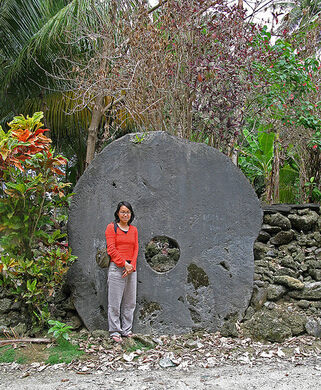
Yap is perhaps most famous for its Rai Stones, the giant stone currency of Yap. These are giant stone disks with a hole in the middle to make them easier to carry. The largest of these stones could weight up to four tonnes. Rai Stones have been mined by the Yapese for at least 400 years, possibly beginning around the 16th to 17th century. They were the most valuable form of currency on Yap, used for exchanging during weddings, buying land, etc. Most of them were too large to be easily moved, thus ownership did not involve ‘possession’ in the traditional sense. Rather, people and villages kept track of who owns which Rai Stone by collective agreement. This abstract currency has more recently been compared to the much newer concept of cryptocurrencies (e.g. here). Indeed, one does not even need to be able to find the Rai Stone for it to have value. There are reports of Rai Stones sinking to the ocean floor, who existence were still tracked and ownership traded. Rai Stones all had different values. The most important determinant of the value of Rai Stones was not just their size, but rather the amount of effort and danger that went into acquiring them. For the stone required to mine a Rai Stone did not exist on Yap, so in order to acquire Rai Stones the Yapese would go on long voyages of a week or more to another island, mine the stone there, then tow it back behind the canoe on a raft. The most common source of Rai Stones was Palau, over 400km (250 miles) away. These journeys were dangerous, especially the return journey when a large stone was being towed, so often Yapese lost their lives in the attempt (though more often still in the quarrying process than the actual journey). The more dangerous these voyages were and the more lives lost, the more valuable the Rai Stones were.
Unsurprisingly, the Palauans were less than thrilled when a boatload of Yapese would disembark on their shore, to spend weeks mining stone and waiting for favourable conditions for a return journey, all the while eating their food and making a general nuisance of themselves. The unwelcome intrusions of the Yapese caused conflict and European visitors to Palau who happened to be there while the Yapese were there observed that the two groups seemed to be enemies.
I'm going to have to write this in two comments I'm afraid because of reddit's word limit, so check in the replies on this one for the continuation.
The story of the SS Gange and those on it is a significant one both with regards to the history of migration to Australia and, up to a point, the history of Australia's involvement in World War 1.
Some context though first. Malta is, for those who don't know, a small island but very densely populated island in the Mediterranean. In 1916, the population stood at 200,000 people. Being a British colony at the time, the British had to foot the burden of providing for this population as the island was not (and still is not) self sustainable. Malta was a valuable strategic outpost for the British in World War 1 - it came to be known as the Nurse of the Mediterranean for its role in treating the wounded from Gallipoli - so getting rid of the island was out of the question. Something had to be done however to reduce the burden that the population was to them. Migration was that solution.
One of the places where migration was encouraged to was Australia. Now, Australia in that period followed what is now known as the White Australia policy - essentially meaning that only white people were to be allowed into the country. As part of this policy, immigration officials could administer a dictation test in any European language to any arrival as they saw fit.
Now, the jury was out as to whether the Maltese were considered to be white. They were part of the British Empire, in very close proximity to Europe, had very extensive European History (see Knights of St. John and further prior), and were Catholics. On the other hand though, they were quite Arab looking in visual characteristics, spoke a Semitic language, and - worst of all - were ready to work long hours for low wages.
This latter point was the crux of the matter. Many Maltese found work in the mines - especially those at Mount Lyell - which resulted in unions crying foul over them. The Zeehan Branch of the Amalgamated Miner’s Association for instance through its branch secretary Walter S. Geard wrote (pg 71+72 on the link) to the government in May 1912 and described the Maltese as ‘very undesirable immigrants’ and expressing his distaste at how they were allowed to compete with ‘white Australians’ on the workplace (with the word 'white' being underlined for emphasis). Like his letter there are many others which follow a similar vein, while a company in Portland even had to promise that it would stop employing Maltese so to avert a strike.
All this context is significant to note as we come to 1916. World War 1 was ongoing and Australia's Prime Minister William (Billy) Hughes was under pressure from the Imperial government in London to up the war contribution. Conscription was not implemented in Australia at that point, and so Hughes opened the door for it by calling for a referendum on the matter, which was set for the end of October that year. One of the main arguments presented against it by the anti-conscriptionist lobby was that conscription was merely an excuse to send working Australians into battle and replace them with cheap, foreign labour.
Enter the SS Arabia in September, arriving in Sydney with 97 Maltese immigrants onboard. All but 10 of them were of military age, and only half of them could speak English. This was definitive evidence, the anti-conscriptionists said, of the government's plan to import cheap labour. The Argus reported a 'Maltese Invasion', the Brisbane Worker carried a statement by the Australian Worker's Union which read that the Maltese were nothing more than 'coloured job-jumpers' who had to be isolated and black-banned, and The Worker warned of the Maltese 'Black Menace', writing ‘if you want to preserve your woman folk from the contamination of the black man, be careful to vote “No.”’ The Premier of South Australia, Crawford Vaughan, no less – even told parliament of his ‘grave suspicions’ that the Germans had orchestrated the immigration of the Maltese with the hope of hurting the pro-conscription campaign and hence the war effort, a claim reproduced by The Age and The Argus.
Faced with this pressure - Prime Minister Hughes announced that no further 'cheap labour' will be accepted into Australia, and instructed the British authorities to stop issuing passports for entry into Australian to Maltese of military age. The government made sure to check all British ships en-route to Australia to see that there were no Maltese onboard. Indeed, there were none.
However, what Hughes and the government did not know at that point was that there were indeed Maltese en-route to the Antipodes. 214 of them, no less. They were onboard the French ship the SS Gange which had left Malta on 12 September - before passports had stopped being issued. 165 of them were of military age and, tragically for Hughes, they were scheduled to arrive in Australia on 28 October - the eve of the referendum.
Continuing with the theme of firearm curios, today I'm writing about a truly odd duck, the Australian Owen Machine Carbine. Named for its young designer, Evelyn "Evo" Owen, this World War II era submachine gun is generally forgotten about in favor of the more widely used Sten, let alone the photogenic Tommy Gun, but in point of fact, it rightfully can be considered one of the best firearms of the conflict, wryly noted in British testing near the end of the war as "functionally better than any other British designed weapon of this class".
Evelyn Owen, right, with his creation (AWM)
Designed in the 1930s, and originally rejected by the Australian military as unnecessary, in Australia at least it has somewhat legendary status as a product of local ingenuity that had to fight the bureaucracy to be given a chance to shine. While a teenager, Owens had already been experimenting with designs, creating a working submachine gun out of a type pump, a shoe-horn, a gas pipe, spring, and .22 barrel. At the age of 21, Owens made his first design submission of an automatic to the Army Inventions Board in 1936, but it was quickly rejected. The mere concept of a submachine gun was also something of a deterrent, and the officers, who had no formal training for their position beyond normal military duties, simply didn't see the need for one, and if they did, believed that a British design would be assuredly superior. He wasn't deterred though, and in the summer of 1939, seeing war on the horizon, made a new attempt with what was fundamentally the Owen Gun design.
.22 caliber Owen Gun Prototype (AWM)
Originally in .22, it was admittedly underwhelming, not to mention downright ugly with its barebones design and upward facing magazine, but the officer at the Victoria Barracks, Col. Wright, again sent him packing. The British didn't have an SMG, so Australia didn't need one either! When war broke out in shortly after, he joined up as did many young men, but also saw a new opportunity to get his design accepted for production, given the now pressing need for arms. Coming into contact with an official at a local steelworks, Lysaghts, he passed along his prototype for inspection, an exchange of which there are several competing accounts, most involving a sugar sack. Whichever you accept though as gospel, Vincent Wardell and his brother Gerard, an engineer there, were impressed enough to assist Owen in reaching out through back-channels to skip past the Army officials who had been sandbagging him, resulting in the Central Inventions Board giving it a test, and for Owen to be transferred to work for it in late 1940, now under the wing of Captain Cyril Dyer who saw his potential.
There were still hurdles to be had though, especially continued resistance from within the Army acquisitions chain, especially the Master General of the Ordnance, which oversaw the regional AIBs, and continued to insist there was no need for such a design, and as before that if there was they would use a British one, even if they had no actual power to interfere with the CIB. The initial test model, done in civilian .32 caliber as the Army refused to provide military rounds for testing, was done entirely on Lysaghts dime. Despite the tests done by civilians proving the design's worth, the Army officials continued to turn their noses, even as members of the AIF in North Africa reported back that a better SMG would be well appreciated, and the only available arm was the prohibitively expensive Thompson gun bought from the USA, which lacked the durability of the Owen Gun in any case.
1940 .32 caliber prototype (AWM)
Sick of the continued stonewalling, Wardell and Own went to the top, finding an ear with Sir Percy Spender, who was the Army Minister, and in turn allowed to present the design to the War Cabinet in April, 1941. Unlike the officers of the MGO, the Cabinet officials were receptive, not only interested in the design, but put-off by the way the Army had up to then done their best to kill it, and 100 samples were quickly ordered for further testing.
The Army of course still tried to kill it, as did the Directorate of Ordnance Production. Knowing that the British Sten was soon going to be available and the Army trusted whatever the British could do would be better than some Australian kid, they sought to undermine the Owen design by insisting it be made in .38, an under-powered rimmed round which often resulted in jams, and wasted the time of the designers attempting to overcome the issues. When, as expected, the .38 model underwhelmed at trials, Wardell insisted on comparative tests of several calibers together, his team at Lysaghts having, with foresight, developed alternatives anyways, and the 9mm quickly impressed, not just against the other versions, but against the British Sten which had finally arrived for testing by the MGO as well. The Army had tried to quash 9mm, insisting that it wouldn't be useful as Australia lacked production facilities at the time, but that of course wasn't an argument against the 9mm Sten.
1941 .45 caliber prototype (AWM), 9mm prototype (AWM), and .38 mm prototype (AWM). Note the curved magazine necessary for the inappropriate, rimmed cartridge.
The simple design might have lacked in visual charm, but more than made up for it in performance, proving to be a reliable piece of equipment that could readily stand up to the kind of abuse a military firearm could expect. Being considered more comfortable and easier to use then the comparable Sten and Thompson certainly didn't hurt either! In commentary on the design by the Patent office, they laid out just what made the gun stand out so well:
The Owen Gun was an automatic firearm of the usual recoiling breech bolt type , with a fire control member cooperating directly with the trigger. Its outstanding features included:
- extreme simplicity of design and construction, which enabled it to function successfully under difficult service conditions;
- the rapidity with which it could be taken to pieces and reassembled ;
- the system of fire control which facilitated economical expenditure of ammunition ;
- a tubular stock body and, in later models, a hollow breech bolt ;
- high muzzle velocity, which helped to make the gun a very effective short-range weapon.
By placing the magazine on top the centre of gravity of the gun was made to coincide with the gun's longitudinal axis. This gave greater accuracy of fire under fully automatic conditions .
Another great advantage was gained from this placing of the magazine: if mud got into the weapon round the breech it would drop straight to the ground; if it entered the magazine it either tended to drop out or was pushed out by the magazine spring. The Sten gun, on the other hand, was loaded on the side and ejected spent cartridges to the other side so that mud tended to lie in the bottom of the casing round the bolt. It was the Owen Gun's ability to operate under muddy conditions that made it superior to other sub-machine guns in the jungle. All these advantages, combined with an unusual simplicity of design, singled the Owen Gun out from its contemporaries and its predecessors.
This is several days late but...
Our Oceania FAQ has plenty of great reading, and is one of the best curated on AH - I'd highly recommend checking it out, you'll definitely find something you'll like.
Welcome to the sixth installment of our Summer 2019 Floating Features and Flair Drive.
Today’s theme is Oceania, and we want to see everyone share history that fits that theme however they might interpret it. Share stories, whether happy, sad, funny, moving; Share something interesting or profound that you just read; Share what you are currently working on in your research. It is all welcome!
Floating Features are intended to allow users to contribute their own original work. If you are interested in reading recommendations, please consult our booklist, or else limit them to follow-up questions to posted content. Similarly, please do not post top-level questions. This is not an AMA with panelists standing by to respond. Such questions ought to be submitted as normal questions in the subreddit.
As is the case with previous Floating Features, there is relaxed moderation here to allow more scope for speculation and general chat than there would be in a usual thread! But with that in mind, we of course expect that anyone who wishes to contribute will do so politely and in good faith.
Please be sure to mark your calendars for the full series, which you can find listed here. Next up on Wednesday, August 21st is the History of Religion and Philosophy. Don't forget to add it to your calendar!
If you have any questions about our Floating Features or the Flair Drive, please keep them as responses to this comment.