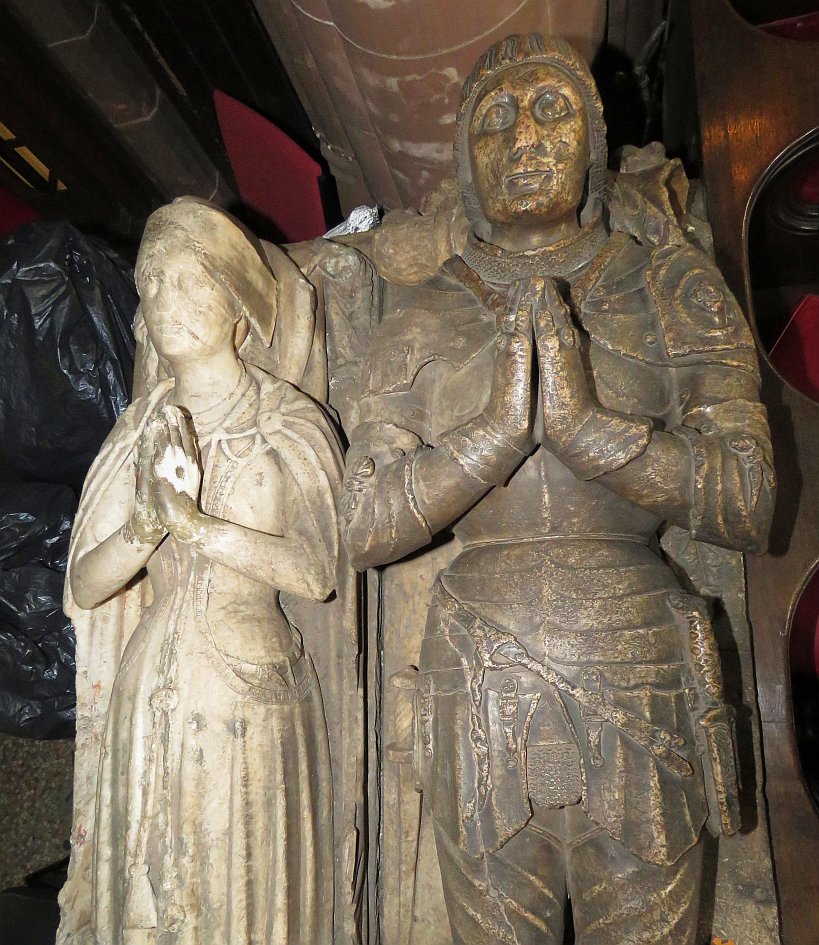
Yes, English knights did wear armour with fluting, and they did so through much of the 15th century. However, this armour was fluted in a style that is distinct from the more famous 'gothic' armours of the late 15th century Holy Roman Empire - fluting is seen in a distinctly 'English' style and in what might be called a 'western European' style. Stylistically, it is an important element of the armour styles present in England from 1420 onwards. As evidence I'll mostly be referring to the funerary effigies and monumental brasses depicting English men at arms, and drawing from Dr. Tobias Capwell's Armour of the English Knight 1400-1450, which is the essential text on English armour in the 15th century (the second volume, covering the next half of the century, is forthcoming).
Fluting in English armour starts* in the very early 15th century. Indeed, fluted elbow (couters) and knee (poleyns) armour in England predates the much more famous German fluted armours by several decades (not that the English -invented- it, necessarily, but they were early adopters). These early fluting patterns are generally radiating or starburst patterns on the 'wings' of the elbow and arm armour. You can see fluted couter 'wings' in Sir Arnold Savage's monumental brass and see fluted poleyn wings in John Sutton's funerary effigy. Until around 1430 this is the main form of fluting that you see on English armours depicted on funerary effigies and monumental brasses. After 1430, fluting becomes more common, and proliferates until around 1485 or so. As the decades roll on, you see fluting change in form - on couter and poleyn wings you see a more 'organic' or 'branching' style alongside the older 'fan' or 'starburst' form, and the flutes themselves are sometimes rounder and deeper and more distinct. You also see more elements of the armour become fluted - the pauldrons (or besagews) and tassets most prominently. You can see this on Richard Vernon's Effigy. After 1450 things get a bit out of hand, though never as exuberant as the South German 'gothic' armours. On the effigy of Robert, Lord Hungerford in Salisbury Cathedral you can see fluted cuisses (thigh armour) and vambrances (arm armour) as well as fluting on the tassets, poleyns, couters and pauldrons. You also see fluting on gauntlet cuffs, for instance on those of Thomas Erdington's effigy and very occasionally as a 'starburst' on the plackart (which is more typical of continental Europe) as on the effigy of Thomas Vaughan.
Generally speaking, the armours mentioned above are all of an evolving 'English' style, which while it was influenced by armours elsewhere has some pretty distinctive features, especially the fluting. In many cases, these armours would have been made domestically, or perhaps in the low countries. However your also see fluting on the 'Italian Export' style armours that are also depicted, like the effigy of Richard Beauchamp, Earl of Warwick, though this is in a somewhat distinct style. What I haven't found evidence for in England is South German 'gothic' style armour - though we know of some armour trade between Nuremberg and England in the 14th century at least.
As to the uses of fluting, it's been argued that fluting makes armour stronger without making it heavier, or that it offers odd angles to incoming blows. This is hard to prove, but it is worth noting that the rise and fall of fluting follows the dictates of fashion rather - it comes into fashion and comes out, and often coexists alongside unfluted armour. To me this points to it being a decorative feature rather than a protective one. But of course social display is one of the uses of armour, so even if its not protective, fluting can still be 'practical'.
*I am not including radially fluted helmets, which can be seen centuries earlier, or the paralell-fluted knee cops of the 14th century.