From my knowledge of renaissance armor, it seems there is an abrubt jump from the full harnesses of 1550 to savoyard armor of 1600; personally I have seen very few examples of three-quarter armor before savoyard and post full-harness. So what exactly did the armors of 1560-1599 look like?
This is a great question. The slow diminishing of armour over the 150 years between 1550 and 1700 is at once a story that everyone thinks they know, and one that is easily oversimplified. In some ways it does boil down to guns, but in other respects the story is much more complicated than that. Rather than a simple case of armour becoming obsolete, we see how it was continuously adapted and used for different roles as warfare changes, with continued use by troops in sieges and heavy cavalry into the modern era, almost to dawn of modern ballistic armour in the 20th century. But you probably know that already, since you're asking about the critical 1550-1600 period.
The story of 'three quarter' armour goes back longer than 1550. Long before the gradual abandonment of full harness, men at arms would wear lighter armour for certain circumstances, or certain types of troops would be more lightly armoured than the fully armoured men at arms. At times, these troops would wear something like the full harness of men at arms, but with some pieces taken off to save weight or expense. In the 15th century, this normally meant forgoing leg harness entirely - in both documentary records like the Howard accounts and in art like the Pastrana Tapestries and the Swiss Chronicles and many others. This makes sense - modern kinemetric studies show what anyone whose tried running in hiking boots already knows - weight on the end of your limbs, especially your legs, is more fatiguing than weight carried on the body. This means that often men at arms fighting on foot didn't wear leg harness at all, preferring a 'half armour'. This armour continued into the 16th century and beyond - we often associate it with early modern Spanish soldiers, or Elizabethan soldiers, or whatever, and it's often depicted on portraits starting around 1550, as less complete armours become more commonly depicted.
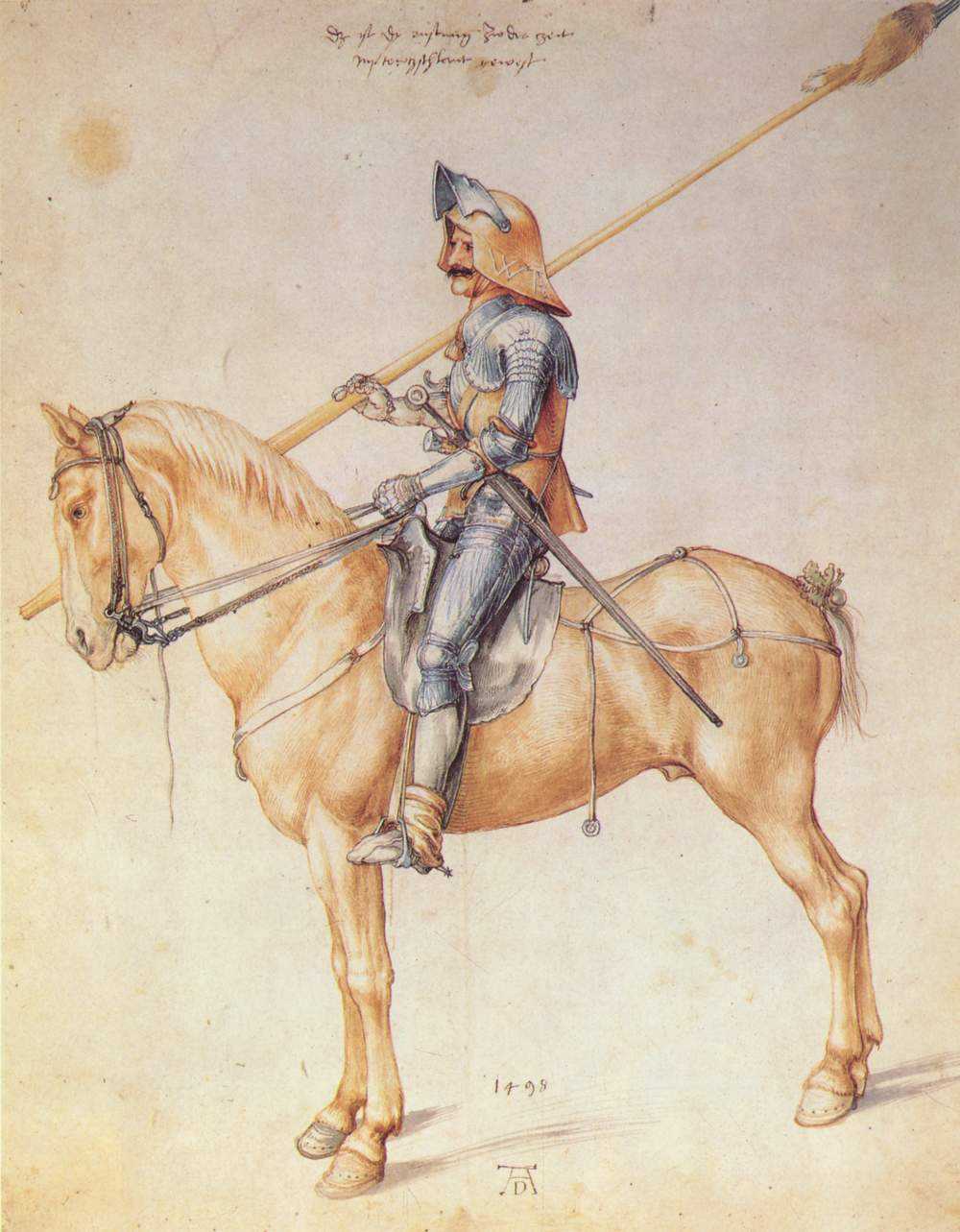
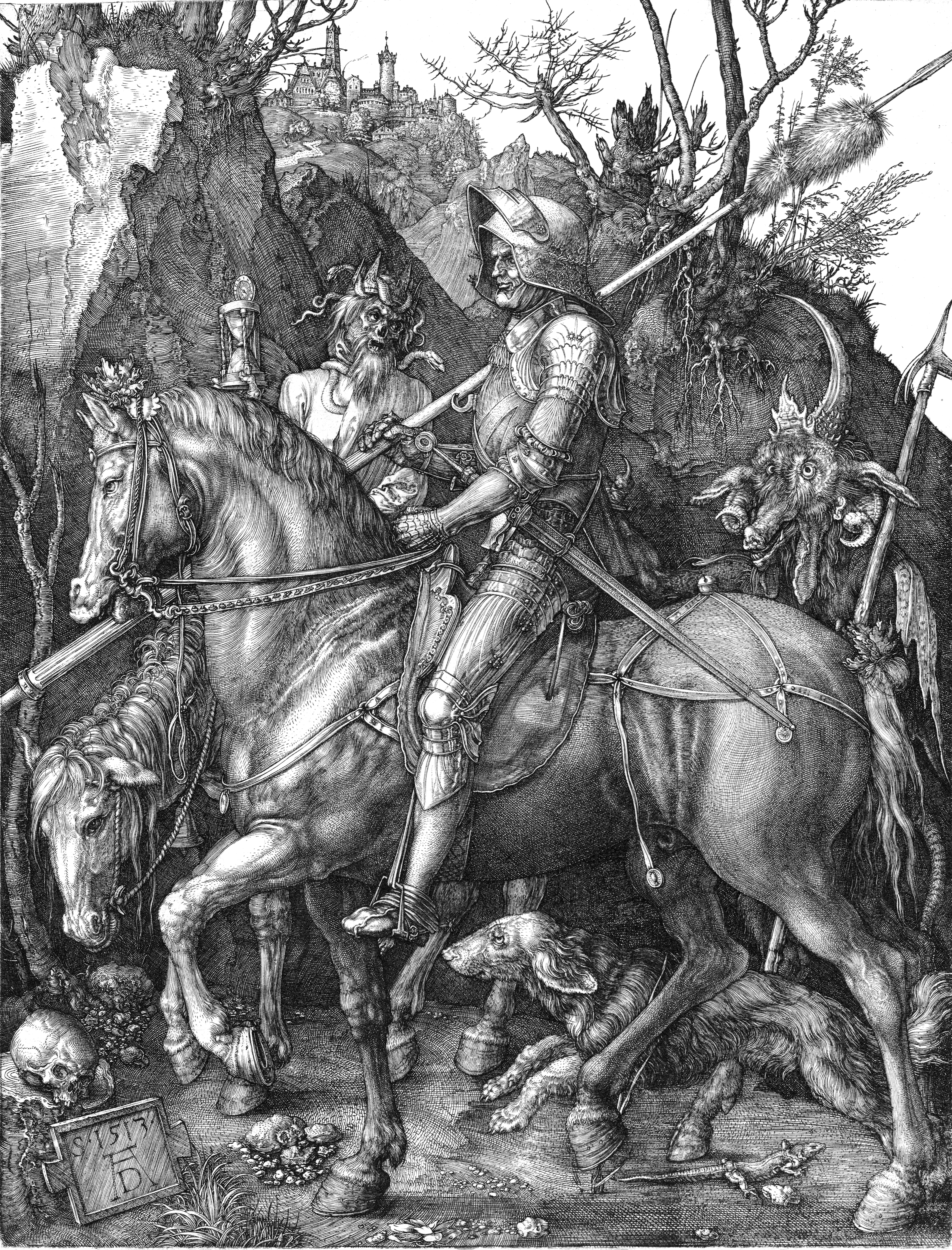
But what about three-quarter armour? I first see this (and in the end, most frequently see this) as equipment of lighter cavalry, rather than equipping infantry (though it does that too, albeit often in a different form). The earliest depictions I commonly see are of militia cavalry in the service of German city-states around the turn of the 15th century (this is not to say that three-quarter armour wasn't used earlier). Albrecht Durer, the great master of the Northern Renaissance, often depicted these soldiers. In 1498 he drew a rider in three quarter harness with a lance rest and a fairly heavy cavalry lance. This would go on to form the model of his greatest engraving, commonly called 'The Knight, The Devil and Death' as well as his St George. Ironically, the soldier depicted in the engraving probably isn't a Knight at all but a well-to-do townsman of Nuremberg. Durer also depicted St George in this three-quarter armour in the Paumgartner Altar, where he literally depicts his patron as the saint. In his unpublished thesis, Callum Tostevin-Hall argues that this use of townsmen in a sacred/chivalric context may be an expression of 'town pride' for Nurembergers like Durer. Durer aside, you see a number of other depictions of three-quarter harness in turn of the century German art, as in this depiction of soldiers in the Schwabian war. These soldiers could roughly be called 'demi-lancers', though often the term is used more specifically to those soldiers who use a lighter cavalry spear, without a lance rest. In the 16th century (particularly after 1530 or so), these soldiers and later the pistol-armed 'schwarz reiters' (black riders) were increasingly used to supplement or replace fully armoured men at arms, whose expensive equipment was increasingly unappealing. As the century wore on, cavalry tactics would also move away from those of men at arms toward more flexible tactics that required more lightly armoured troops.
In this early period, these early three-quarter harnesses are essentially just full harnesses without greaves. This starts to change in the 1520-30s, when you begin to see cuisses replaced by laminated tassets that go all the way from the breastplate to the knee. These can be worn either as part of a full armour (generally with a full poleyn over the knee), or as part of a three-quarter harness (often with just a simple final lame). You can see a fairly early example of this here. In the 16th century, the armour for the elite was increasingly made in the form of 'garnitures' - mix-and-match sets of armour that could be reconfigured to fit multiple roles, from light cavalry and infantry to medium cavalry to heavy cavalry to tournament use. You see these garnitures often used in their 'three quarter' configuration.
So that takes us up to 1560. It's in the third and fourth quarters of the 16th century that the full harness is largely supplanted by three quarter armour, as you guessed. All the trends I mentioned above - the supplanting of men at arms by cheaper cavalry, the move toward less shock-based cavalry tactics, and the use of guns, make full armour less and less appealing as the century goes on. The role of gunpowder is more complex than you might guess - to be brief, rather than rendering armour obsolete, gunpowder encouraged armourers to protect the most vital areas (torso and the front of the head, but especially the torso) with thicker and thicker metal, until breastplates are twice or three times as thick as they were in the 15th century. In order to save weight, often soldiers would forgo armouring their lower legs, preferring a three-quarter harness that might weigh as much or more than a full armour from the century before.
So after that long preamble, what did these armours -look- like? Generally speaking, they would have the laminated tassets I talked about before, a gorget, full arm harness and a burgonet on top. Special mention should be made of the 'black and white' armour of the 'schwarz reiters' I mentioned before, which you can see in massive quantities in the armoury of Graz. This armour combined steel left 'rough from the hammer' contrasting with sunken bands of polished steel, producing probably one of the -awesomest- looking armours of the early modern period. While originally the unpolished surface alternating with a polished one was a way to create an aesthetic effect on the cheap, you also see some very ornate armours in this style. But this 'black and white' armour was mostly done in the german lands. Elsewhere the armours would be plainer steel or perhaps entirely unolished. Another style you often see is the 'anime' style of cuirass, which can be seen here in this armour attributed to a young Edward VI - this armour was made of small, overlapping lames, rather than a single plate, making armour that was more flexible and comfortable to wear.
As I mentioned, often three-quarter armours (or armours worn in the three-quarter configuration) would be worn with a burgonet one of the most adaptable helmets of the 16th century. Like the sallet in the century before, the burgonet could be open faced, or it could protect the face falling buffe. It could have no cheek pieces, hinged cheek pieces like an armet or a pivotting lower bevor like a close helm. Whatever it was, it generally had a brim, either fixed or pivotting. As you can see from some of the armours above, you could also see fully enclosed close helmets used with three-quarter armour.
As you probably noticed, the armour overall isn't that different from the cuirassier armour of the 17th century, though the silouette is quite different, with the waistline plunging as the 16th century wears on and then abruptly rising in the 17th. Another difference is that by the end of the 16th century the lance rest has disappeared from the three quarter armours, being only used for the increasingly rarely fielded full harnesses. But despite these differences by the middle of the 16th century, the basic concept of the three quarter harness - laminated tassets, a semi-enclosed helmet, full arm harness - were well established, and they would remain in use for around 100 years.