The image is an illustration of Johan Nieuhof's travelogue of China. ( An embassy from the East-India Company of the United Provinces, to the Grand Tartar Cham,..) I'm not sure where the name 'Vitek' comes from; it's not used in the text. 'Ninifo' is, and is from Mílè pú[sà], the Chinese name of the Buddha Maitreya, of which Budai, commonly called the 'laughing buddha' (or 'fat buddha') is an incarnation.
There are many Budai statues in China and the text does not give much indication of which ones he may have seen. The engravings for it were based off sketches Nieuhof had made. Some of his own drawings are in his 1658 report to the directors of the Dutch East India Company (VOC), which you can find digitized at Bibliothèque Nationale de France, where it lives now. The drawing that served as the model for this engraving isn't in it, though. But you can compare, for instance, this portrait to the later engraving based on it. As you can see, a lot of detail has been added. It was standard practice at the time for engravers to add embellishments to make a prettier picture.
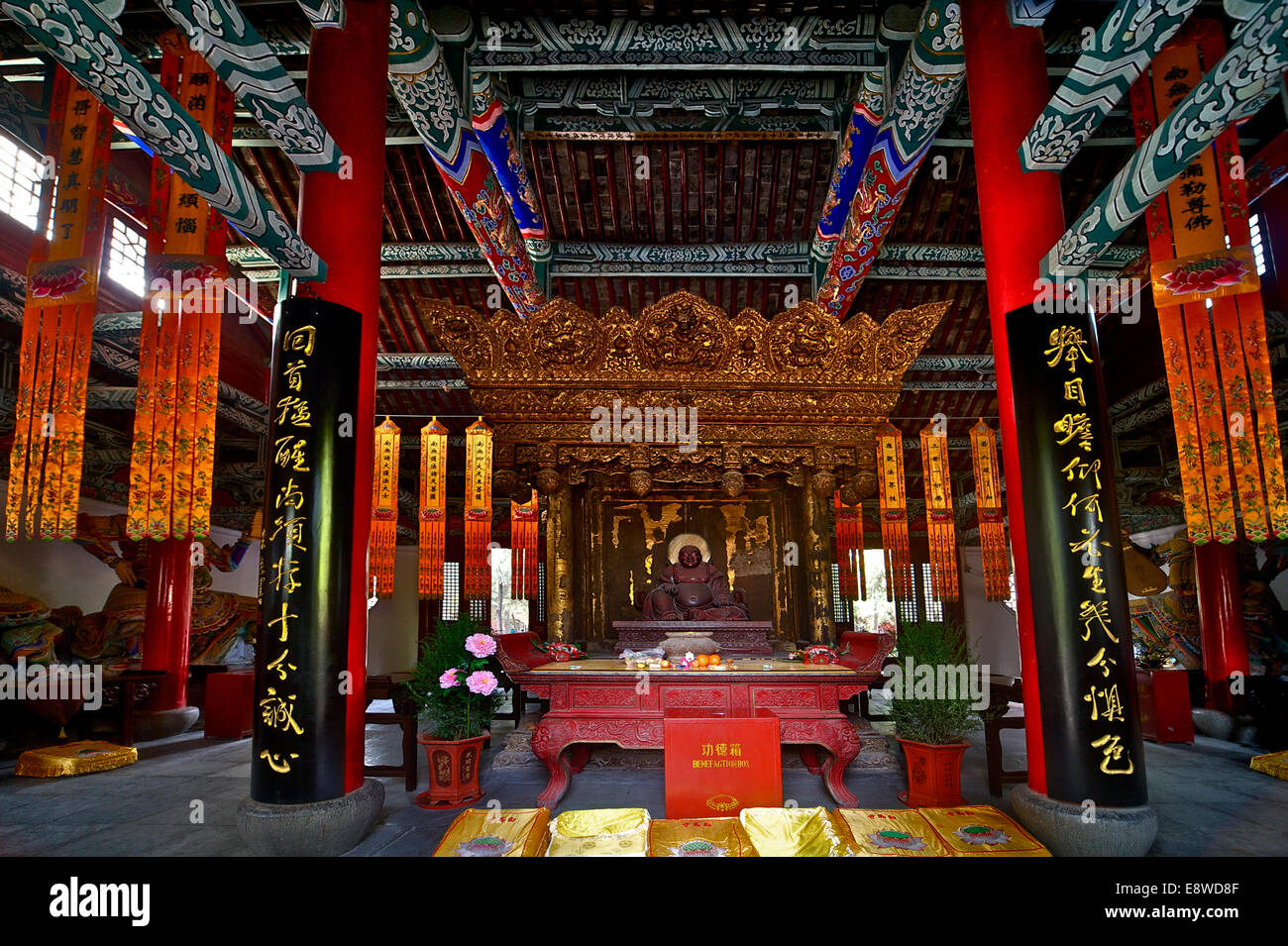
In this engraving, the statue itself is a reasonably accurate representation of a Budai statue; there are many that look like that. The demon-like figures flanking him though, pretty obviously look a lot more like contemporary European ideas of demons than anything you'd find in Chinese art. The temple building looks very much to be a chinoiserie , a Western conception of Chinese style. (I'd say it reminds me more of this 18th century 'Chinese' pavilion at Drottningholm Palace, than this actual Chinese temple).
In short: The statue itself is probably based off a drawing of an actual Budai and the rest of the scene from the engraver's own imagination.