Do we have any written primary accounts or artwork by the first Chinese goverment or emperors court, to find out that Britain and its people came from an island really, really far away and what did they make of its culture, history, fauna, flora, society, religion, monarchy etc... and for the rest of western Europe in general if I can score any bonus info answers,
Cheers
Well, the first and simplest question is, why would you expect them to care? This isn't meant to be snarky or anything. It's simply fact that England/Britain really didn't feature on China's geopolitical radar until the mid-18th century. During the Late Ming, English interests didn't overlap with China's. It wasn't English ships seizing Malacca, it was the Portuguese. It wasn't the English East India Company colonising Taiwan, it was the Dutch. There were no English horse archers gathering outside the Great Wall, nor were English samurai invading Korea. The only time there was a major confrontation with England was in 1637, right near the end of the dynasty, when Captain John Wendell of the East India Company attacked Chinese ships in Canton and forced the provincial authorities to permit trade by English ships. But by that stage, the Ming had rather more existential issues to deal with, thanks to the emergence of the Manchu Qing Dynasty northeast of the Wall and a major peasant uprising based out of the western hinterlands, while England headed towards civil war and interregnum.
The first imperial court to know Britain was an island did so likely at the same time they found out that it existed at all, likely through this. This is the world map produced by Matteo Ricci in 1602, called the 萬國全圖 wanguo quantu (lit. 'Complete Picture of the Myriad Nations'). (If you remember /u/hannahstohelit's post on the first meeting of European missionaries with the Kaifeng Jews, this is the same guy.) More specifically, it's a later Japanese copy printed in colour. The text is identical, however, so I link this version (because it's a much smaller file than the facsimile Chinese print).
In basic terms, it conveys five things about Britain. The first is its general shape. The second is its position relative to the rest of the world. The third is its rough subdivisions – bear in mind that at the time he created this map, James VI of Scotland had not yet acceded to the English throne. To the north is 思可齊亞 siqeqiya, or 'Scotia', to the south is 諳厄利亞 aneliya, or 'Anglia', and to the southeast, 婆林日 polinri, which seems to be unidentifiable. The island to the west is 喜百泥亞 xibainiya, or 'Hibernia'. The fourth has to do with its fauna. Ricci has this to say about England specifically:
諳厄利亞無毒蛇等䖝雖
別處携去者到其他即
無毒性
Anglia has no poisonous snakes or other such creatures, and when one | brings them from other places they also | lose their poisonous nature.
The fifth is a rough description of the political system, religion, customs and economy of all the states of what he calls Northern Europe (北歐邏巴洲 bei ouluoba zhou):
北歐邏巴洲有三十餘國皆用前
王政法一切異端不從而獨崇奉
天主上帝聖教凡官有三品其上
主興教化其次判理俗事其下專
治兵武土產五穀五金百果酒以
葡萄汁為之工皆精巧天文性理
無不通曉俗敦實重五倫物彙甚
盤君臣康富四時與外國相通客
商遊徧天下去中國八萬里自古
不通今相通近七十餘載云
Northern Europe has over thirty countries all ruled by | monarchies. In all of them, heresy is not followed, and all solely worship | God [and His] holy teaching. Of all officials there are three types: the highest [are those who] | promulgate and educate [about] God [i.e. priests]; next [are those who] pass judgement on and manage vulgar affairs [i.e. magistrates]; and the last [are those who] specialise | in soldiers and warfare [i.e. officers]. The earth produces [the] five grains, [the] five metals and a hundred fruits. Alcohol is | made using grape juice. Its crafts[men] are exquisite, and [as regards] astronomy and moral philosophy | all are well-versed. Even the vulgar set great store by the Five Relationships. Goods are gathered together [such that] all | is plentiful. The princes and ministers are prosperous and wealthy. At all times, they communicate with foreign countries. | [Their] merchants have travelled all across the world. China is eighty thousand li (40,000 km) [away, so] since ancient times | [there has been] no contact, [but] now there has been contact for around seventy years.
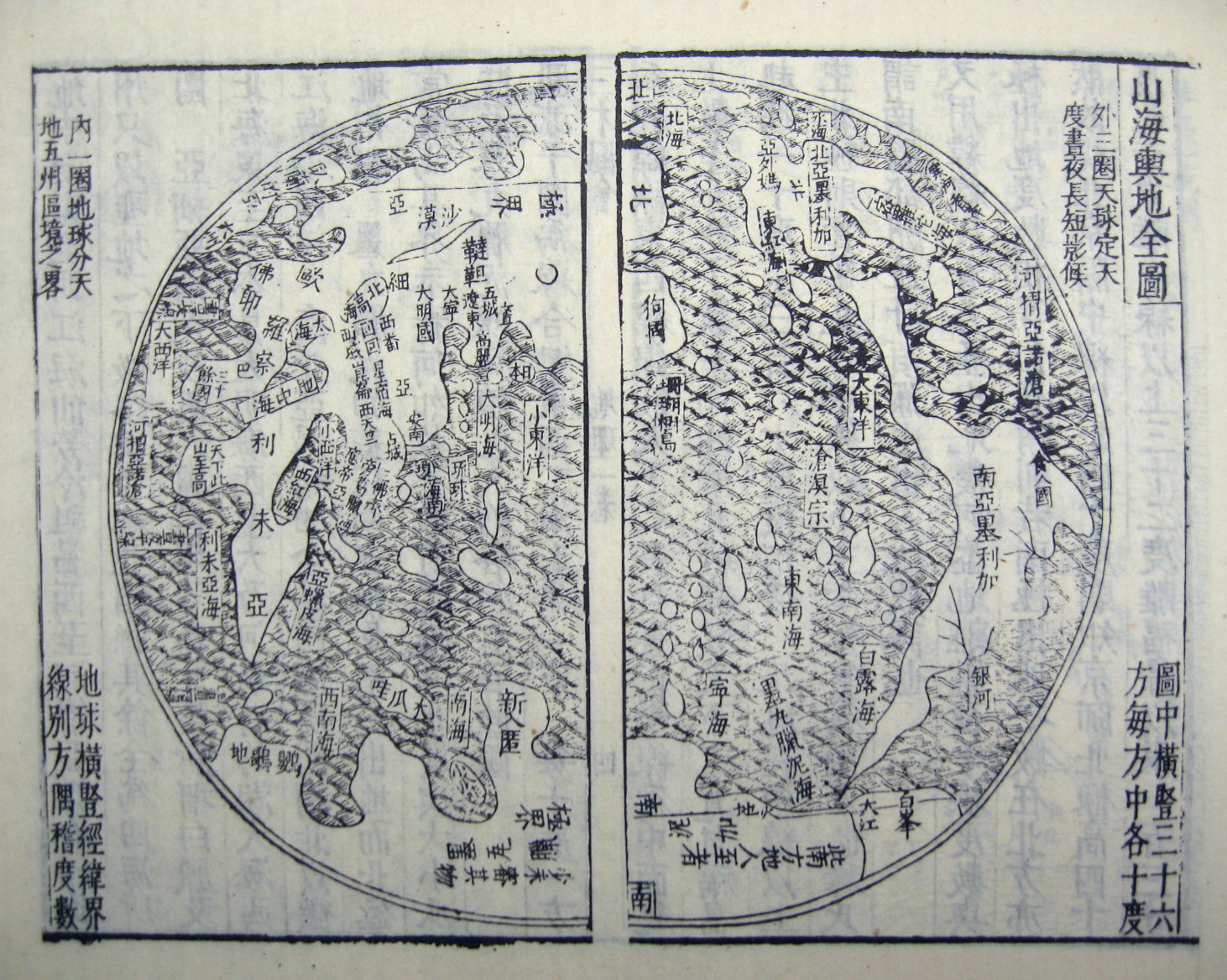
If you'd been a Late Ming courtier, then England would have appeared to be in the middle half of an island north of France ruled by a Catholic monarchy, where snakes stopped being poisonous, there was a booming wine industry, and everyone could expound on astronomy and morality. But that assumes that you paid attention to England at all. The 山海與地全圖 Shanhai yudi quantu (lit. 'Complete Picture of Mountains, Seas and Land'), a 1609 map derived from Ricci's, omits any sort of detail in the British Isles whatever, even names, although to be fair it also simplifies the rest of Europe massively. The only named country in Western Europe is 佛郎 folang, 'Francia'. The characters over Spain simply read 三十餘國 – 'over thirty countries'.
The Qing, the last imperial dynasty to rule China, shared the Ming's general lack of concern with Britain for about a century. Frankly, they had much bigger fish to fry. In the 1630s-60s it was the remnants of the Ming and the peasant rebels; in the 1660s-80s it was the revolting feudatory princes of the south and the independent regime on Taiwan, in the 1650s-80s the Russians were trying to win over Qing clients in eastern Siberia. Then, the emergence of the Zunghar Khanate threatened the Qing's Inner Asian dominion, leading to seven decades of on-and-off conflict from 1687 to 1757. Britain, which was neither a credible military threat nor an active colonising power in Southeast Asia, simply wasn't worth consideration to the same degree as European and Central Asian powers that were in the area.
Perhaps best illustrative of this is a series of comments which the Kangxi Emperor wrote regarding the Qing Empire's geopolitical situation some time before his death in 1722, and read out at a gathering shortly afterward, the contents of which are relayed to us by a French Jesuit, Antoine Gaubil. Gaubil transcribes the emperor's piece in full, revealing that the three European powers he was concerned with were Russia, the Netherlands, and Portugal. Russia, thanks to its expansion in Siberia, had a considerable land border with the Qing, stretching from the Altai Mountains to the Pacific, as well as had dealings with the Zunghars, making it the most immediate threat, but the Dutch, whose powerful navy and strong finances gave them control over much of Southeast Asia and interests 'in the vicinity of the Chinese province of Yunnan', were also an object of suspicion, despite their expulsion from Taiwan by Koxinga. Portugal still held onto Macao, and apparently Luzon. However, Kangxi seems to have conflated Portugal with Spain (who actually owned Luzon) here, as should become evident later. Kangxi was aware of more than a few goings-on in Europe – he alludes to the Great Northern War in his section on Russia, and his section on 'Portugal' reveals an awareness of the Spanish colonial empire, and that the king of 'Portugal' was of the same family as that of the king of France (as a result of the War of the Spanish Succession, which placed Louis XIV's grandson on the Spanish throne as Philip V.) However, as noted earlier, he says nothing of England. Was this a matter of Gaubil omitting France's ancestral (and now Protestant) maritime rival from consideration? Plausible, but unlikely – Portugal and the Netherlands had also been recent enemies in the War of the Spanish Succession. The most likely explanation is the simplest – the Kangxi Emperor wasn't concerned.
The Qianlong and Jiaqing Emperors ended up speaking or writing directly to British diplomatic missions, but both retained a degree of aloofness about the whole affair. Qianlong, ever the universalist, on the surface level dismissed the British embassy's demands and their trinkets and curios, but privately was aware of his state's reliance on foreign silver and continued to cultivate his interest in foreign technology through having his Jesuit courtiers document the various instruments the British brought with them. The Jiaqing Emperor was warier of British interests in South China, but nevertheless had little to say beyond a few general statements:
...it is alleged that their people are adorers of the Middle Kingdom’s morals and greatness. This is the barbarians’ usual statement. They travelled an extremely long distance to my imperial court under the name of paying respect, but in fact they must have other intentions.
What these other intentions are, he never says, nor does he seem to have attempted to find out.
This lack of imperial concern and awareness outside of direct contact remained the case during the Opium War of 1839-42. In May 1842, 33 months into the war and three months before the war would be concluded with the Treaty of Nanking, the Daoguang Emperor summoned Ilibu, a Manchu official, to question him about Britain. Various questions were asked, including, 'Where is Britain?' 'How far away is Britain?' 'Why are Kashmiri and Indian troops fighting for them?' 'Why is a 22 year-old woman its sovereign ruler?' That such questions were being asked so late in the day is indicative of how little of an appraisal of the situation the Qing actually had, not unlikely because Britain had not previously shown itself to be a major problem.