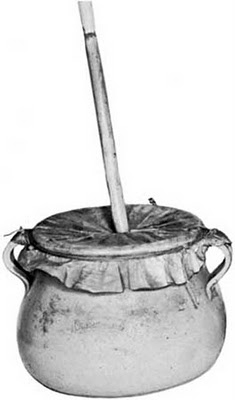
I have this image of ointment containers sealed with something resembling leather that makes them look a bit like drums in my head. (Like this but with a clay jar instead of glass https://images.freeart.com/comp/art-print/fa211389/apple-jelly-jar.jpg )
I'm not sure this is the right method though.
If someone were to seal a container long term to keep water and air from circulating during transport or storage but it was in too small quantity to use a barrel (I.e. using ceramic or the like as a pot) how would they seal it? Stretch leather over it and dry it up? Would they have a way to seal a ceramic lid? What did they do in the medieval period?
I'm mostly looking for mid to late medieval methods but am curious about all forms of it. Heck if it turns out having a tiny barrel made for your pot of jam is the best way that's what I'll use in my story though that'd be silly!
In the period 500-1500 A.D. Castles and country houses were equipped with ice cellars, where large blocks of ice were stored in winter. The ice was cut from frozen ponds or made by stamping snow. Due to the large quantity, it remained frozen underground for a long time and could be used until the summer. Ice cellars were only for the rich people. Ordinary people still used methods such as drying and smoking, but also began to add ingredients to products to make them last longer. Vegetables were cut and pickled on acid (vinegar). Salt and sugar were used for brining and jams, thus extracting moisture from food.
Your question reminded me of the "Keulse pot" (Dutch for Cologne pot, I don't know of a decent translation to English), which by means of a stick and a pig's bladder can be turned into a folk instrument: foekepot or rommelpot.
As early as the 13th century, stoneware was made in the area around Cologne. From the 14th century onwards, the Cologne pottery became famous because of the Keulse pot. Cologne pottery did not only come from Cologne, it was also made in Belgium and the Netherlands (Limburg). Keulse potten are made in all kinds of sizes, from small to large with a capacity of 30 to 50 litres. In winter, little or nothing grew on the land. In rural areas, most families were self-sufficient in vegetables, meat and eggs. Cutting beans and sauerkraut were typical winter vegetables from the Keulse pot. In the summer vegetables such as legumes and cabbage were harvested. For pickling they used salt, a coarse linen cloth and a wooden board that fitted into the opening of the pot. And a heavy boulder. During the pickling process, the main concern was to add sufficient salt to the vegetables to form a brine in which no germs could develop. For pickling in salt, 1/3 of the weight of the vegetables in salt was used. In the Keulse pot, you put finely chopped layers of cleaned, raw vegetables alternating with layers of salt, right up to the top. A clean cloth was then placed on top of it, followed by the plank and the stone. The stone was used to squeeze the moisture out of the vegetables by means of strong pressure and to keep the top layer under the brine. The pot was placed in a cool place. The pots were checked at first every 14 days, later every 3 to 4 weeks. The moisture had to be removed. A clean cloth was also put on top of the pots. Stone and plank had to be rinsed well. If necessary, new brine was added. In the winter, a portion of vegetables was removed from the pot and rinsed well before cooking. In November usually the pig was slaughtered. The ham and bacon were dried in the chimney. The other pieces of meat were placed in Keulse potten in the same way as the vegetables. Because in winter the chickens hardly lay eggs, in summer the eggs were boiled, peeled and placed in a Keulse pot, poured with vinegar and covered again.
Airtight sealing such as tin cans and home canning (weck jar) was only introduced in the 19th (and early 20th) century.
I base this answer mostly on the information available from the Historische Vereniging Wijhe. The Wijhes Museum in Wijhe (the Netherlands) has some Keulse potten on display.