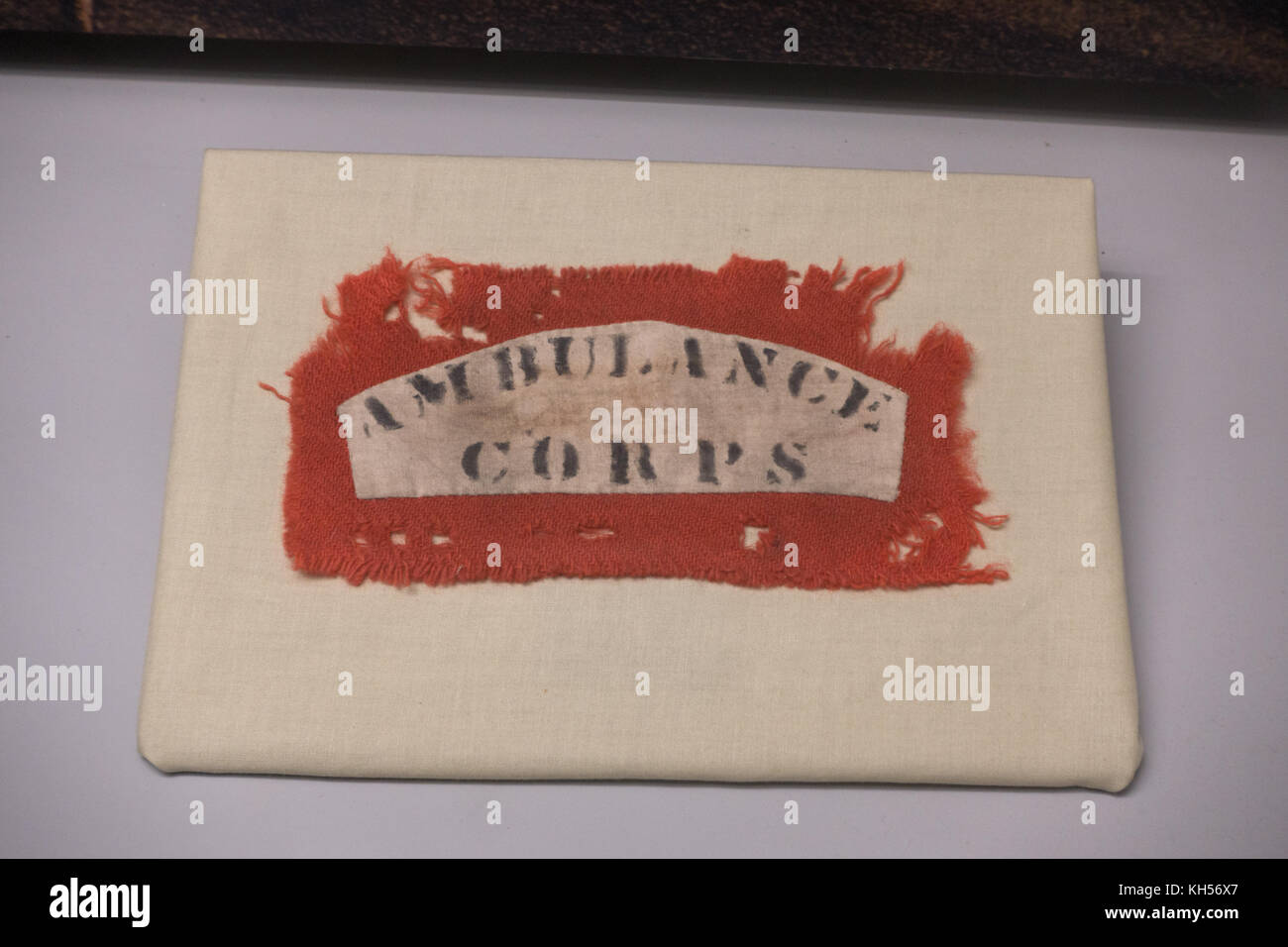
Two of my all time favorite things are combat medics and civil war history. I know both sides had medical staff, surgery professionals and makeshift hospitals to treat the injured, but was there anyone who was expected to protect and remove the injured during a battle? If so did they have any special tile or markings? Or was this procedure handled simply by any soldiers who found themselves in a position where this was necessary, combined with a general respect for injured men on both sides?
My main source will be McPherson's Battle Cry of Freedom. Unfortunately, I don't have access to specialized sources that deal only with the medical aspects of the Civil War, but McPherson's book should provide enough information to answer your question.
According to him, "Traditional practice in both armies assigned regimental musicians and soldiers "least effective under arms" as stretcher-bearers to carry the wounded from the field and assist the surgeons in field hospitals." However, he goes on to say that those men were not really useful, usually running away in terror and not having the resources necessary to carry away all the wounded to safety. The fact that the Army was awfully small previous to the war did not help matters. It had grown tremendously during the war, and with it the number of casualties as well. As a result, simply impressing drummer boys and ineffective soldiers into being "combat medics" would not be enough. They lacked the training and morale to carry out their work effectively.
Civilians helped as well in many ways, volunteering to go to the front to carry away the wounded to Army hospitals. But some of them were "worse than useless". For example, after the Battle of Second Manassas, a contingent of volunteers arrived to the scene already drunk, and they bribed the ambulance drivers to take them back to Washington, instead of taking the wounded men. Under such circumstances, the soldiers had little faith in the Army medical services, and they often broke ranks to carry comrades to the hospitals, knowing that no one else would. After battles, a common practice was to organize a temporary truce where the soldiers would go for their wounded companions, and then bury the fallen.
It was clear that change was necessary. Fortunately, when men failed to step up to the challenge, the women stepped forward. Many women created different associations to provide relief and supplies to the fighting men. In April 29, 1861, a reunion in the Copper Institute of New York created the Women's Central Association for Relief, in order to coordinate and expand the scope of these associations. The association would eventually become the U.S. Sanitary Commission, inspired by the work of Florence Nightingale and the British Sanitary Commission during the Crimean War. The Army Medical Bureau at first opposed such efforts, and Lincoln was skeptical, but he did sign the order that created the Sanitary as an official body.
We can say a lot about the brave efforts of the nurses recruited by the Sanitary and their herculean labors in favor of the soldiers, but when it comes to your question the important fact is that the Sanitary pushed for reform in the ambulance system. Jonathan K. Letterman became the medical director of the Army of the Potomac after the Seven Days, and he created a dedicated Ambulance Corps that had the duty of evacuating the wounded men in the middle of battle. Unlike the previous volunteers and soldiers, these men were trained and had high morale, which they needed, because going into the battlefield to evacuate the wounded was a dangerous task. The system quickly spread from the Army of the Potomac to other Union armies, until it was mandated by an 1864 law.
The Confederates, for their part, also created a similar system, the Infirmary Corps. But they did not have the resources in either quality or quantity. Nonetheless, they matched their Union counterparts in valor, and maybe surpassed them in improvisation and creativity.
Aside from these specialized corps, both sides still needed to recruit volunteer nurses to help the wounded or organize truces so that soldiers could rescue their comrades. Clara Barton, an exceptional woman who took part in this war and in the Franco-Prussian War and would later help create the American Red Cross, related the horrific scenes that took place after the battle: "By midnight there must have been three thousand helpless men lying in that hay. . . . All night we made compresses and slings—and bound up and wet wounds, when we could get water, fed what we could, travelled miles in that dark over these poor helpless wretches, in terror lest some one's candle fall into the hay and consume them all." Similarly, during the Overland Campaign, more specifically the initial battles of the campaign in the Wilderness, the fighting died down because soldiers sought to rescue their wounded from the forest fires started by the artillery.
So, to summarize, there were special units tasked with protecting the wounded and taking them to Army hospital as fast as possible, the Ambulance Corps in the Union and the Infirmary Corps in the Confederacy. At least in the Union side, they wore special uniforms and had their own badges and banners. Nurses of the Sanitary Commission or volunteer civilians helped to evacuate the men as well, and organizing truces to rescue the wounded was a common practice, especially after particularly hard-fought battles.
Sources: As I said, I took this mostly from McPherson's Battle Cry of Freedom. In his biographical note, McPhersons recommends William Q. Maxwell's Lincoln's Fifth Wheel: The Political History of the United States Sanitary Commission, as a source for the Sanitary Commission and their labor for the Union. I haven't read it personally, but I suppose it can give you a greater insight if you want to go deep into the topic.