I usually write long meandering comments on various parts of Aztec life, often trying to humanize an oft demonized group while at the same time maintaining the distinctiveness of a group whose society evolved completely separate from Afro-Eurasia. Balancing the familiar and the alien can be a bit of a challenge requiring a delicate touch, and since I've been rather busy with some happy life events recently, I'm just going throw out some oddities from a truly weird part of Mesoamerican history: the fall of the Toltecs.
If anyone has heard anything about the Toltecs, it's that they were the legendary progenitors of the Aztecs, who ruled a great empire under the God-King Ce Acatl Topiltzin Quetzalcoatl, who eventually vanished to the East, prophesied to return some day. There's about a million problems with that framework, but the point is that Toltec history seems to be All Topiltzin All The Time. What about his successor, poor Huemac. Yes, poor Huemac who... led the Toltecs to dissolution through his debauchery and adoption of human sacrifice, which would eventually consume his own children. OK, so maybe not such a sympathetic figure, and maybe one who ultimately earned his lonely suicide at Cincalco.
The above may sound melodramatic, but melodrama (and sex, and violence) are exactly the tone the Toltec legends that have survived enthusiastically adopt. Keep in mind, we do not have anything resembling primary sources from the Toltecs, our information instead comes from the tales about the Toltecs as told by the groups which would later dominate the Basin of Mexico, which are often just as much myth as history. Often the stories of the decline of the Toltecs strike a familiar moral tone of fables. Davies, in The Toltecs: Until the Fall of Tula notes "all these stories have a faintly moralizing note, and their content reeks of decay and dissolution" (p. 394), although these episodes often utilize tropes specific to the culture of central Mexico. One such story, for instance, has Huemac demanding his winnings from a ballgame in greenstones and quetzal feathers, instead of maize, emphasizing his vain frivolity.
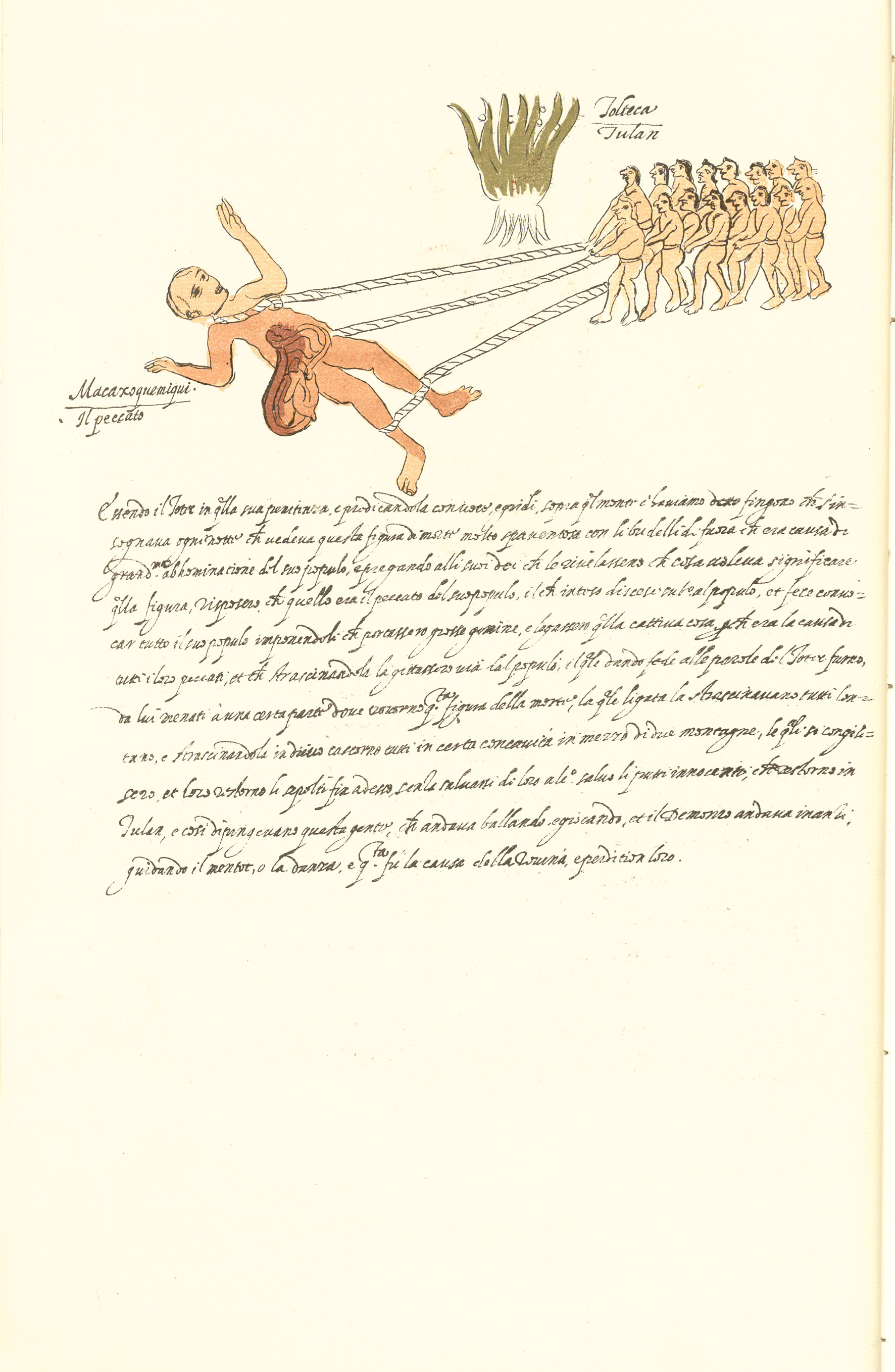
Other stories seem to just come out of nowhere, like the stinking corpse. In the Leyenda de los Soles, a Nahua creation myth/history, in the waning days of the Toltecs a giant stinking corpse appears. The stench is so bad that (per Bierhorst's translation), "whoever smell it dies from it, as well as whoever does not smell it, who simply passes by" (p. 155). Eventually the people band together and drag it out of the city with ropes. The significance of the corpse is not even attempted to be explained in the text, and it could be written off as just an odd aside, but the amount of text devoted to talking about this huge festering corpse is almost as long as the amount of time spent talking about the life of Topiltzin. Also, the tale shows up in various other histories and is even depicted in the Codex Rios. It's this obviously important event to those preserving the history of the Toltecs, but without context it could just as easily be the plot of a surrealist art film.
The more venal aspects of the fall of the Toltecs are more universally understandable. For instance, in the Annals of Cuauhtitlan, Topiltzin is disgraced when some scheming sorcerers pressure him into getting drunk whereupon he sleeps with his sister. Totally normal stuff, assuming your "normal" is the plot of a Game of Thrones episode. His successor Huemac is no less brought down by his lust. One of those same sorcerers, along with another, change themselves into women and sleep with Huemac, who then abdicates. Of course, Huemac had already been established as a total horn-dog, who had sought out a woman to be his wife who, and this really is a direct quote from the primary source, had "buttocks an arm-span wide" (p.38).
Some of the aspects of the decline and fall of the Toltecs are familiar tales of morality and the consequences of moral decline. For instance, "don't get drunk and fuck your sister," is sound advice for living a moral life, and it is embedded in repeated themes of sexual debauchery leading to great moral trepitude. Huemac's successor, Cuauhtli, apparently fully in the throes of the wicked sorcerers, ushered in an era where human sacrifice was fully embraced, with noble children being drowned, wives shooting their husbands with arrows, and captives having their skin flayed off. That the Aztecs, who were enthusiastic practitioners of human sacrifice would maintain this a evidence of a moral decline is odd, to say the least, contradictions in mythology are not exactly unknown.
Other elements of the Toltec's downward spiral have less self-evident symbolism. We might easily understand Huemac as a man of venal nature, given to lust and petty desire, but did we really need his appreciation of a nice badonkadonk preserved for the ages? Likewise, we might interpret the stinking corpse as symbolic of the breakdown of the body politic, but why a giant rotting corpse to begin with, and what made this tale so central that it would be repeated again and again? There are, no doubt, nuances of Postclassic culture in these stories which we can only speculate upon, but that's part of the appeal of the history of the Americas. When humans crossed Beringia we were still thousands of years from the advent of the sedentary, stratified societies which now form the template of our modern life. Yet, peoples separated by thousands of years and thousands of miles all developed a societal framework which seems to mirror each other; it's a fascinating natural experiment. At the same time, however, when we truly delve into these societies, we can also see their differences and unique aspects when can then drag us deeper into the endlessly fractal nature of culture.
^(Both the Annals of Cuauhtitlan and the Legend of the Sons are collected in what is known as the Codex Chimalpopoca, with a 1992 English translation by Bierhorst, cited here.)
In June 1751, Maria Flores, a mestiza (a woman of mixed European and indigenous ancestry) from Mexico City, was brought before the Inquisition in New Spain. Interrogators confronted her in the usual way. Part of what made these events terrifying and powerful (and one of the ways that they got people talking) was that a person was not told why they were being called. They did not know if they were accused of something or if they were being called as witnesses. The interrogators asked simple questions like have you seen any religious crimes lately? Have you been going to church? Do you know the prayers? All of these questions were an effort to find and correct religious transgressions, and they often came across other transgressions when people talked about something the inquisitors had no previous knowledge of.
Maria, though, did fine with these questions, so the interrogators became more overt in their efforts to get her talking. They revealed that several witnesses had accused her of making and trafficking illicit love powders out of her small shop, known as Los Muchachos (translated simply as The Boys, which as it turned out was a wonderfully ironic name).
Maria was like most women of the Spanish colonial urban American world: she was not sequestered in the house. She was actively involved in the community and an economic producer in her own right. Though she was not a wealthy woman, she owned her own store (although I could not tell what she actually sold in it; perhaps food or perhaps an early modern pharmacy of sorts). Like most women, Maria was also mobile, moving around the city in her day-to-day activities, which gave her lots of time to cultivate social and economic networks throughout Mexico City. Her social network, like most women’s social networks, bridged the so-called caste system in New Spain. Many people are taught in high school that colonial Latin American society was strictly divided by racial class, with Spaniards at the top, followed by creoles, mestizos, indigenous people, and people of African descent. You may have also seen the famous casta paintings, which show a father and mother of different racial make-ups, and what classification their child was.
In practice, this regulated caste system only existed in the minds of elite officials. Although people certainly saw racial difference, people could move between different castes. A person might be categorized as mestizo in one document and an indio in another document. Friends might have called the person by yet another classification. In an age before birth control, people had sex and had children before they were married, and in the throes of passion, made-up racial categorizations was rarely given much consideration. Often, couples merely exchanged a spoken promise that they would get married later before commencing the physical consummation of their love. In other cases, one’s caste was more about the company you kept, the language you spoke, or the cultural affinities you expressed. So if you were technically a mulato but you dressed as an indigenous person, you spoke an indigenous language, you lived in an indigenous community, and you married an indigenous woman, people might have thought of you as an indio, not a mulato.
Unfortunately for Maria, all of these social conventions about sex, indigeniety, race, love, and social/economic networks converged to doom her.
Over the course of the preceding month of May 1751, the Inquisition took statements from several witnesses who had contact with Maria in her shop, in the streets, and in the plaza near her shop. Their statements revealed a startling number of times during which Maria sold magic powders that provoked passionate love. Witnesses reported that she also kept a hummingbird in her house and had another dead hummingbird decorated with pearls and corals on her person. Hummingbirds remained powerful symbols in Central Mexico, a cultural tradition inherited from earlier indigenous beliefs. For instance, the Aztec god Huitzilopotchtli, the God of the Sun and War, was depicted as a hummingbird. If you have ever observed hummingbirds, you might have noticed that they are indeed warriors, fighting with and spearing each other with their long pointed beaks. And of course, the beak has phallic symbolism: a long object inserted into a flower. A dried hummingbird charm, like the one Maria owned, has even been found by a researcher, stuck hundreds of years ago in the middle of a volume of colonial documents.
Maria was also said to have offered enchanted fruit, worms, and insects to passers-by, all of which could be eaten or dried, ground, and consumed to cause lust. During sales pitches, she assured her clients that these products were “medically very effective.” She had some powders that would initiate torrid communication between a client and the person to whom the powder was given. She had others that a client could put in the food, shoes, or the clothes of someone they desired in order to attract them. If a client put a little love powder into an envelope along with a letter to someone he or she disliked, the recipient would soon be their friend.
The victims of the powders were furious that they were being manipulated by Maria’s magic and were more than willing to testify against her. As the investigation into Maria’s love-magic continued, witnesses helped uncover others who were complicit in her illicit dealings. These conspirators were brought in for questioning and defended themselves by providing more information about Maria, whom they claimed was the true ringleader and initiator. One conspirator mentioned that she and Maria made magic powders together, but they blessed them in the name of Saint Antony to avoid anything diabolical. Another witness detailed how they made attraction water by dissolving powder in water, washing their genitals with it, then flinging the water onto the clothes, the bed, and over the walls of their intended targets’ house. A third witness said Maria had frequent, secret rendezvous with two Spanish women and an indigenous woman late at night, yet another suspicious activity.
When confronted with the accusations, Maria admitted that she had sold love powders but denied other accusations, saying that the other rituals and superstitious activities had been merely tricks. But her answers were not satisfying enough to the investigators who arrested her and brought her to one of the Inquisition’s secret prisons.
Just to highlight again that this is a nice, open space for any America Latina experts and enthusiasts: let's hear some historia(s)!
Today we often tend to talk of "America" or the "Americas" (depending on one's region). But these are not and haven't always been the standard and only terms used for the continents. I want to look at some pre- Hispanic and earlier, Spanish terms, combining two older answers of mine.
Two main lines will be:
1 The European colonisation led to a partly submission of native American histories and ideas - including their terms for the known world. These and their cosmologies do continue to have major meaning for indigenous people until today.
2 Their "replacement" terms usually are ideologically tied to Europe or European powers: eg America (an Italian guy called Amerigo), the "New World" (so the Old World must be more important, right?!), or "Latin America " (French 19th century diplomacy).
When talking about pre-colonial "America" we have to keep in mind that while there was exchange between different population groups over large distances - there would not have existed a knowledge of the whole South American or North American continent, or even of the Americas.
I'll have a look first at terms used by the pre-colonial/colonial Nahua (aka Aztecs) of central Mexico, and then more briefly at the South American Incas. These were the two largest states at the time of conquest in Latin America, so we have quite some knowledge of their perceptions. This is not make them out as more important though than any of the many and highly diverse native American people with their own worldviews!
Anáhuac/ Cemanahuac
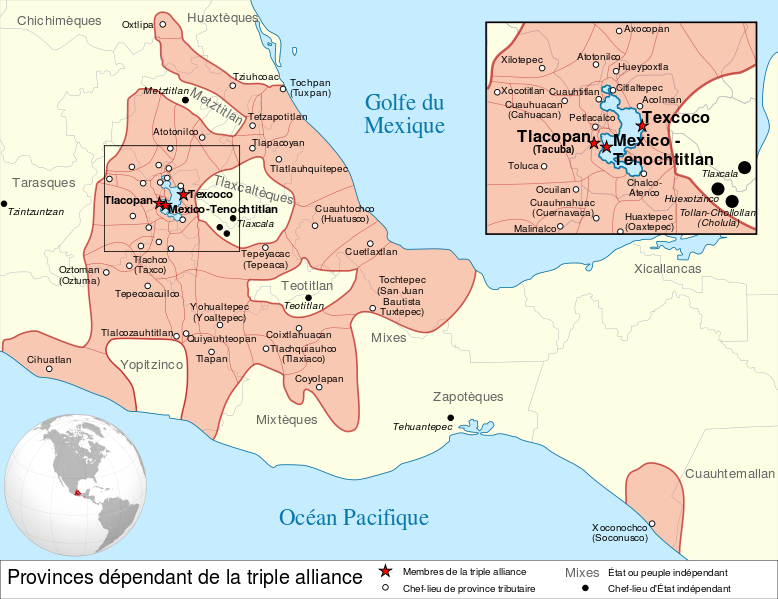
The Nahuatl term Anáhuac means "beside/close to water" and is most commonly used for the Valley of Mexico in central Mexico. More specifically it would have designated the south-central part of the valley, and was sometimes even used for Mexico-Tenochtitlan and its surroundings. The Nahua and the Triple Alliance (the dominant political entity in the Valley of Mexico just before European contact in 1519) did not have an exact European border concept, which might add to why different interpretations exist for the space of Anáhuac (this map gives an idea of the Triple Alliance's extension before conquest). John Bierhorst in his Nahuatl-English dictionary gives us the following meanings:
- At the seashore ..., close to water ...
- At the shores of paradise...
- New Spain [following Motolinía's memoriales], the known world before Cortés...
So while 1. can fit with the Valley of Mexico (and/or Tenochtitlan, being close to Lake Tezcoco), with 2. we have a more spiritual meaning, and with 3. even a meaning extentending over the whole of colonial Mexico. This last one was very probably strongly shaped by colonial views, as the author draws on the Franciscan priest Motolinía here. Overall, the most common use for Anáhuac is for the Valley of Mexico though.
To make matters slightly more complicated, there was also the term cemanahuac (which I haven't come across as much). It comes from the words "cē" meaning one/whole, and "Ānāhuac" as described above. It can be translated as "land completely surrounded by water". The most probable definition of this would be the land mass known to the Nahua, surrounded as it was by the Pacific and Atlantic oceans. According to Bierhorst
- The world, the earth... [drawing on Motolinía again here], the whole world, in the world, throughout the world, throughout Anahua (the known world before Cortés); the Aztec empire (?...)...
- The eternal shore, paradise
- Island, the city of Mexico (?, usage expressly forbidden by Motolinía...)
Again we don't have one fixed meaning here. I'd still note that Cemanahuac would have designated a larger unit that Anáhuac - referring most probably to the lands (or world) known to the Nahua. Not also how we have again a spiritural meaning under 2. here - although the meaning of "paradise" should to be taken with a grain of salt. While Franciscans like Motoliía drew on Christian terms, the Nahua notions of an afterlife were very different from the Christian paradise.
Tawantinsuyu
This term was used by the Incas for their empire, probably the largest in the pre-Hispanic Americas. In its official language Quechua it comes from “tawa” meaning four and “suyo” meaning state. It is often taken to mean "the Four Regions", referred to the Inca empire's division into Chinchaysuyu, Cuntisuyu, Qollasuyu, Antisuyu, terms which partly continue in use today (this map gives an idea of the four regions ). While these regions were loosely tied to the cardinal directions, their center was at the imperial capital city Cuzco; apparently once again the limits of the regions were not clearly fixed. By the 1530s the Incas had formed a large state with its center on the Andes. At the point of its largest extension, the Inca state consisted of modern-day Peru, large parts of modern-day Ecuador,parts of modern-day Bolivia, north and central Chile and northwest Argentina.
To this can be added the pacha concept. It was used to divide the different spheres of the cosmos, on three levels. The levels or realms were not only spatial, but simultaneously spatial and temporal, differing strongly from European spatial conceptions. In a maybe similiar way, Mesoamerican cosmology also knew a conjoining of spatial with temporal notions.
I'm less familiar with the Incas than with the Nahua, so hopefully someone can add to this very brief overview. Hopefully it's shown that there were different conceptions of the pre-hispanic known world in different parts of Latin America - the two just mentioned being only the best-known examples. And that there was often a conceptual division between the known world and a cosmological view of the world.
[1/3]
If you ever visit Peru, you'll probably make a trip high into the Andes to Cuzco, the former Inca capital that sits at an altitude of over 11,000 feet. After you catch your breath, you'll marvel at the architectural wonders the Incas built. The Spanish colonists who took over built a lot on top of it, but the foundations of much of the city are Inca. And boy, are they well-built! In a region prone to earthquakes, on the Eastern rim of the Pacific ring of fire, the Incas cut the stones in their structures so precisely that the stones fit together perfectly with no mortar / cement / glue needed to hold them together, and the buildings have survived over 500 years.
One of the most impressive structures is the Inca castle / fortress that sits in the middle of Cuzco. Walking past it at night, with the lights dancing across the stones, is a magical experience. However, it would have been a whole lot more magical hundreds of years ago, for the stones used to be completely covered in gold and silver. The Spanish conquistadores stripped the fortress of its adornments and hauled the precious metals back to Europe by the boatload.
Pretty amazing to walk through the city and imagine what was, and where all that wealth went.
I want to talk about the semana tragica, or tragic week, in Argentina (not to be confused with the one in Spain)- the week of January 7th, 1919. While the events of that week were originally and purportedly about labor conflicts- a massive strike leading to retaliations by the authorities against those in the labor movements- they essentially ended up becoming a South American pogrom against the Ashkenazic Jewish community in Buenos Aires.
It started with a general strike in December 1918, at a metallurgical factory. After weeks of the strike, the police showed up on January 7th to break up the strikers. The clash led to fatalities among strikers; their subsequent funerals turned into impromptu protests, where the same cycle of violence began again as government forces forcefully intervened. By the end of the week, the general strike that ensued was the largest thus far in Argentinian history.
The police and army were among those brought out by the government in response to the strike, but there were also civilian nationalist groups which were formed in response. One of these was the Guardia Blanca (White Guard), a group consisting mostly of members of the elite, who agitated (in the midst of the post-Bolshevik Revolution Red Scare) against socialists, anarchists, foreigners, and anyone who seemed "Russian"- we'll get back to this in a second. There were several other similar groups defined as Defensores del Orden (Defenders of Order), which included elites, politicians, members of the clergy, and members of the armed forces. These were the groups that largely carried out what an observer called "the first pogrom in Argentina."
Why was there a pogrom? While Jews were among those who were part of the labor movement, this isn't the reason why they were singled out. It was, instead, because they were identified as "rusos," Russians, to the general public (some were also called "polacos," Polish). Since so many (apparently 80%) of Argentina's Russian immigrants were Jewish, and since these anti-labor, anti-communist elites believed that all Russians and Russian immigrants were infected with these foreign and harmful ideologies, they began to pursue the Jews. In addition, many (including the US Ambassador to Argentina) believed that the Argentinian labor movement had been instigated by Bolshevik influences outside of Argentina, and so Russian immigrants came under special suspicion; they identified these influences with Jews.
But even had that all been true (and there is no reason to believe it was), nothing could have excused the brutality that the semana tragica wreaked on the Jews of Buenos Aires. Contemporary accounts describe Jewish buildings, belongings and books being burned, men's beards being ripped out, women and girls being raped, and elderly people being violently beaten, generally by the members of these civilian groups. Many of those killed and wounded over the course of the week were Jews, most of whom were targeted solely for their religious identity and country of origin. Even police officers would raid Jewish homes, stealing money and valuables. Jews were arrested simply for having been born in Russia, or for knowing the wrong people. Much of this took place in the upper borders of the Once neighborhood of Buenos Aires, which bordered (and still borders) the area of the Facultad de Medicina (School of Medicine), which had a large antisemitic civilian group and where Jewish students were already targets of harassment.
The idea that Jews would be targeted in this way made sense in the context of the national attitude toward them until then. For years they had been faced with suspicion and prejudice by the Catholic Church and its priests (who spread antisemitic propaganda from their pulpits and in the streets). Jews were tarred as greedy usurers in student textbooks, were singled out as pimps and deviants (while there was a Jewish presence in the Argentinian underworld, it was a small part of it that got a vastly disproportionate amount of attention), and socialist traitors. The newspapers were often filled with these characterizations of Jews- who, of course, were often also identified with the radical, communist rusos. While this sentiment had previously been bubbling under the surface, the strike made it boil over violently. In addition, there were reports that some shopkeepers and businessmen felt that destroying Jewish shops could mean destroying competition.
In many ways, the response of the Jewish community- both in the short and long term- reflected its overall diffidence as far as its ability to take a stand for its rights. Early responses were generally apologia, trying to show that "most Jews aren't protesters" and that the majority of the community did not deserve this, that most of the Jews were law abiding citizens who just wanted to live in peace. There was relatively little call for justice or outcry against the police's role in the violence. A united Jewish communal group, the Comite de la Colectividad, was founded to advocate for the community but quickly dissolved, and it wouldn't be until the 1930s that such an organization would be finally founded.
The historian Judith Laiken Elkin attributes, in part, to the semana tragica a feeling that would linger among Argentinian Jews for decades: that it was dangerous for them (more than for others) to represent themselves politically, and that the entire community could be “held hostage” by the actions of only a few. This feeling discouraged the mainstream Argentinian Jewish community to distance itself from radical political activity and activism, and encouraged a non-confrontational relationship with the government, which became important later when antisemitism resurfaced later on. Among other times, they resurfaced in the early 1960s, when antisemitism surged following Eichmann's kidnapping from Argentina by Israel, and in the late 70s-early 80s, when antisemitism was endemic among the junta and its military, leading to Jews being singled out for mistreatment. The conspiracy theories regarding Jews wouldn't go away either- one of the most outlandish would be the Plan Andinia, a theory popularized in the 70s that the Jews were planning to steal the Patagonia region from Spain and Chile to make a Jewish state.
I'd love to write a little bit about some indigenous people who withstood, and defeated, the Inca. The Inca are rightfully known as one of the most successful conquering states in the history of the Americas and even the entire world. Inca armies with tens of thousands of soldiers marched up and down western South America, conducting intensive campaigns and defeating dozens of other polities that were themselves successful states.
But even as Inca power continually grew (until the Spanish conquest), a few other native South American groups were able to withstand their hegemonic power. I'm going to talk about two of those: the Shuar and the Mapuche. These groups' success in repelling Inca forces not only highlights their fortitude and skill in battle, but also hints at complex forms of organization and society in places that are often traditionally considered basic hunter-gatherer regions that could not have withstood state incursions.
The Shuar, who are still a vibrant indigenous community in Ecuador and Peru, have historically lived on the borderlands of the Amazon Basin and Andes mountains. In the early 1500s, the Inca Emperor Huayna Capac was a tried and true conqueror who had brought new land under Inca dominion in modern day Ecuador, Colombia, Chile, and Argentina. At one point, the emperor himself led an attempt to conquer Shuar lands in the Ecuadorian Amazon. Shuar resistance was apparently so fierce that Huayna Capac, the divine king of the all-powerful Inca state, was forced to retreat into the Andean highlands. Huayna Capac supposedly hid his failure by saying the Shuar would have made unworthy imperial subjects.
Before the Inca-Shuar conflict, another indigenous group stopped Inca expansion at the southern end of South America. As far as we know, the Mapuche didn't have a statelike organization system. But when 20,000 Inca soldiers came marching to the Maule River in central Chile, the Mapuche and their allies were able to muster a similarly massive army. After refusing diplomacy with the Inca, the Mapuche won a three-day battle, and Inca conquests in Chile ended. It's important to note that this exact narrative has been challenged, and some historians have suggested that Inca incursions in Mapuche lands were actually prevented by two battles and continual harassment, followed by Inca governmental reluctance to commit resources to this region. Nevertheless, the fact remains that a supposedly stateless society was able to muster an army of thousands and defeat the incredibly effective military machine of the Inca state.
In conclusion, it's interesting to think about how the Inca perspective has warped our view of other South American societies that encountered them but were not conquered. The Inca considered Amazonian tribes like the Shuar savage, uncivilized peoples -- an idea which has been either continued or reproduced in most post-Conquest views of history in the Americas (Andean civilization vs. Amazonian noble savages). And we often think of the historical Mapuche as a similarly stateless people -- but they were able to muster thousands of soldiers to defeat the Inca, and later went on to defy Spanish, Argentinean, and Chilean conquests for hundreds of years.
This is a piece I wrote awhile back, but as it is relevant, and to me super-duper interesting, I've gone through and done some slight improvements to it to repost!
Dueling in South and Central America flourished mostly in the 19th century continuing into the 20th century, and in fact the region was the last real hold out in terms of prominent adherence to the dueling code. Declines in dueling often correlate closely with national, traumatic losses, much of Europe seeing the end come precipitously after World War I, while the American Civil War in turn heralded the decline in the US. But Latin America lacked a similar flash point to so suddenly reshape the culture of honor, so while Latin American duelists had drawn their influence from the manner of dueling that flourished in Italy and France in the late 19th century, that influence did not similarly carry across the Atlantic to cause a precipitous decline, and rather from dueling in Latin America died off much more slowly, and piece meal, with the last proper duel reported to have been the 1971 encounter in Uruguay between Liber Seregni and Juan P. Ribas. Neither was injured in the exchanges of fire.
Dueling was prominent in a number of countries in the period, including Argentina, Peru, Cuba, and Mexico, but Uruguay undoubtedly 'takes the cake'. The debate over dueling in the country raged on for decades, beginning in the 1880s when the practice started to become prominent as part of the general imitation of French culture that was impacting Latin American elite culture in the period. The debate and conduct was, in many respects, no different then their European counterparts of the period, such as in Italy which I written about here. Politicians and journalists were some of the most prominent practitioners, engaging in the duel as part of a public ritual of masculine posturing, and at least several duels would be reported monthly in the Uruguayan papers, although as with the French and Italians, fatalities remained fairly rare. The intention behind these duels was to demonstrate ones honor and put on a show. In theory, certainly, it was about showing you placed your very life on the line in defense of honor, but in practice, it was understood by almost all that an actual death was, far from unnecessary, almost certainly detrimental to results participants hoped to win in public opinon.
As long as no serious injuries or death occurred, prosecution was nearly unheard of, and actually quite unpopular in the rare cases it happened, although even in those rare cases minimal penalties could be expected. When a judge ordered two university students and their seconds held in jail pending trial for their recent sabre duel, he was met with outcry such as in this editorial:
Never has [a judge] proceeded in such a manner with persons of a certain [social] condition. [These] distinguished university students [...] have been treated [...] with a rigor previously only employed with individuals accused of serious crimes.
Dueling was a crime, but it was a crime of the elite, and they expected to still be treated as such, at the least with kids gloves, if not by being entirely excused in keeping matters of honor outside of the courts.
But what sets Uruguay apart not only from her fellow Latin Americans, but from almost every country in which the duel was a cultural institution bar Russia (where an 1894 regulation basically required it specifically of Army officers), was that the end result of the debate was the 1920 law which decriminalized the duel.
Realizing that the anti-dueling laws from the 1888 law which specifically criminalized dueling were both unenforceable and contravened popular (elite) opinion, the duel was essentially downgraded to a misdemeanor in the penal code following the 1920 reforms, as long as it met certain criteria, specifically that the dispute had been submitted to an honor tribunal, the tribunal agreed that the point of honor being argued over justified the challenge, and that no other amenable alternative was viable.
From there the duel needed to conform to the extralegal dueling code of the time, but otherwise the duelists themselves were not committing a felony. The idea of the honor tribunal was hardly new, either in Europe or other Latin American nations such as Mexico, but no other country gave them such actual, legal power as to essentially sanction a duel as one possible solution, in all other cases the expectation being that they were an alternative rather than preventative.
Just how effective the law was is somewhat unclear. Proponents hoped that by semi-legitimizing the entire process they would actually cut down on the number of duels, since it forced potential duelists into the reconciliation framework of the tribunal, which would head off most, even if not all duels from happening. The evidence suggests that they weren't incorrect in the basis of this assessment, since a larger percentage of 'affairs of honor' seem to have been resolved peacefully through the tribunal process post-1920, but the unintended side-effect was that in creating the framework, many more honor disputes now were being submitted to it, which seems to have increased the net number of duels happening, even if they decreased as a end result of honor disputes relative to before!
This breath of life was only temporary, and the duel did eventually begin to decline even in Uruguay, although slower and less drastically than in countries such as France, which saw a quick, marked decline after WWI (although a few isolated duels continued to happen until the last known French duel in 1967). Newer generations just saw less value in the old ideas of honor and its defense, and the practice fell out of use. That didn't stop it from being fondly remembered however. It wasn't until 1992 that the 1920 dueling law was repealed, and not everyone was a fan of that! Julio Sanguinetti, then President of the country, apparently lamented the loss of the law in remarks given in 1999^1.
1: El Pais (Montevideo), 28 Feb. 1999, p. 19. I don't read Spanish so am relying on Parker's characterization here, but if anyone is able to find that article and translate the exact quote, I'd be super stoked!
Sources
I maintain a complete bibliography of dueling works, including a section on Latin America. The most relevant sources I'm drawing on here is the work of David S. Parker who has done some really excellent work on the point of honor in early 20th c. Uruguay.
I am deep into dissertating, so I hope it’s ok if I use this to ramble about some of my own research.
American historians often characterize the period between the end of the American Civil War and the beginning of the Spanish American War as a low point in the United States’ diplomatic relationship with Middle America. A slew of economic depressions convinced many Americans that the answer to the boom/bust cycle was to export more and more of their goods outside the country. Middle America seemed the perfect market for those excess goods. At the same time, high tariffs limited the number of import goods coming into the country. Thus we have a curious paradox. Americans thought that they needed to expand their economic influence abroad, while at the same time the official stance of the US government was to limit that very influence and redirect it inward.
What ended up happening was an unofficial, though informally acknowledged precursor to more overt American Imperialism. Wave after wave of American businessmen, fortune seekers, outlaws, and miscreants trying their luck outside the country. One of the most notable of these was fruit companies, several of which would eventually combine into United Fruit. Tramp steamers cruised up and down the coasts of Honduras, Nicaragua, and Guatemala trading with local plantations and shipping them to the US. The plantations were frequently owned by the local elites, who hoped to take advantage of the United States’ proximity to further their own economic and political goals. The transmission of goods and wealth in this system became the backbone of later American attempts at imperialism. In order for locals to succeed in their own endeavors, they had few options but to seek outside aid. Though the US was the nation in closest proximity, this also included Europeans nations, most notably Great Britain and Germany. Central American leaders attempted to play the more powerful nations off each other, with limited success. In Nicaragua, President Zelaya created new tariffs and taxes to profit himself and his country off of foreign trade, and was consequently called a tyrant by the United States. When the US overlooked Nicaragua in favor of Panama for the site of the now famous canal, Zelaya tried to get Germany and Japan interested in a new canal through Nicaragua, though without success.
My interest is in the sailors who actually created or facilitated this economic and political network. Though they may not have thought about it, they were an essential component in the Atlantic System. They seem, however, to have been a largely forgotten one. The only attention that they received in the United States was due to the fact that ships flying American flags declined dramatically. This obscures the fact that it was still American capital behind many of the ships that cruised across the Caribbean. United Fruit Company, for instance, owned a fleet of ships to carry their cargo to the United States. Every single one of them sailed under the Costa Rican flag.
I think the best way to see how this whole complicated mess looked on the ground is to look at smuggling. Smuggling highlights both the positive and the negative connections across the Caribbean basin. Cigars, liquor, diamonds, silks and other goods travelled around in an illicit trade network, to the profit of individuals and organizations, but at the expense of national sovereignty. Cuba, in particular nourished a flourishing smuggling network to the general benefit of the Cuban Revolutionaries. Cigars in particular made their way from Cuban hands into the United States where they were exchanged for munitions and supplies which were then smuggled back onto the island. This was such a common activity that one journalist remarked that “every Cuban camp has been growing a batch [of tobacco] for years.” In one case, Customs officers in New Orleans seized more than 3000 cigars, more than 2,500 rifle cartridges, and three entire cannons. Cuban patriots could continue their struggle for independence with these items.
Though the smuggling trade was beneficial to Cuban Revolutionaries, it also provided an impetus for the United States to get involved. Smuggling was a direct threat to the United States’ authority and safety. Not only because the US was not getting taxes from the goods, but also because unsupervised entry into the nation was a threat to public health. In 1897, this threat turned into reality as yellow fever swept across the US South. Federal medical investigators eventually traced the epidemic to Ocean Springs, Mississippi, specifically a hotel known to harbor Cuban Revolutionaries.
Ironically, the national response was not to blame the smugglers or the revolutionaries, but to blame Spain for not controlling its own borders. The need to prevent the spread of disease via smuggling was one justification put forward when the United States decided to intervene in the Cuban Revolution. It was also a justification that the US would use frequently during the Banana Wars, notably with the Dominican Republic in 1916. Thus we can see some of the roots of American Imperialism in Middle America in the economic situation nearly fifty years before.
I've always wondered how on Earth a handful of Spaniards defeated the entire Inca empire? When Atahualpa Inca, the last emperor, was captured by conquistadores (and eventually murdered), he had 2,000 veteran troops with him. I know the Spanish had some advanced technology and other advantages, but we're not talking machine guns. Just be sheer numbers, it seems like even disarmed the Incas could have overwhelmed the Spaniards. How did they lose?
Ditto for the Aztecs.
Continuing with the theme I've been following for most of these, it is time to talk a real favorite of mine in the history of firearms, South American Mausers! As previous write ups I've done have touched on, the Mauser style rifle became one of the most popular designs for military service rifles in the late-19th century, with a number of countries adopting Mauser rifles for their military, or else taking inspiration from the design, such as in the case of the American M1903. Some countries, such as Belgium, possessed a well developed firearms industry already, and were able to manufacture Mauser rifles themselves after licensing the design, but others, such as Siam, lacked the domestic industry so had to sources theirs through contract, either from factories in Germany.
In South and Central America, a number of countries followed similar leads fielding both contract Mausers, as well as building their own under license, and the arms carried are often some of the most sought after by collectors for both the historical interest, as well as the elaborate crests generally stamped onto their receivers. There isn't the time to run through them all, but I will touch on a few!
Argentina's series of Mausers are perhaps the most famous, at least after the fact, due to the national crest displayed on the receiver, as well as the secondary crests used for special groups such as the military academies, seen here via Ball. Starting with the Model 1891, Argentina would carry Mausers through the better part of the 20th century, ordering an initial production run of 180,000 rifles and 30,000 carbines which were built in Germany by Ludwig Loe & Coe, or else Deutsche Waffen- und Munitionsfabriken. The Model 1891 was essentially the Model 1889 Belgian Mauser, characterized most notably by the protruding, single-stack magazine, and thus two decades later, the Argentinians decided to upgrade, adopting the Model 1909 which was based on the more modern German Model 1898. No longer entirely dependent on German assistance, the Argentinians were by then to also manufacture themselves, producing some 85,000 in total to supplement those coming in from Germany.
What in the end leads to enduring collectors interest in the Argentine, as compared to any number of similar countries arms, is where they ended up. Although Argentina remained out of combat during the Mauser's heyday, the rifles themselves did see combat elsewhere, most notably the Chaco War, as Argentina sold arms and munitions to Paraguay both in the lead-up and during the conflict itself. This however would come to bite them in the butt when captured arms with the Argentine crest caused some embarrassment. The result was a change to the law requiring future sales of surplus to grind the crest off! Quite saddening, and driving quite a premium for those with the crest intact on the collectors market.
Close on the heels of Argentina in joining the Mauser family was Brazil, who followed a very similar path in their adoption of the Model 1894, a slight modification of the Model 1893 'Spanish' Mauser. As with Argentina, their early armaments were contract rifles, through Loewe, DWM, as well as FN in Belgium, and in the same tradition, it carries a crest that stands to rival that of Argentina, although I won't go playing favorites. The Brazilians would cycle through several periodic updates, with the Model 1904, Model 1907 Carbine, and Model 1908, the latter two being adoption of the action perfected in the German Model 1898, and mostly constructed by DWM in Germany. The relationship would continue through the 1930s and the purchase of the Model 1935 'Banner Rifle', but while new production of the Model 1935 continued abroad, Brazil also worked to update existing stocks, converting their 1908s into 'Model 1908/34 Short Rifles' at Itajuba, as well as new rifles.
This also reflects an interesting change in Brazilian strategic thinking, since while they had previously chambered their rifles to 7x57mm (7mm Mauser), these were chambered to .30-06, the caliber of choice for the hemisphere's hegemonic power, the United States. One further notable Mauser would be produced, again in .30-06, the postwar Model 1954 Short rifle, but while Brazil would send a force overseas in World War II, it was not with their own weapons, but instead American M1 Garands, among a number of other items such as helmets and web-gear that were supplied to Brazilian forces as they prepared to enter the conflict in Italy.
The last one I will touch on is Chile, least of all because they carry on what you might by now suspect to be my favorite aspect of these rifles, the crest! Chile had purchased German arms previously, including Mausers, as well as Austrian and American, but more piecemeal prior to the adoption of the Model 1895, which was, like Brazil, a modified Model 1893, and as with both earlier powers, produced in Germany by DWM and Loewe. Interestingly, included in the order are some Model 1893, identifiable by the bold handle, which were intended for the Boers, but never delivered due to the British blockade, and instead repurposed for Chile, carrying both the 'OVS' and Chilean stamps.
Engaged in something of an arms race with Argentina at the end of the century, it is amusing to consider that both countries not only were stocking up on similar weapons, but that they were coming from the same manufacturers in Germany! Although when it came time to update their arsenal with the Model 1912, while continuing with the Mauser design, this time as others had using the Model 1898 as the basis, the Chileans contracted with the Austrian firm ŒWG (Steyr).
Fun fact, we wont ever have DEEP knoledge on inca's culture for these reasons:
This is not an absolute truth. Edit: some grammar
No one has spoken of plants yet. With the recent news of wildfires in the Amazon and neighboring countries, I recalled a study I read some time about geoglyphs left by natives around 9,000 years ago. It is known that there are regions in the Amazon where the soil is black and fertile for various food crops and this study proves that in the Holocene, the man on this continent was still a hunter gatherer, so nomadic, domesticated plants, kept key species for their food and production of materials, had rich knowledge of the species and the environment passed orally and the most important is that they managed it all sustainably. That's why I find the fossil and artifact records so important and fascinating; and I can see a lot about their way of life at that time. It is not mystery but simplicity. It is already a deep knowledge. https://www.academia.edu/37145628/Direct_archaeological_evidence_for_Southwestern_Amazonia_as_an_early_plant_domestication_and_food_production_centre
Wow can I ask what the clothing is on this art and anything about it? It looks really interesting
Something I often wonder is why the Inca navigation is so often overlook, they are known to have constructed big balsa ships to trade along it's coast and maybe even with Mesoamérica, there are also records that point towards very big totora ships that with use of a unique "guaras" system for steering could have been the key to demonstrate the myths of Tupac Inca Yupanqui going to Polynesia as demonstrated by the Viracocha I, II, and III expeditions.
Welcome to the tenth installment of our Summer 2019 Floating Features and Flair Drive.
Today’s theme is the History of Middle and South America, and we want to see everyone share history that fits that theme however they might interpret it. Share stories, whether happy, sad, funny, moving; Share something interesting or profound that you just read; Share what you are currently working on in your research. It is all welcome!
Floating Features are intended to allow users to contribute their own original work. If you are interested in reading recommendations, please consult our booklist, or else limit them to follow-up questions to posted content. Similarly, please do not post top-level questions. This is not an AMA with panelists standing by to respond. Such questions ought to be submitted as normal questions in the subreddit.
As is the case with previous Floating Features, there is relaxed moderation here to allow more scope for speculation and general chat than there would be in a usual thread! But with that in mind, we of course expect that anyone who wishes to contribute will do so politely and in good faith.
Please be sure to mark your calendars for the full series, which you can find listed here. Next up on Tuesday, September 10th is Archaeology. Don't forget to add it to your calendar!
If you have any questions about our Floating Features or the Flair Drive, please keep them as responses to this comment.
CENTRAL AMERICA... for starters.