Much like how in modern firearms there has been a downsizing in projectiles from 500 grain 0.5" musket balls to 55 grain 0.223" jacketed bullets or subcaliber rounds in tanks. Was there ever a general shift in arrow size and design?
Generally, no, as far as "smaller, faster, harder arrow designs to hit harder" goes. There was evolution towards bigger heavier bows with bigger heavier arrows in East Asia, with the adoption of the big Manchu bow in Qing China, followed by its adoption in Mongolia, from where it spread across the steppe, influencing bow design in the Crimean and Turkey. These didn't necessarily have any higher draw weights than earlier bows, but they typically had greater draw lengths (and thus stored more energy for the same draw weight) than shorter bows. It wasn't necessary to use such big bows to attain such long draw lengths - Korean bows achieved the same with a much smaller package. However, the big bows might have provided that in a form that was easier to make more cheaply, and easier to maintain in the field.
Smaller faster arrows don't hit harder - they hit less hard. The bow is limited by how much energy is stored in the bow, and by how much of that energy is transferred to the arrow (i.e., the efficiency of the bow). Generally, the lighter the arrow, the less energy is transferred to it. If the bow can be approximated as a linear (Hookean) spring, the stored energy is approximately F*(L-B)/2, where F is the draw weight, L is the draw length, and B is the brace height. This energy goes into moving both the arrow and the limbs. We can model the limbs as having some effective mass M. The arrow has a mass m. In this case, the efficiency of the bow is
E = F*(L-B) / (2 * (1 + f^2 M/m) )
where f is the ratio of the effective speed of the limb (say, the speed of the centre of mass of each limb) to the speed of the arrow. For a reasonable rough estimate, we can assume that f^2 = 1/10.
From this, we can calculate the arrow energy and the arrow speed:
As the arrow gets lighter, it's faster but has less energy. Below a particular mass (which depends on the bow), there is only a small increase in speed, and a large decrease in energy. Above a certain mass, there is only a small increase in energy, and a large decrease in speed. Typically, one would use arrows in the range where both speed and energy are reasonably high. For a typical Asian composite bow, this is about 30g. Light arrows of about 20g can be used for longer range, and heavier arrows of about 40g can be used for better anti-armour performance at short range. For heavy-weight bows, like the Manchu/Qing bow, the English longbow, and the Japanese yumi, heavy arrows are needed for reasonable efficiency - arrows of 80g to 125g are not unusual for these bows.
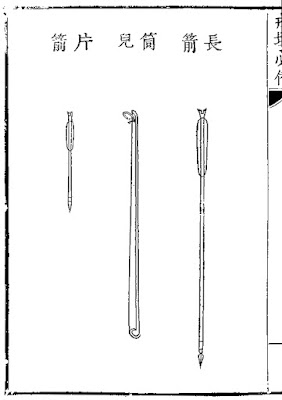
There was some use of lightweight arrows beyond the flight arrows of about 2/3 the weight of the typical arrow. Short lightweight arrows were sometimes used. The most extreme case was the Korean pyeonjeon or "baby arrow", much shorter than a normal arrow. These were shot using a half-cylinder arrow guide, usually made from bamboo:
A fictional depiction in the Korean movie War of the Arrows (2011) shows the basic technique well:
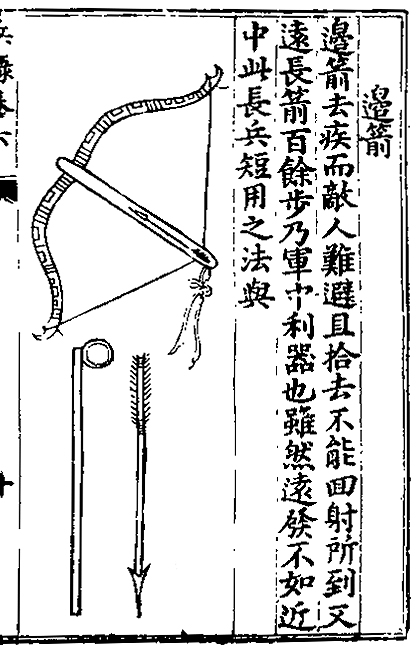
Similar arrow guides and short arrows were used in China:
Arrow guides were also used in Western Asia (e.g., the Turkish siper) and Byzantium (the solenarion). These were often in the form a short guide that was attached to the wrist of the bow arm, allowing the shooting of an arrow a few inches shorter than the draw length (but not as short as the very short pyeonjeon).
These were used for long range shooting and had 3 advantages:
Longer range (due to the higher speed)
It was harder to see them coming in, so they were harder to defend against
If the enemy didn't have similar arrow guides, they couldn't be shot back by the enemy
Their disadvantage is that they don't hit as hard, have worse armour penetration, and less stopping power.
References:
The graph and discussion of effiency is from T. A. Nieminen, "The Asian war bow", https://arxiv.org/abs/1101.1677
The contemporary illustrations of Chinese and Korean arrow guides are from "Bian Jian (箭)", http://greatmingmilitary.blogspot.com/2015/09/bian-jian.html which has further discussion.