[deleted]
Well, contrary to a somewhat popular belief, they most certainly weren't just sitting around dancing naked in the woods. Not that you implied they were, but it's certainly all-too-common of a belief. Largely through archaeology, with limited examples of writing and a lot of back-tracking history, we have come to understand that Native America actually had some significant urban development. Seeing as you reference the Roman Empire and want "far before", I'll try to keep medieval happenings to a minimum.
So, one thing to keep in mind before we start is that indigenous American civilizations have been constantly evolving, and when Europeans entered the fray they evolved all the faster. The Comanche split from the Shoshone with the arrival of horses and built a new culture surrounding them, the Navajo are far well removed from the Yeniseian peoples that they have been proposed to be linked to, and in that same line of thinking it would be easy to forget that the Mayas, the Tupi, the Huron, and the Mapuche all started as Siberian tribes crossing a natural bridge. The scale of the evolution is massive in this sense, that their arctic origins are for many near impossible to guess if looking at any given group. There is hardly a culture in the world that remains stagnant for long, so keep this all in mind as I try to relate what was going on in the ancient Americas.
Starting off in the Eastern Woodland region, if you watched the same tapes and had the same textbooks I did in elementary school, the first thing to note is that during the Roman period (~300 BCE - 700 CE) we're starting to see an increase in the quality, quantity, and uniformity of ceramics and their artistic design. Moreover, we're starting to see large-scale settlement of populations that will eventually go on to become the Mississippian Civilization. They have begun the long-distance trade and general cultural exchange characteristic of the later period, with each given site developing and sharing gradual improvements on bone-and-stone crafts, textile manufacturing, as well as improvements to farming techniques. This transition from a hunter-gatherer to a sedentary agrarian society across so much land might've been significantly aided by the importation of the Three Sisters agricultural system, which was characteristic and quite well established in the following Mississippian civilization.
Because this is a period of significant change and gradual development between sites, many don't refer to this as a unified 'civilization'. Rather, the general term for this collection in chronology is called "The Hopewell Tradition". Known for its long-distance trade routes mirroring the rise of the Mississippian Civilization, the Hopewell Tradition is ancestral to groups like the Caddoan, Muskogean, Siouan, and certain Algic (Algonquian) peoples. The Sioux are famously remembered as nomads of the Great Plains, but only turned to this lifestyle in the wake of the collapse of the Mississippian Civilization, later wars with groups like the Iroquois and the Cree, and in no small part enabled by the spread of horses.
For a broader look at the Hopewell Tradition for free online, Britannica covers a fair bit of the basics. Meanwhile, National Geographic has published about the "Hopewell Interaction Sphere" relating to long-distance pilgrimage and debunking the myth of indigenous Americans living cozy, isolated lives.
If we go further to the west, we run into the Ancestral Puebloan Civilization. While sometimes called "Anasazi", this is a Navajo term of rivalry that modern Puebloan peoples ask not to be used. The Hopi have offered the term "Hisatsinom" and the Tewa offer "Se'da" to be used in its stead, but I will hereforth abbreviate "Ancestral Puebloan Civilization" as APC.
APC originated around the 12th century BCE, not too far removed from the reign of Ramesses II in Egypt, the Bronze Age Collapse, the Trojan War, the Aryan migration into India, it's at the very end of the Shang Dynasty of China and its Oracle Bones, and is right in the middle of the Nordic/Germanic Bronze Age. APC eventually 'collapsed' around the 12th and 13th centuries CE, contemporary to the era of Crusades, the Song Dynasty of China, and the rise and flourishing of Great Zimbabwe. The exact reasons for its disintegration and the mass migration of its people south can't be necessarily pinned to any one thing - like the Mississippians, it might've been in no small part due to climate shifts at the time, their intensive agriculture eroding the soil they used, as well as pressure from new arrivals.
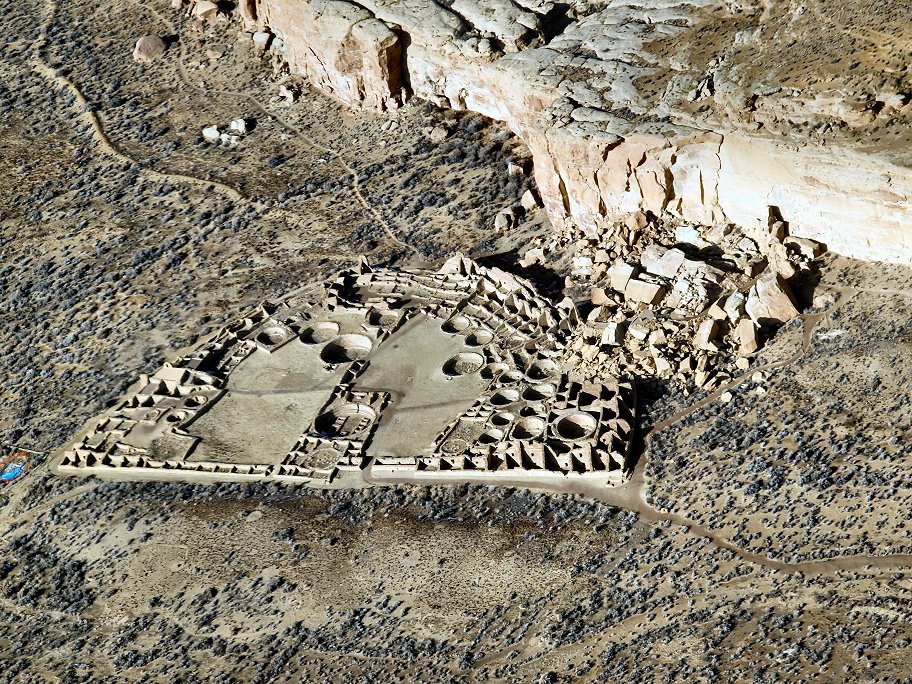
I'd hope you might already be familiar with APC, even if you don't necessarily realize it. If you've ever seen dramatic pictures of houses carved into the cliffs of Colorado, or aerial pictures like this, you're already quite familiar with them. Things characteristic of later Puebloan peoples, such as the kiva - essentially a circular pit dug into the ground that could be small like this or being a bit larger or even just gigantic - these being used for ceremonial and religious function. During the Roman period, APC had only relatively recently (~500 BCE) become reliant on maize/corn agriculture as its main food source alongside squash and beans. This period is also characterized by funky baskets like this as compared to painted ceramics of the civilization in later periods. In fact, this period of APC is actually called "Basketmaker II", from ~1500 BCE to ~500 CE.
Known in its earliest days as a hunter-gatherer, pit-house building, basket-weaving civilization, the Ancestral Puebloans figured out stone architecture, fortification, multi-storied palatial complexes ("Great Houses"), and an agrarian lifestyle. They bear many similarities, with great continuity, to their descendants in the modern Puebloan peoples such as the Hopi, Zuni, and Taos. For further reading, here is Britannica, the National Parks Service, and The New World Encyclopedia
(1/2)